Top 10 Interview Questions for Cybersecurity Engineers
Cybersecurity is the only IT field that hasn't been hit by a recession. Due to high demand, there is also competition for jobs in cybersecurity, so you need to be the best. While possessing the necessary cybersecurity skills is half the battle, cracking the interview is another story altogether. Here is a list of top Cybersecurity interview questions and answers prepared by experts at InfosecTrain that will help you ace the interview. And the questions are:
1. What is encryption?
Encryption is the process of transforming the plaintext (Eg: Hello) into an unreadable format like a random arrangement of alphabets, numbers, or symbols (Eg: 2dosm). With the help of encryption, we can securely send the message to the intended target. And only that target can read the message with the help of a key.
2. What is encoding?
The encoding process ensures that data is formatted correctly, allowing applications and recipients to interpret it correctly. For example, it is like transforming data into a scheme that can be understood easily so that communications can take place.
3. What is hashing?
Hashing maintains data integrity. The hash function generates a string of data based on the information stored. The hash generated after transmission can then be compared to the original data to verify that the data has not been changed. It should not be trusted if they do not match because the information has been altered and cannot be trusted.
4. What are the various layers of the OSI model?
- Application layer
- Presentation layer
- Session layer
- Transport layer
- Network layer
- Data Link layer
- Physical layer
5. What do you know about cross-site scripting?
An XSS (or cross-site scripting) attack involves client-side code injection. When an attacker runs malicious scripts, they perform negative actions on websites or applications. It allows the attacker to carry out tasks that they would otherwise not be authorized to carry out.
Web applications are predisposed to cross-site scripting attacks today, mostly because vulnerabilities are unintentionally written into their code. Security considerations are ignored during the development cycle, and the resulting vulnerabilities have a serious negative impact on the business.
6. What is a vulnerability assessment?
The vulnerability assessment process is used to identify flaws in target systems. In this case, the organization knows that the system or network has flaws and wants to find the weaknesses and will fix them according to priority.
7. List a few common cyberattacks that you know?
A few common cyber attacks known are:
- Phishing (including Smishing, Vishing)
- Malware
- DDoS
- Password Attacks
- Malvertising
- Drive-By Downloads
- Man in the Middle
- Rogue Software
8. What are the different response codes we usually receive from a web application?
1xx – Informational responses
2xx – Success
3xx – Redirection
4xx – Client-side error
5xx – Server-side error
9. What can we do to prevent the brute-force attack?
If you want to avoid brute-force attacks, you need to make sure that password best practices are in place and strictly followed. In basic terms, you can achieve this by enforcing policy at the system level so that even if a user tries to circumvent these measures by using a weak password, they will not be able to do so.
10. List a few port scanning techniques?
- Ping Scan
- UDP
- TCP Half-Open
- Stealth Scanning
- TCP Connect
Cybersecurity with InfosecTrain:
InfosecTrain is the leading provider of consultancy services, certifications, and training in information technology and cyber safety. Our accredited and skilled trainers will help you understand cybersecurity and information security and improve the skills needed. Not only do they give you the best training, but they will also expose you to new challenges that will be very helpful to you in the coming future. Join InfosecTrain to get the best Cybersecurity training.
How to prepare for the Microsoft SC-200 exam?
The SC-200 stands for the Microsoft Security Operations Analyst professional exam. The certified candidate works with organizational stakeholders in order to safeguard the organization's information technology systems. The primary objective of a Microsoft Security Operations Analyst is to decrease corporate risk by quickly resolving active attacks in the environment, advising on threat prevention strategies, and reporting policy breaches to relevant stakeholders.
Why SC-200?
With the increasing violations of organizational policies, companies are on a constant lookout for Microsoft Security Operations Analyst Associates. Their objective is to discover and report these violations, as well as to decrease risk by immediately recognizing and remediating current assaults in the environment. They can provide recommendations on how to strengthen threat prevention procedures. To protect the company's IT infrastructure, they collaborate with business partners.
Microsoft certifications have been gaining popularity lately. The Microsoft Security Operations Analyst is an associate-level profile. It is a wise decision to get this certification.
Exam Details
Exam Name: SC-200: Microsoft Security Operations Analyst
Exam Pattern: Multiple Choice Questions, Drag and Drop, Multiple Answers, Scenario-based, etc.
No. of Questions: 50-60
Exam Duration: 120 minutes
Exam Languages: English, Japanese, Chinese (Simplified), Korean, French, German, Spanish, Portuguese (Brazil), Russian, Arabic (Saudi Arabia), Chinese (Traditional), and Italian
Domains of the Exam
 \
\
Preparing for SC-200 Exam
SC-200 certification will assuredly be the next big hit. We have mentioned some tips to help you ace this certification exam in your first attempt:
- Always consult a relevant and trusted source to study the whole exam pattern and subjects.
- It is critical to devise a plan for preparedness. Make sure you're giving enough time to each domain corresponding to its weightage in the exam.
- You can utilize online study tools to supplement your learning. To know more about this exam you can check out the SC-200 video on our YouTube
- You must have a dedicated study place that is free of any distractions.
- Examine the sample papers before taking the exam to get a sense of how the questions will be organized.
- Taking breathers at regular intervals can help you retain what you've learned by refreshing your thoughts.
- Time is a valuable resource that must be used wisely. Make your plans in advance so you have enough time to revise.
- Self-study is a non-negotiable component of the process. If you read the subjects before the training session, you will have a better understanding of the subject.
- Live a healthy lifestyle to avoid health problems at the 11th hour that might affect your ambitions.
- Just like Dorothy completes Jerry in Jerry Maguire, training completes your preparation. Choosing the appropriate training provider may make a big difference in the game. We at InfosecTrain provide the SC-200 Exam preparation training.
SC-200 with InfosecTrain
To gain instant recognition and credibility with SC-200 and boost your career, you can opt for Exam SC 200: Microsoft Security Operations Analyst Certification Training. It will provide professional knowledge and an in-depth understanding of security operations. We are one of the leading training providers with our well-read and experienced trainers. This certification will indeed merit each penny and minute that you will invest.
How to Counter Data Breaches in a Dynamic Organization?
In this digital era, data breaches and ransomware attacks are on the rise. It can harm businesses and customers in various ways, including financial loss, reputational damage, and lost time. Because of the seriousness of data breaches, several companies have even lost their entire business. This blog will show you how to safeguard your organization's data from attackers.
Let us first understand what a data breach is before we learn how to prevent data breaches. Simply put, a data breach is a security incident in which confidential and protected data of an organization or a user is accessed without authority. A data breach can be intentional or unintentional.
What are the different ways to prevent data breaches?
Below are a few of the tips to prevent data breaches:
1. Create a thorough strategy: It is critical to have a strategic vision for your security posture and a solid plan to achieve it. IT security teams frequently react to issues rather than adopting a proactive approach that satisfies business risk tolerance levels. To continuously discover, assess, and remediate security risks and threats throughout your IT environment is the foundation of a good security posture. Also, ensure that you have ample resources to implement that entire strategy.
2. Know your IT environment: Better network visibility and knowledge are required to safeguard your organization from security threats. In a constantly changing IT environment, it is critical to be aware of what is going on every day so you can see problems early and prevent them from spreading.
3. Adopt good password policies: Keeping a password that is unusual and difficult to predict is a fantastic start in the right way. Make sure you never reuse passwords and update them regularly.
4. Secure the router: Router security is an essential part of information security that is sometimes disregarded as attackers can quickly gain access to users' sensitive and private data and start cyberattacks on their devices by hacking into routers. By enabling encryption on your wireless communication, you can secure all of the devices in your network.
5. Frequent and continuous security audits: Regularly auditing your network infrastructure is a best practice that can help you protect your company's sensitive data. Suspicious activity can be identified and analyzed, allowing you to notice potentially risky situations that could lead to a significant breach in the future.
6. Educate your teams for cybersecurity: It's necessary to educate your team members about the potentially fatal implications of security breaches. Suppose a security culture is established at all levels of the organization, from junior personnel to the top executive; in that case, your company could avoid and be significantly less likely to suffer a data breach.
How can InfosecTrain help you?
Every firm must ensure data security. The methods listed above are the most effective and simple approaches to ensure data security. If you want to acquire knowledge of measures and steps to prevent data breaches within an organization, you can enroll in various security training courses at InfosecTrain. We are a major IT security training and consulting firm around the globe. You can also opt for our CompTIA Network+ certification training course, which will teach you all about essential computer networks. This knowledge will further help you to protect digital data. Do not let your organization become the next victim of a data breach!
Cyber Risks That Pose a Threat to IoT with 5G Network
What is IoT?
A network of physical items, or things, implanted with sensors and other technologies that allow them to communicate and exchange data through the internet with other devices or systems is known as IoT.
5G Network
Without a question, 5G offers a whole new universe of opportunities for services that benefit from the faster speeds and reduced latencies. This means that, more than ever before, we will be surrounded by a wide variety of networks. According to the researcher’s warning, there is a considerable risk associated with the expansion of data traffic and mobile IoT connection, which should be resolved by the telecom industry before 5G is adopted on a big scale. Let’s see what the associated risks are:
IoT Security Challenges on 5G Networks
Following are some of the most crucial security problems for IoT on 5G:
Compromise on availability
One critical area of risk is availability compromise, which occurs when an attack takes a network offline, resulting in lost connectivity and serious damage for corporations. Governments have a specific reason to be concerned about availability breaches because they might have serious consequences for national security if purposefully targeted at critical energy or defense assets.
System of Authentication
For their 5G networks, providers use authentication systems, which have also advanced from 4G to 5G in a substantial way, to identify devices on their networks. For 5G security, strong device authentication is required for massive IoT networks, such as connected municipal infrastructure, hospital systems, or smart offices and residences with a huge number of devices collecting data.
Compelling urge for efficiency
Ironically, efficiency offers its own set of risks. As networks like to inform us, 5G is tremendously fast, but this also means that collecting data from a compromised system will take a bad actor much less time.
Cyber Security Solutions for 5G Networks in Advancement
Many of the recommendations for dealing with 5G security issues are similar to those for dealing with vulnerabilities to present networks, which is as follow:
- Prefer applications with encryption capabilities
- Use the most up-to-date antivirus security software
- Using firewalls
- Conduct routine malware analysis
- Monitor DNS activity
While current techniques will continue to be valuable, the new use cases of 5G in IoT applications will bring new dangers that require wiser solutions. It'll be challenging to secure sensitive personal data stored and sent by connected devices.
Cyber Security Certification with InfosecTrain
The cybersecurity industry is huge, InfosecTrain provides premium training for those who wish to advance their career in the IT Field. Our trainers are extremely well-versed in a wide range of fields. We're a world-class training company with a global reputation for excellence in training. Begin your preparations by enrolling in a Cyber Security Certification training course.
Hundreds of Thousands of Windows Credentials Exposed by Microsoft Exchange Autodiscover Bug
It appears that Microsoft users are still encountering challenges with email-related concerns. A problem that has infiltrated Outlook was recently reported. Then there's the most recent invasion. A design vulnerability in a function of the Microsoft Exchange email server has been identified, which may be used to capture Windows domain and app credentials from users all over the world.
Amit Serper, AVP of Security Research at security firm Guardicore Labs, claimed he discovered credentials for firms from several industries when looking through the URLs that linked to their honeypots.
- Food manufacturers
- Investment banks
- Power plants
- Power delivery
- Real estate
- Shipping and logistics
- Fashion and jewelry
- Publicly traded companies in the Chinese market
Serper revealed the findings of an investigation into Autodiscover, a technique used to authenticate to Microsoft Exchange servers and configure client access, on Wednesday. There are several versions of the protocol to choose from. Guardicore investigated a POX XML-based Autodiscover implementation and discovered a "design fault" that could be used to 'leak' web requests to Autodiscover domains outside of a user's domain as long as they were in the same top-level domain (TLD).
To test the protocol, the team initially registered and acquired a variety of TLD-based domains, such as Autodiscover.com.br, Autodiscover.com.cn, Autodiscover.com.fr, and Autodiscover.com.uk.
The researchers say they "were just waiting for HTTP requests for different Autodiscover endpoints to come" after assigning these domains to a Guardicore web server.
“The intriguing issue with a big portion of the requests we received was that there was no attempt on the client's side to check if the resource is available or even exists on the server before submitting an authenticated request,” Serper said in a study released today.
He also claims that the back-off mechanism is the source of the leak since it is always attempting to resolve the domain's Autodiscover section. It always fails to reach the domain owner using the Autodiscover url that is established automatically. In HTTP form, all of the credentials that were collected had no encryption at all. Serper recommends that customers utilize more secure authentication methods like NTLM and Oauth.
Security Training with InfosecTrain
InfosecTrain is a worldwide leader in IT security training and consultancy. Enroll in one of our security training courses to learn how to keep a healthy security posture and avoid security breaches. Our highly skilled instructors will provide you with all of the knowledge and skills you will need to assure preparedness and uncover methods to strengthen your response when the worst happens to your and your company's IT systems from unattended bugs and security attacks.
Top 10 Measure to Mitigate Insider Security Threats
Attackers are continually targeting companies, but what if the attacks originate from within? Insider security threats are posing a greater threat to businesses than at any other time in history.
The following are 10 steps that all firms should take to minimize these dangers and safeguard crucial company data:
- Data Encryption:
Always encrypt information if you wish to reduce the impact of an insider threat. Not all employees require access to all data, and encryption offers an extra layer of security. - Understand the Various Sorts of Insider Risks:
Insider threats come in all shapes and sizes. Some are malevolent, while others are the result of carelessness. Employee behavior, such as trying to retain data, can help identify malicious threats. Additional security controls may be a good option in this situation. - Background Check, Before Hire Someone:
Do a background check of any potential employees before you bring them on board. This will not only reveal any unusual past behavior, but it may also serve as a deterrent to employing fraudsters or people with ties to your competitors. - Enforce the Division of Roles and Least Privilege:
When it comes to effective job separation, you must use the principle of least privilege, which means giving employees access to only the resources they need to complete their tasks. - Use Monitoring Solutions:
If you're able to track down the source of an insider assault, monitoring solutions such as those that leverage application, authentication, and device information can be a priceless asset. - Establish Strong Policies and Practises for Password and Account Management:
If an organization's computer accounts are compromised, insiders will be able to bypass both physical and automatic defenses against insider attacks. - Maintain a system of checks and balances for all employees and systems:
Having more than one person with access to a system, tracking that usage, and prohibiting the use of shared usernames and passwords are all critical safety measures. - Consider Access Controls:
Access restrictions may aid in the prevention of both malicious and careless risks. This also makes information access more complex. - Examine Network Records:
Keep track of all of your network logs and let others know you do so. This will demonstrate to employees that you are keeping an eye on their activities, reducing the likelihood of an insider assault.
Provide Regular Cyber Awareness Workshops and training
Frequent, proactive cyber awareness workshops, realistic phishing attacks, and other similar activities can help train staff to better identify and respond to information security risks.
Security courses with InfosecTrain
InfosecTrain's trainers are extremely well-versed in a wide range of fields. We're a world-class training company with a global reputation for excellence in training. Enroll in InfosecTrain's Security courses to begin your preparations.
How To Become A CISSP Certified Professional?
In the modern digital world, information systems are exposed to numerous threats and attacks. To combat these threats and attacks, information security within the organization is becoming an essential part regardless of the company's size. So, it is impossible to emphasize the importance of information security professionals in enterprises. If you seek a career in cybersecurity and think being a CISSP certified professional would help you get there, you have come to the correct place. This blog will brief you about what you have to do to become a CISSP certified professional.
What is a CISSP Certified Professional?
The CISSP certified professionals are experts who safeguard data and information systems. They have the skills and knowledge needed to create, develop, and manage a world-class cybersecurity program. Companies are turning to CISSP certified professionals to help them handle crucial issues and respond to security breaches.
Why be a CISSP Certified Professional?
Before you decide to pursue CISSP certified professional career, you should conduct extensive studies to learn more about the profile and its implications on your career. Here are a few benefits of becoming a CISSP certified professional.
- You will get better job opportunities.
- You will enhance your earning potential.
- You will become a member of ISC2, the largest association of cybersecurity professionals in the world.
- You will have improved IT skills.
- You will gain years of practical cybersecurity experience.
- You will learn all facets of the cybersecurity industry.
- You will get an advantage over your peers.
Tips to Become a CISSP Certified Professional
Here are some tips to become a CISSP certified professional.
Learn basics of cybersecurity: You must first become familiar with the current cybersecurity landscape and fundamental cybersecurity concepts.
Obtain necessary experience: You need to acquire at least five years of paid experience in the two or more information security domains of CISSP CBK to become a CISSP certified professional. Even if you do not have the required experience, you can become a CISSP certified professional by passing the CISSP certification exam and becoming a member of ISC2.
Get certified: Certification is the finest way to prove your knowledge and expertise. So, if you consider a career in cybersecurity and want to become a CISSP certified professional, the CISSP certification exam is the first step in the right direction. The Certified Information Systems Security Professional or CISSP is a globally recognized gold standard for information security professionals.
Get endorsed: It is easy to perceive that passing the CISSP certification exam is all that matters. But after passing the CISSP exam, the candidate must have their credentials endorsed by another CISSP who is well regarded.
CISSP Certified Professional with InfosecTrain
By enrolling in the CISSP certification training course at InfosecTrain, you can take the first step toward becoming a CISSP-certified professional. We are a global leader in cybersecurity and information security training. Our CISSP certification training course covers all you need to know to pass the exam and become a CISSP certified professional.
SSCP vs. CISSP Exams: How Are They Different?
The demand for cybersecurity professionals is growing for various roles with the increase in the amount of digital data and transactions. For both IT professionals and those making a lateral career move into a new industry, this has opened the doors to a lucrative career shift. If you are thinking about getting a cybersecurity certification to help you grow or change careers, SSCP and CISSP are two options. The Systems Security Certified Practitioner (SSCP) and Certified Information Systems Security Professional (CISSP) are well-known information security certifications that can help professionals advance in their careers. In this article, we have compared both the certifications offered by ISC2.
Difference Between SSCP and CISSP Certification
We compared the SSCP and CISSP certifications based on the following criteria:
1). Primary Focus
The SSCP is aimed at technical professionals. It explains how to incorporate, build, design, and implement security in technology. The SSCP is a credential worth looking into if you are interested in infrastructure security. The CISSP, on the other hand, was developed with leaders in mind. It focuses on how to develop a program and apply security concepts to the workplace. Also, the SSCP focuses on the technical application, while the CISSP focuses on the business alignment of that application.
2). Domains
SSCP Domains:
Domain 1: Access Controls
Domain 2: Security Operations and Administration
Domain 3: Risk Identification, Monitoring, and Analysis
Domain 4: Incident Response and Recovery
Domain 5: Cryptography
Domain 6: Network and Communications Security
Domain 7: Systems and Application Security
CISSP Domains:
Domain 1: Security and Risk Management
Domain 2: Asset Security
Domain 3: Security Architecture and Engineering
Domain 4: Communication and Network Security
Domain 5: Identity and Access Management (IAM)
Domain 6: Security Assessment and Testing
Domain 7: Security Operations
Domain 8: Software Development Security
3). Roles
The SSCP is suited for those who work in the following roles:
- Network Security Engineer
- Systems Administrator
- Security Analyst
- Systems Engineer
- Security Consultant
- Security Specialist
- Security Administrator
- Systems/Network Analyst
- Database Administrator
The CISSP is suited for those who work in the following roles:
- Chief Information Security Officer (CISO)
- Chief Information Officer
- Director of Security
- IT Director/Manager
- Security Systems Engineer
- Security Analyst
- Security Manager
- Security Auditor
- Security Architect
- Security Consultant
- Network Architect
4). Experience Requirements
SSCP certification requirements: Candidates must have at least one year of cumulative work experience in one or more of the SSCP CBK's seven domains.
CISSP certification requirements: For the CISSP exam, candidates must have a minimum of five years of paid work experience in at least two of the CISSP CBK's eight domains.
5). Exam Information Quick Comparison: CISSP vs SSCP

SSCP and CISSP with InfosecTrain
If the pandemic has left you with some free time, improving your professional skills is an excellent way to spend it. There's a steady demand for qualified IT Security experts, especially today when so many companies are dealing with new cybersecurity issues related to extensively scattered work environments. InfosecTrain offers both SSCP and CISSP certification training courses. If SSCP is your goal, our (ISC)2 SSCP certification training can help. And if your goal is CISSP, then you can opt for CISSP certification training. The training teaches you how to identify vulnerabilities, defend against attacks, and respond quickly in an emergency.
Why Should You Opt For A CISSP Certification?
The Certified Information Systems Security Professional, abbreviated as CISSP, is a globally recognized information technology and security certification. It is offered by International Information System Security Certification Consortium (ISC)2. The CISSP certifies that you are at the top of your cybersecurity game in terms of knowledge and experience, and it has a documented track record spanning more than 25 years. The certification verifies a candidate's knowledge and skills in all aspects of information security. The CISSP certification is usually reserved for security professionals who have worked in the field for a long time.
There are tremendous options available when it comes to security certifications. In this blog, let us look at why you should get the CISSP certification and its impact on your career before taking the exam.
- Advancement in career: The CISSP certification was created to see if you have the necessary experience, knowledge, and critical thinking skills to do your job well. CISSP is one of the most appealing of all IT jobs. If you are a CISSP, you are likely to have more experience than the rest of your colleagues or coworkers, putting you at the top of your field. CISSP will also provide you career growth within your organization.
- Salary advancement: The CISSP certification will undoubtedly amplify your earning potential, as organizations requiring the position pay highly. CISSP certification holders can earn six-figure salaries depending on their level of expertise.
- Globally recognized credential: The CISSP certification is highly regarded by most influential organizations and even multinational corporations, like Google, CISCO, Microsoft, Dell, P&G, IBM, and many others in the IT industry.
- Expertise that is evergreen: No matter how many products and technologies change, the skills, information, and concepts learned for the CISSP certification are priceless and ageless, especially if one continues to complete the educational criteria to keep the certification for a long time.
- Stable IT profession: With an ever-increasing demand for qualified professionals, information security has been acknowledged as among the most stable careers in IT. The field of cybersecurity is quite lucrative.
- Vendor independent credential: Since the CISSP is a vendor-neutral credential, the value of the certification is unaffected by changes in technology or approach within an organization.
- Part of the largest community: You will be a part of a global community of certified cybersecurity experts dedicated to creating a safe and secure cyber world once you have been certified and become an (ISC)2
- Significantly few competition: Most professionals in the IT security field consider CISSP to be the essential credential, which sets it apart from its competitors.
CISSP with InfosecTrain
The CISSP exam is a popular choice among professionals with prior expertise in information security. It offers a clear indicator of broad-based, platform-agnostic information security proficiency that can assist professionals in advancing their careers. Enroll in InfosecTrain's CISSP certification training course to open many career opportunities in the ever-expanding cybersecurity field. We are one of the leading providers of information security training around the globe.
The Essential Know-How of Targeted Ransomware
Ransomware is a category of malware that encrypts the file of its victim. To obtain access to a victim's system, ransomware attackers frequently use social engineering techniques like phishing. The attacker then demands a ransom from the victim in exchange for restoring access to the data. It can be disastrous to an individual or an organization. Ransomware is a category of malware that encrypts the file of its victim. To obtain access to a victim's system, ransomware attackers frequently use social engineering techniques like phishing. The attacker then demands a ransom from the victim in exchange for restoring access to the data. It can be disastrous to an individual or an organization.
Asymmetric encryption is used by ransomware. It is a type of cryptography that encrypts and decrypts a file using a pair of keys. Ransomware encrypts valuable files and demands a ransom to unlock them. Without access to a private key, it is almost impossible to decrypt the files being held for ransom. Malware needs an attack vector to form its presence on an endpoint before encrypting files.
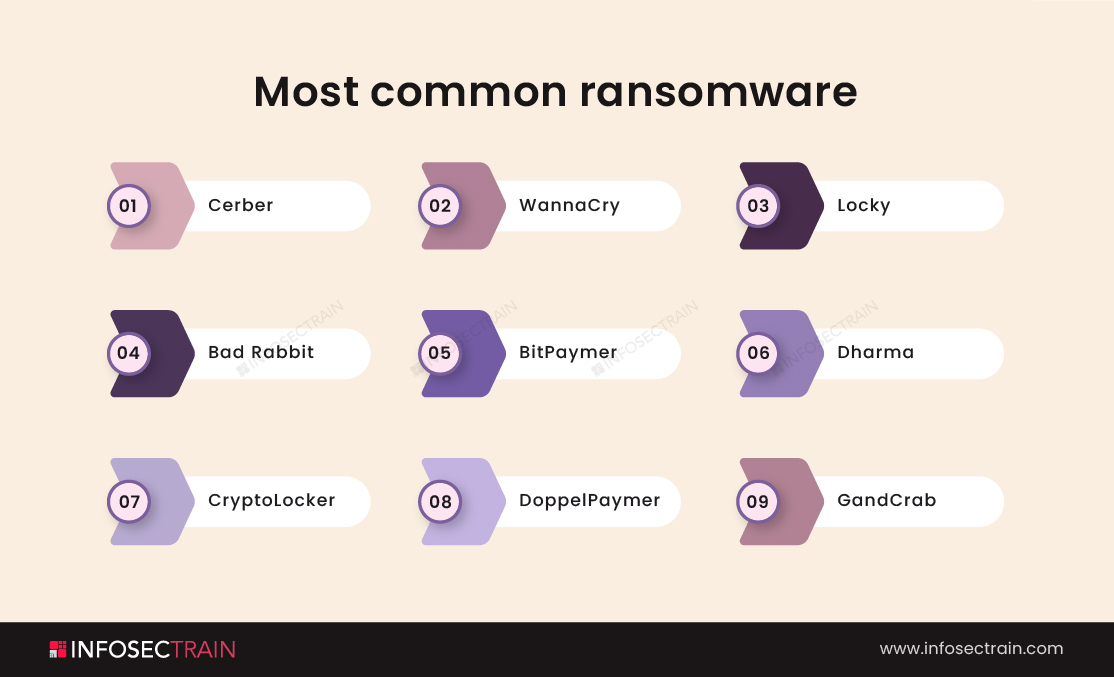
What is the most prevalent method for ransomware to target a victim?
Attackers use custom Tactics, Techniques, and Procedures (TTPs) to target particular organizations based on their ability or need to pay significant ransoms. In some cases, such as educational institutes, it is a matter of chance.
Who is the target for a ransomware attack?
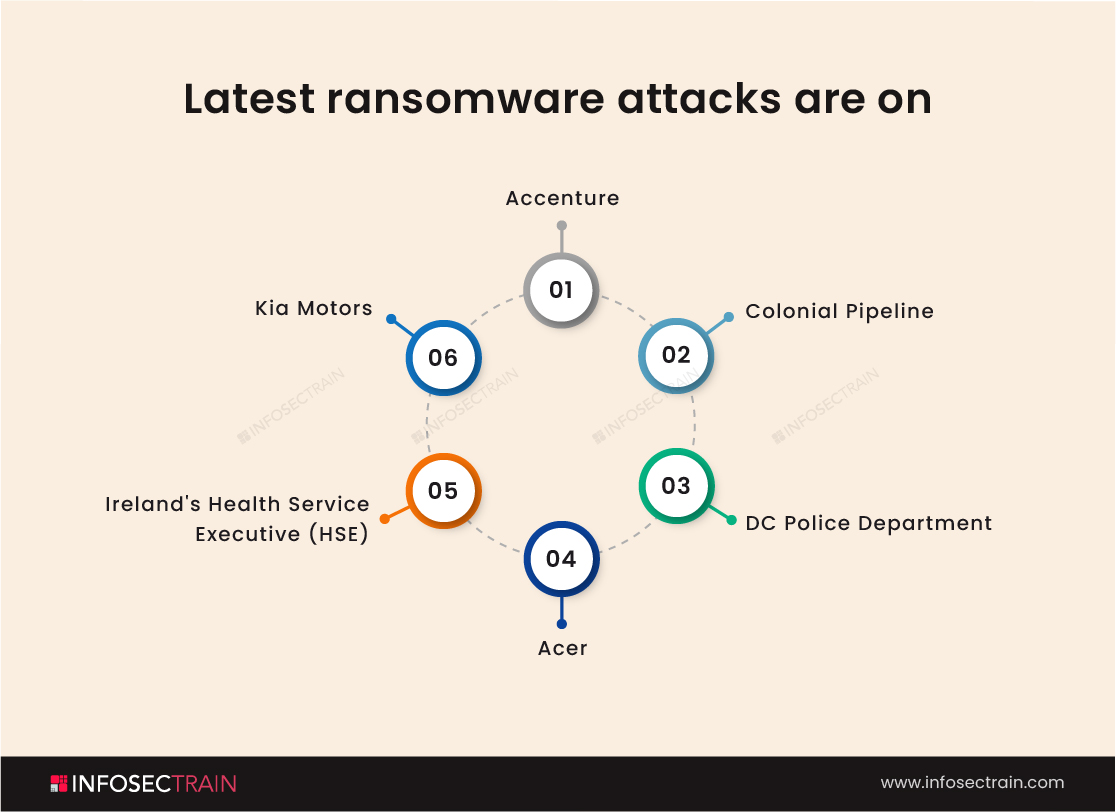
It has an impact on every vertical, government, and organization. Attackers of ransomware are increasingly targeting sensitive enterprises that can hardly suffer downtime. Some of them are listed below:
⦁ Government agencies
⦁ Healthcare facilities
⦁ Critical Infrastructure (CI) providers
⦁ Law firms
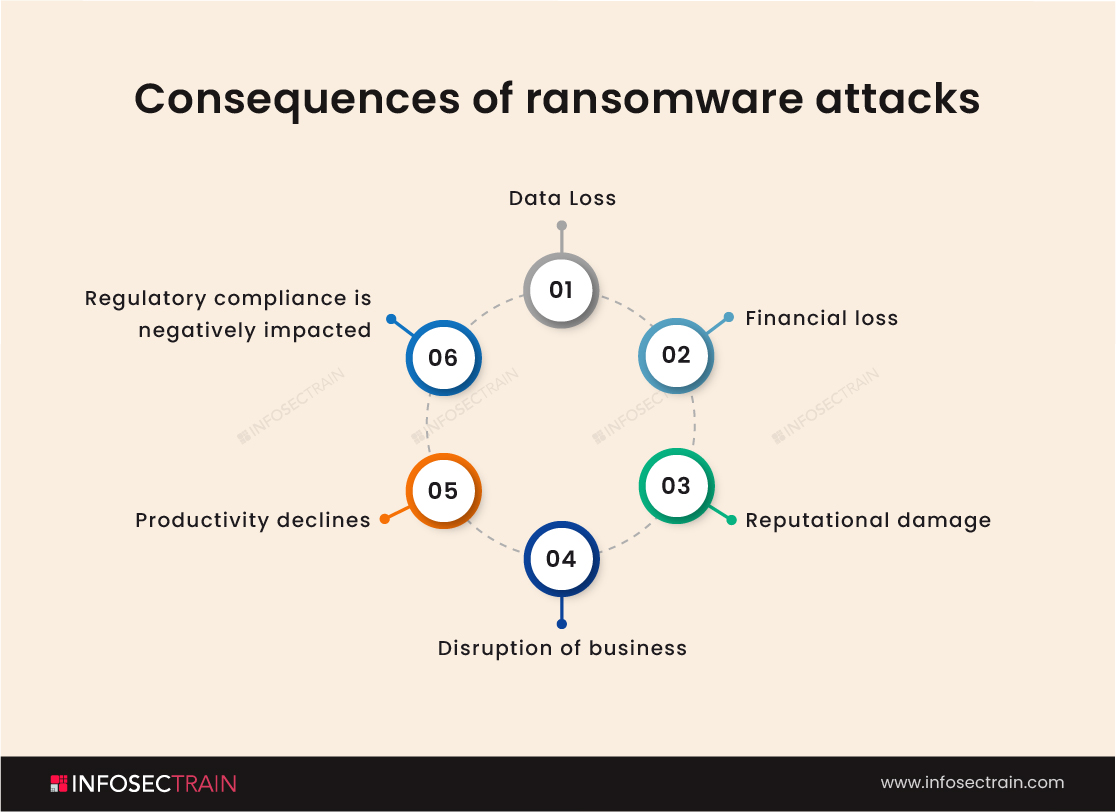
What are the various measures to prevent ransomware attacks?
When it comes to ransomware attacks, the essential thing for attackers to search for is a susceptible network. Unfortunately, once an attack has been performed against your system, you can do nothing to undo the damage. So, the best defense is prevention. You can take several protective measures to avoid becoming infected with ransomware. Such as:
⦁ Maintain sound access control
⦁ Use a firewall and trusted antivirus software. It is vital to have a strong firewall in place and to maintain your security software up to date.
⦁ Install a good backup system. It is the easiest approach to regain access to your data.
⦁ Make sure that all of your systems and software are patched and up to date.
⦁ Anti-phishing solutions should be used in combination with phishing awareness training.
⦁ Ensure the security of your Remote Desktop Protocol (RDP)
⦁ The ransom should not be paid. It just serves to promote and fund these attackers.
⦁ Ensure that your Remote Browser Isolation (RBI) solution incorporates Content Disarm and Reconstruction (CDR) features.
⦁ End-users can be helped by providing regular and practical cybersecurity awareness training
.⦁ Take cybersecurity seriously and hire more highly educated cybersecurity experts needed to combat these attacks.
How can InfosecTrain help?
InfosecTrain is a worldwide leader in IT security training and consultancy. Our highly skilled instructors will provide you with all of the knowledge and skills you will need to assure preparedness and uncover methods to strengthen your response when the worst happens to your and your company's IT systems from ransomware attacks. Enroll in one of our security training courses to learn how to keep a healthy security posture and avoid ransomware attacks.
How to become an IDM pro with SailPoint IdentityIQ?
In recent years, businesses have struggled to provide their employees with the adequate level of access to the right resources at the right time. Therefore, attackers can take advantage of the compromised user credentials to access the organization’s sensitive data. This soaring demand for secure access management within an organization has increased the demand for skilled professionals in identity management.
What is an IDM pro?
IDM pros are technical experts who guarantee that only authenticated users are granted access to the specific applications, systems, or IT environments for which they are authorized in an organization. They provide scalable identity management solutions along with threats and risk assessments for their organizations.
What is SailPoint IdentityIQ?
SailPoint IdentityIQ is an on-site solution for password and identity management for on-premise and cloud applications that includes policies and certifications.
Why be an IDM pro with SailPoint IdentityIQ?
There are several benefits of becoming an IDM pro with SailPoint IdentityIQ. Some of them are listed below:
- You will significantly enhance the security of sensitive data from potential data breaches in an organization.
- You will work with globally leading technology.
- You will be able to reduce IT costs within your organization.
- You will trust each other better within your organization as SailPoint IdentityIQ helps better in determining who is doing what and who has access to what information.
- IDM pros with SailPoint IdentityIQ may limit the risks by using the software to reveal who edited, copied, or deleted specific data from your servers and take prompt action to halt it when an issue emerges.
- You will assist companies in selecting the best possible solution for their Identity and Access Management (IAM) problems.
- You will earn more money because the pay is higher than those offered to colleagues working on other technologies.
- You will have lucrative career opportunities.
How to become an IDM pro with SailPoint IdentityIQ?
Here are a few tips for becoming an IDM pro with SailPoint IdentityIQ.
Gain basic knowledge of SailPoint: You need to get familiar with the SailPoint software and technology.
Get help from a professional: Enrolling in instructor-led training will help you get through your certification exam with the assistance of a professional. It will assist you in understanding the concepts of SailPoint IdentityIQ, identity cubes, certifications, lifecycle manager, identity risk modeling, and more.
Get certified: Prepare for and pass the various certifications that validate your SailPoint product expertise to become an IDM pro with SailPoint IdentityIQ. You can refer to the official SailPoint certification webpage and select the certificate that aligns well with your career goal. Some of the SailPoint Identity certifications are mentioned below:
- SailPoint Certified IdentityIQ Professional
- SailPoint Certified IdentityIQ Engineer
- SailPoint Certified IdentityIQ Architect
- SailPoint Certified IdentityIQ Cloud Engineer
- SailPoint Certified IdentityIQ Development Engineer
- SailPoint Certified IdentityIQ Security Engineer
- SailPoint Certified IdentityIQ Cloud Architect
- SailPoint Certified IdentityIQ Development Architect
- SailPoint Certified IdentityIQ Security Architect
Final Words
SailPoint is a pioneer in enterprise identity management. IDM pros using SailPoint IdentityIQ give a suitable solution for their company to have a high level of corporate control. Suppose your goal is to advance in your career by becoming an IDM pro with SailPoint IdentityIQ. In that case, you can check out and enroll in SailPoint IdentityIQ online training and certification course at InfosecTrain. We are a leading training provider across the globe. Learn with our highly skilled and accredited instructors.
Top 10 Cyber Security Trends in 2021
Organizations are being transformed as a result of technological breakthroughs that are occurring at a rapid rate. Emerging technologies such as cloud computing, AI, automation, and the IoT provide organizations with significant opportunities to create new value. This includes a dearth of experienced cyber-security personnel as well as a steady evolution of cyberattacks and dangerous insider threats.
2021's Key Trends in Cybersecurity
1. Threats to the Clouds
With more and more enterprises moving to the cloud, security measures must be constantly checked and upgraded to prevent data leaks. This has led to a number of cyber criminals devising new techniques to exploit this transition. Many firms are becoming increasingly concerned about cloud security.
2. Implementation of AI
AI integration tactics can be implemented by smaller firms that do not have a cyber security team. Programming AI to evaluate enormous volumes of data can help detect potential risks. Cybercriminals, on the other hand, can utilize the same technologies to find flaws in an organization's technology resources.
3. IoT Security
The IoT and 5G networks will be the next hot topics in cyber security in 2021. With the global rollout of 5G networks in 2020, the Internet of Things will enter a new era of interconnectivity. There is a greater risk of cyber attacks due to a lack of security architecture and awareness among equipment.
4. Automating the Security Processes
Cyber security experts automate business and information technology activities to save costs and improve efficiency. Robotic process automation , machine learning , and artificial intelligence are among the automation methods that these people are familiar with.
5. Phishing Attacks
Phishing attacks are especially dangerous because they deceive people into submitting personal information that can be exploited to get access to confidential data.
6. Ransomware Attacks
Attackers launch ransomware attacks in order to steal confidential information from organisations' databases. Because of this, cyber criminals would demand ransom payments from their victims in order to gain access to databases.
7. 5G
Now, corporations and people may communicate data in a more efficient manner thanks to this next-generation technology. DDoS cyberattacks are becoming increasingly common in industries.
8. Extended Detection and Response (XDR)
Users of XDR can easily access data from endpoints, servers, email, and networks in real time. They can spot possible hazards, and gain knowledge into how to mitigate them, because they have this visibility.
9. Remote Work
"Work from home" is the future of the workplace for many companies, and they've realised it. In order for organisations' remote access capabilities to be secure and patched efficiently, there are technologies that can be implemented.
10.Threats from the inside
Unrestricted remote access, weak passwords, unsecured networks, and the exploitation of personal devices make it difficult for companies to detect or identify insider threats.
Cybersecurity with InfosecTrain
A wide range of fields is covered by InfosecTrain's trainers, who are experts in their respective fields. Begin your preparations by enrolling in InfosecTrain's CyberSecurity certification training courses.
How do I get my CompTIA Security+ Certification
CompTIA Security+ is a certification that covers concepts like access control, cryptography, threats and vulnerabilities, identity management, and much more. Though CompTIA doesn't demand any prerequisites, most organizations ask for two years of IT administrator experience and a Network+ credential.
In this blog, we will cover a few points on how to get the CompTIA Security+ certificate.
Note: I have researched and made a simple study guide, but as every individual is different, you can add or skip a few of the points mentioned below.
Know the exam details: Before starting any exam preparation, you have to know the exam details, like the number of questions you will face, the types of questions you will face, the time you will get to complete the test, etc.
Exam Name: CompTIA Security+
Exam Time: 90 mins
Number of questions: 90
Passing score: 750/900
Books and Guides: The following process in your preparation procedure should be the books and study guides. The candidate must search for books with appropriate information. Candidates are expected to study various books and manuals, which will unquestionably help them understand the examination.
Join study groups: Study groups are one of the best platforms to prepare for the CompTIA Security+ exam. In these study groups, you will get an opportunity to express your questions and clear your doubts from members who are also preparing for the CompTIA Security+ exam.
Take practice tests: You may be confident about all the topics, but by taking practice tests, you'll get an idea of the questions and patterns you will encounter on the actual test.
Practice tests should only be taken from legitimate and authorized websites.
Get a study buddy: There might be someone you know who is preparing for or has already passed the CompTIA Security+ exam. If so, it would be an excellent idea to seek their guidance. You will be able to learn more about a topic by talking to someone and sharing your ideas.
Instructor-led Training: Training conducted by instructors is essential to clear examinations such as CompTIA Security+. Because for some challenging tests like this, you will need someone who can clear your doubts, someone who can help you organize your education process or someone who can adequately explain the subjects. InfosecTrain offers certified professionals who can help you clear this examination.
CompTIA Security+ with Infosec Train:
InfosecTrain is one of the leading training providers with a pocket-friendly budget. So, if you want to get a good grip on the Security+ Certification Online Training course, then join us to experience an incredible journey with our industry experts. Our courses are available in live instructor-led and self-paced sessions, making it easy for you to take up and complete your learning/training journey as per your convenience with ease. Join InfosecTrain to learn skills that can change your life!
An Effective Guide to The Fundamentals of Data Encryption
In today's digital world, we are inundated by a lot of information, from emails to website data, videos, photos, and many other documents, all travelling from the WWW (World Wide Web) to your computer, phone, or TV. As a result, there are infinite probabilities for the data to be stolen or intercepted by cybercriminals. But as we know, if there is a villain, there will always be a hero. And our hero, who protects all our data, is called Encryption.
What is Encryption?
Encryption is a method of converting plaintext into ciphertext (random placement of alphabets and numbers).
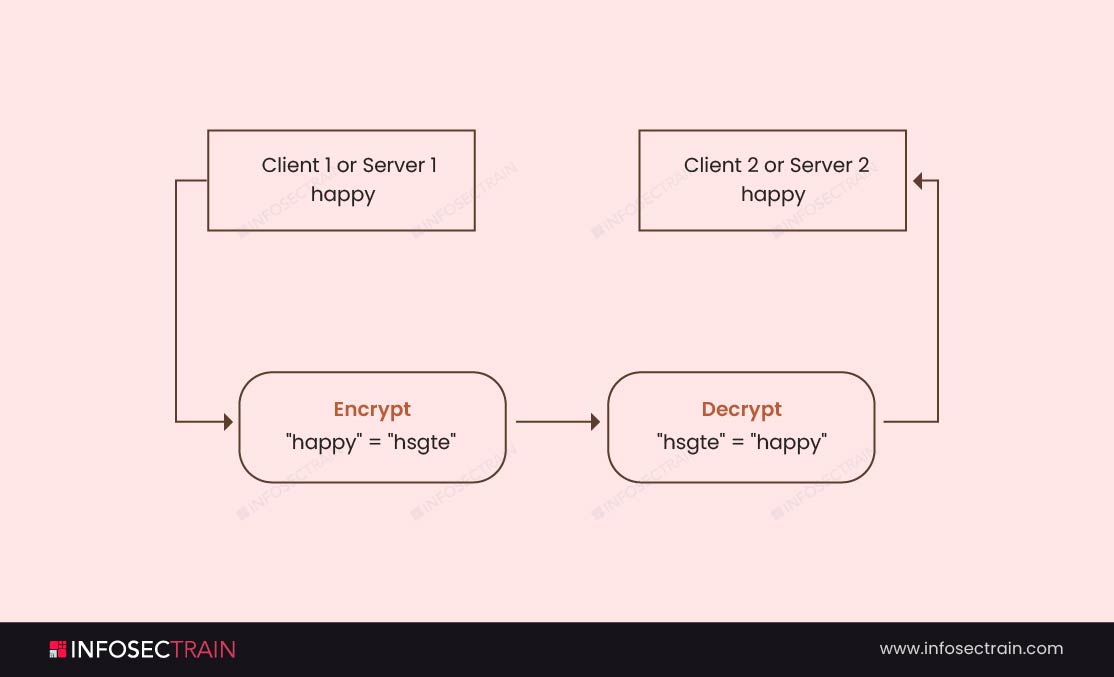
As you can notice in the preceding image, “client 1” is sending a message to “client 2”. The message sent has been encrypted. And, “client 2“ would decrypt the message with the assistance of a decryption key. This approach helps us to maintain and protect the confidentiality of data.
The importance of data encryption
Below are the two main reasons why data encryption is essential.
1. Privacy: Either in the physical world or the digital world, all we want is privacy. I don't know about the physical world, but we can have our privacy in the digital world with encryption methods. Encryption ensures that our data is seen only by authorized or legitimate users and prevents hackers, cybercriminals, internet providers, and even government institutes from reading and accessing our data.
I hope you've come across a caution in WhatsApp, which says End-to-End Encryption. It means your messages are encrypted, and no third party can see them.
2. Authentication: Encryption scrambles data using a randomly generated passcode, called an encryption key, to protect it. This key will prevent third parties from viewing your data. In some cases, hackers can impersonate authorized users to obtain access. Authenticating the encryption key helps protect it from bad actors.
Types of Encryption:
There are two types of encryption:
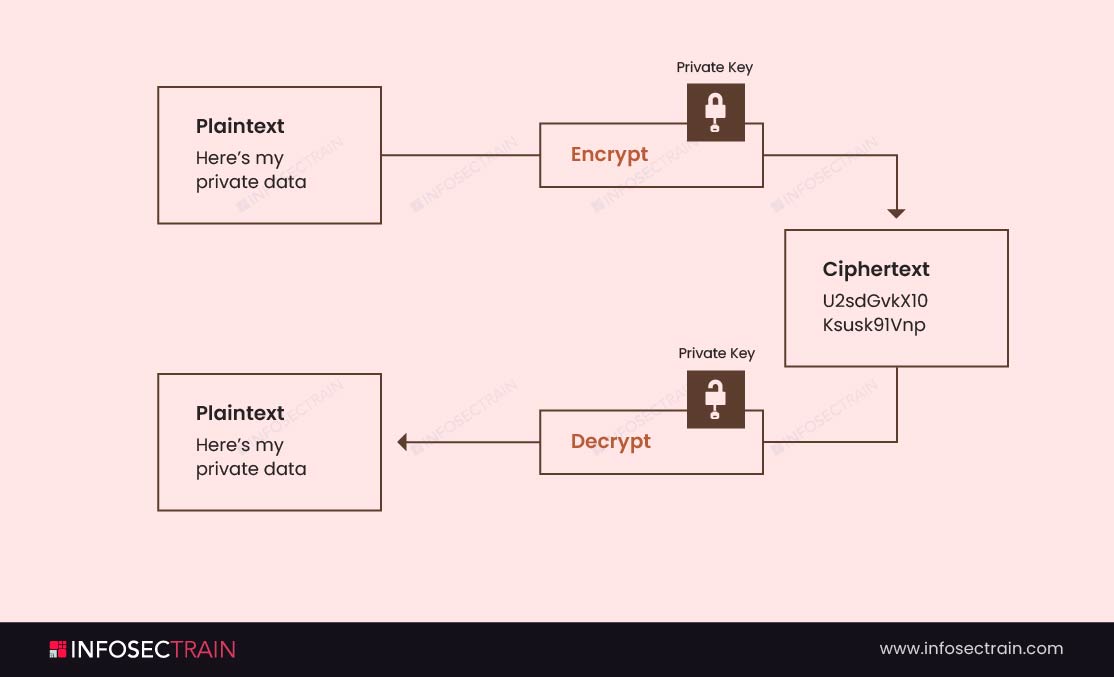
- Symmetric Encryption: Symmetric Encryption is an algorithm for cryptography that uses the same cryptographic key for both the plaintext's encryption and the ciphertext's decryption. The keys may be similar, or there may be a slight variation between the two keys.
Symmetric key algorithm examples:
- The Blowfish
- DES (Data Encryption Standard)
- AES (Advanced Encryption Standard)
- RC4 (Rivest Cipher4)
- RC5 (Rivest Cipher5)
- RC6 (Rivest Cipher6)
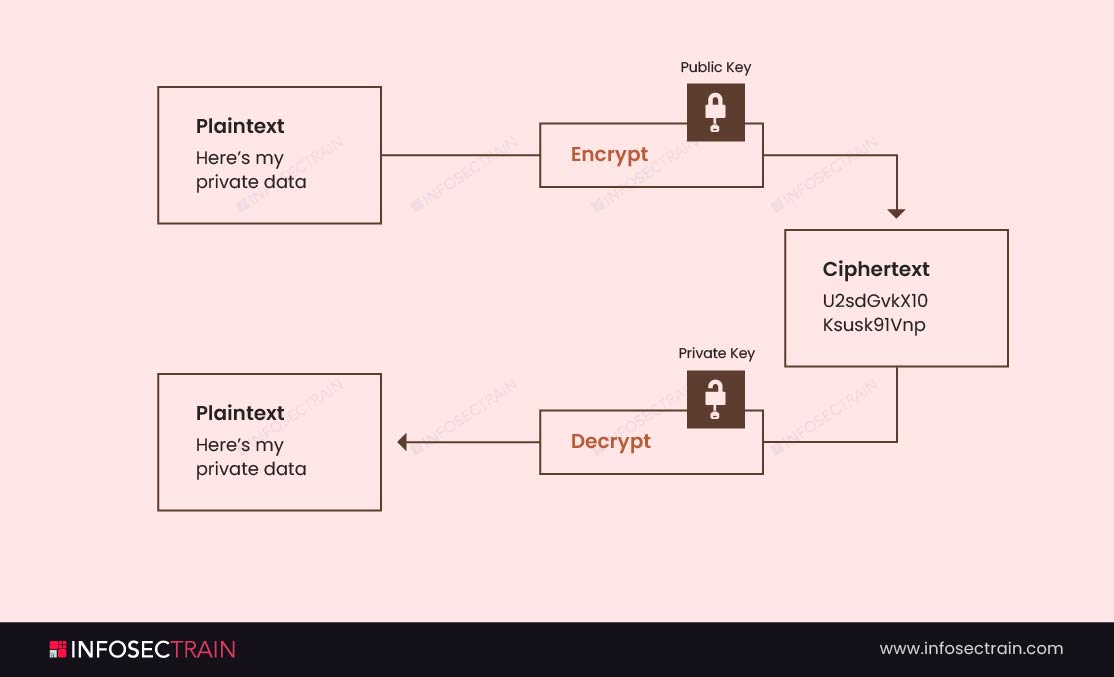
2. Asymmetric Encryption: Unlike symmetric encryption, an asymmetric cryptographic system uses pairs of keys. Each pair is a combination of one public key and one private key. These key pairs are generated via cryptographic algorithms based on one-way mathematical functions.
Examples of Asymmetric Encryption:
- Rivest Shamir Adleman (RSA)
- Digital Signature Standard (DSS)
- Digital Signature Algorithm (DSA)
- Elliptical Curve Cryptography (ECC)
Keys:
Public Key: The public key is used to encrypt data, The public key is free to use.
Private Key: We can encrypt and decrypt the data with the private key, but both the encryption and decryption private keys must be the same. Unlike public keys, the private key must be kept secret.
InfosecTrain:
InfosecTrain is one of the leading training providers with a pocket-friendly budget. We invite you to join us for an unforgettable learning journey with some of the best industry experts to gain a better understanding of the various security courses and other courses on offer. The courses can be taken as live instructor-led sessions or as self-paced learning model-based courses, allowing you to complete your training journey at your own convenience. Choose from a range of courses and training programs i IT, Cloud and Cybersecurity domains and take your career to the next level!
Frequently Asked Questions in the AWS Security Interview
We all understand how important security is for any organization, irrespective of their type and size. The Amazon Web Services (AWS) platform is one of the most flexible and secure cloud services available today. As a result, there is a growing demand for candidates who understand AWS security.
If you're a qualified applicant searching for work in the AWS security area, here's a list of interview questions to help you land your dream job.
1. What does AWS mean by cloud security?
Ans. In order to meet core security and compliance requirements such as data locality, protection, and integrity by utilising AWS cloud security comprehensive services and features.
2. How can you monitor your AWS applications using AWS WAF?
Ans. WAF is a Layer 7 Virtual firewall from AWS is a tool for protecting web applications against typical attacks and bots that may damage availability, breach security, or consume unnecessary resources. As a part of AWS, WAF establishes Layer 7 security rules that govern bot traffic and prevents common attack patterns, such as SQL injection or cross-site scripting, from reaching your applications.
3. What are the various AWS IAM categories that you can manage?
Ans. Users, groups, security credentials, and policies can all be controlled by the AWS account holder. You can also give individual users authorization to make calls to IAM APIs in order to manage other users.
4. When it comes to user passwords, what regulations are there that you can establish?
Ans. Passwords for IAM users must adhere to AWS's IAM default password policy which states that the password length must be:
8-character minimum and 128-character maximum.
Numbers, letters, and symbols are required in at least three of the following combinations.
Must not be the same as the name or email address of your AWS.
5. Where does an IAM role differ from an IAM user?
Ans. While interacting directly with AWS services, an IAM user has long-term credentials that will not expire. As an IAM role, it can assume temporary privileges which are given by AWS STS and we do not have to pass any credentials directly to the user. AWS role can be assumed by an AWS Service or an account.
6. What services are available for implementing a centralised logging solution?
Ans. There are three services you'll need: Amazon CloudWatch Logs & cloudTrail logs, which you'll store in Amazon S3, and Amazon ElasticSearch, which can be used to transport data from Amazon S3 to Amazon ElasticSearch.
7. What exactly is Identity and Access Management (IAM) in Amazon Web Services?
Ans. IAM is responsible for creating and managing AWS users and groups, as well as granting or denying access to AWS resources via policies.
8. What basically is Amazon CloudWatch logs?
Ans. Using existing system, application, and custom log files, Amazon CloudWatch Logs allows you to centrally monitor and debug your systems and applications. You can also use CloudWatch Logs to monitor your logs in realtime for specific words, values, or styles etc, and trigger some actions based on that.
AWS security with infosecTrain
InfosecTrain's trainers are extremely well-versed in a wide range of fields. We're a world-class training company with a global reputation for excellence in training. Enroll in InfosecTrain's AWS security certification training courses to begin your preparations.
The One-Stop Destination to Know Everything About the 2021 CISSP Exam
CISSP(Certified Information System Security Professional) is a globally recognized certification in the Information Security market. It can be said that CISSP certification is equivalent to an ISI mark for Information Security professionals(No one can beat you). Individuals take up this certification to show their expertise in designing, engineering, and managing the entire security posture of an organization.
There are seven wonders, seven seas, and seven seasons so without changing that wonder number, I will tell you seven reasons to pursue CISSP Certification.
1. CISSP certificate will maximize your career potential: According to the (ISC)2 workforce study, there is a shortage of 2.9 million people in the Cybersecurity workforce. Hence, there are a lot of job opportunities rushing to open your door. All you have to do is get a CISSP certificate for yourself. By the way, if I own a company, I will definitely look for a CISSP certified professional for my Information security needs over people with other credentials.
2. Maximizing your earning: More the skills you display, the more money you will make! Well, in the case of CISSP, you are the one who has to control the entire security posture of an organization, so the money you earn will be higher when compared to the other certification holders. The average wage of a CISSP certified professional is $131,030 per annum.
3. You will stand taller amongst your companions: Nah! I am not talking about complan! However, CISSP certification is definitely competing with complan to make you stand taller against your peers because you need to face many difficulties to clear your exam, which itself says about your determination. In fact, in 2017, Cybersecurity Trends Spotlight Report showed that CISSP is the most valued credential.
4. Understanding all the aspects of Cyber Security: To be a CISSP certified professional, you have to be competent at all the aspects of Cyber Security, and the aspects are:
- Security and Risk Management
- Asset Security
- Security Architecture and Engineering
- Communication and Network Security
- Identity and Access Management (IAM)
- Security Assessment and Testing
- Security Operations
- Software Development Security
Understanding these concepts will definitely make you an expert.
5. You will get demonstrated years of hands-on experience: As an assessment, an individual must have at least four years of expertise in the IT industry. Why is it beneficial? Well, my answer is that having experience makes a person better in their field.
6. You will become a member of the largest association: Gaining CISSP certification offers the added advantage of membership within (ISC)², the world’s largest nonprofit federation of cybersecurity experts.
7. No need to hustle to get a JOB: As I said, there is a shortage of 2.9 million people in the industry of the Cyber Workforce. So if you are a CISSP certified professional, companies will be looking for you.
Now, as you have an idea of why you must pursue a CISSP certificate, I will tell you the updated exam format.
Updated Domain Weightages
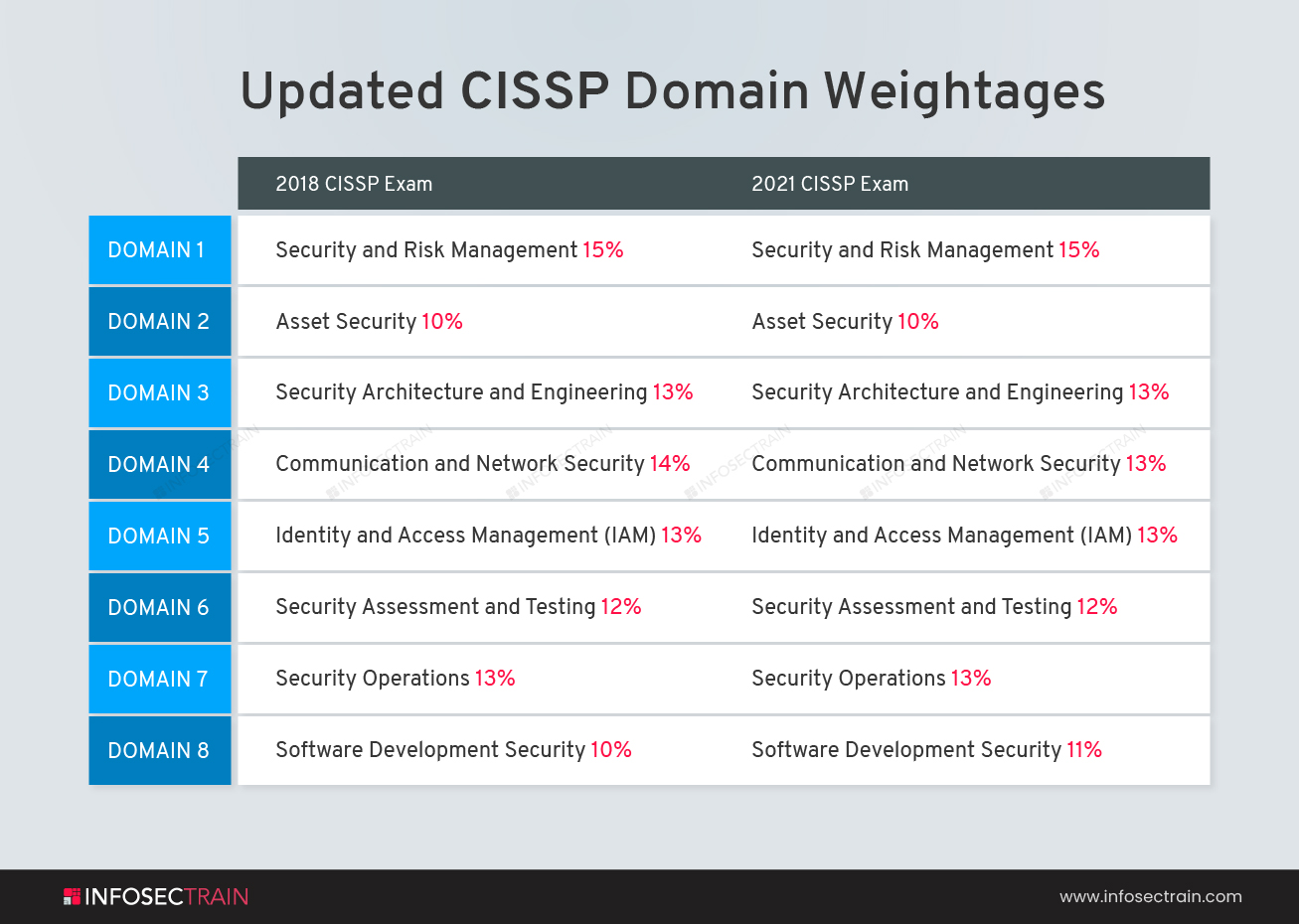
Topics to master:
The 2021 revision of CISSP has added many new topics to the certification exam. Here are the domains you have to master to obtain a CISSP certification in the new decade
Domain 1: Security and Risk Management
Domain 2: Asset Security
Domain 3: Security Architecture and Engineering
Domain 4: Communication and Network Security
Domain 5: Identity and Access Management
Domain 6: Security Assessment and Testing
Domain 7: Security Operations
Domain 8: Software Development Security
CISSP with Infosec Train:
InfosecTrain is one of the leading training providers with a pocket-friendly budget. So, if you want to get a good grip on the CISSP Certification Course, then join us to experience an incredible journey with our industry experts. Our courses are available in live instructor-led and self-paced sessions, making it easy for you to take up and complete your learning/ training journey at ease. Join InfosecTrain to learn skills that can change your life!
Why Should You Enroll in a Red Team Online Training Course?
A Red Team is a group of people trained in the art of hacking, but they utilize their skills for good, also known as ethical or white-hat hackers. This group stimulates an organization to enhance its effectiveness. It works in a way that administrators recognize the risk and a cybersecurity breach that could happen to their organization, and then they hire Red Team to reduce the risk and identify vulnerabilities.
Once the Red Team is selected, they will coordinate with the trusted agents within the company and find different ways to attack the system, server, and data.
- A Red Team is also called an Offensive Cybersecurity Team.
- A Red Team is not just limited to “Ethical Hacking.”
- Red Teams executes assessments to measure organizations’ security postures.
Let me explain how Red Team works:
Phase1: Perform Resonance: Firstly, Red Team researches the weak points and vulnerabilities in the organization systems.
Phase2: Gain Access: The first phase is all about understanding the vulnerabilities. In this second phase, once the Red Team has a clear understanding of the target’s vulnerabilities, they plan and execute the best ways to gain access to those weak points.
Phase3: Enumeration and Escalation: During this phase, the red team conducts recon from inside the network and calculates the best position to achieve their goal.
Phase4: Pivot: Once the team has taken a strategic foothold, it will repeat either some or all the above steps to explore and exploit the additional network. Later they move towards the critical business assets and their desired goal.
Phase5: Persistence: The more skilled the attacker, the more likely their presence can be undetected. In the fifth phase, Red Teamers build non-destructive means.
Phase6: Evade and Erase: Once the Red Team has successfully exploited the systems, they return the organization’s system as they are, that is, without any traces of malware.
Skills needed:
- Adversarial Mindset
- Strong technical skills
- Communication skills
- Persistence
- Determination
- Curiosity
So to become a successful Red Team Hacker, you have to have a piece of sound technical knowledge and be able to advise, think out of the box, and understand the mindsets. So to do so, you will definitely need good guidance where you can get a detailed explanation of every concept, where your doubts are cleared immediately and you get hands-on practical knowledge and you can get this only from Infosec Train.
Red Team Online Training with Infosec Train:
InfosecTrain is one of the best globally recognized training platforms focusing on Information security services and IT security training. Enroll in our Red Team training course to experience the practical sessions and excellent training from the best trainers.
Interview Questions for Microsoft Azure Architect Technologies AZ-303
Microsoft Azure is the second-largest cloud computing platform in the world, and it is rapidly growing. A lot of organizations are migrating to the cloud and Azure is their first preference. Therefore the demand for candidates understanding the Azure architecture is increasing.

An Azure Solution Architect is in charge of advising stakeholders and translating business needs into safe, scalable, and dependable cloud solutions. To implement solutions, you'll need to collaborate with cloud executives, cloud DBAs, and customers. The AZ-303 exam necessitates subject-matter competence in deploying Microsoft Azure solutions. We have brought you some interview questions that will help you in landing your dream job of Microsoft Azure Architect Technologies.
1. What is the definition of a Cloud Architect?
An IT professional who develops an organization's computing strategy is known as a Cloud Architect. Cloud adoption strategies, cloud application design, and cloud management and monitoring are all part of this approach. The Architect can also assist with a variety of cloud settings, including public, private, and hybrid clouds.
2. What is an Azure solution architect's primary responsibility?
An Azure solution architect's main duty is to provide advice to stakeholders and transform business needs into secure, scalable, and dependable cloud solutions. They should be well familiar with Azure management and have hands-on experience with it. Networking, virtualization, identity, security, business continuity, disaster recovery, data platform, budgeting, and governance are all part of the job.
3. What exactly is a Cloud DBA?
Database Administrators, often known as DBAs, are professionals that work with specialized software to store and manage data. In addition, a DBA's responsibilities include capacity planning, installation, configuration, database design, migration, performance monitoring, security, troubleshooting, backup, and data recovery.
4. What are the different parts of a Cloud Architecture?
Networking equipment, servers, and data storage are the primary physical components of cloud infrastructure. A hardware abstraction layer is also included in cloud infrastructure. The layer allows for resource virtualization and cost reduction through economies of scale.
5. What is Azure DevOps?
Microsoft's Azure DevOps is a Software as a Service (SaaS) platform. Its primary purpose is to provide an end-to-end DevOps toolchain for software development and deployment. Furthermore, it is compatible with a majority of top products on the market and is an excellent choice for orchestrating a DevOps toolchain.
6. What does Azure DevOps have to offer?
The following are some of the key duties that an Azure DevOps may perform:
- Azure Board is a solution for agile planning, task tracking, visualization, and reporting.
- Azure Repos hosts private git repositories in the cloud.
Azure Pipelines, Azure Artifacts, and Azure Test Plans are among the others.
7. How can I use VM insights to chart performance?
VM insights are a series of performance charts that track a variety of key performance indicators (KPIs) to help you figure out how well a virtual machine is operating. Furthermore, the charts display resource consumption over time so you can spot bottlenecks and abnormalities, or switch to a viewpoint that lists each machine to see resource utilization by the statistic. VM insights also keep track of important operating system performance indicators including processor, memory, network adapter, and disc use.
8. What are the performance limits of VM insights?
Virtual machines running Red Hat Linux (RHEL) 6 do not have any accessible RAM. Furthermore, metrics are only accessible for data discs on Linux virtual machines that use the XFS or EXT filesystem families (EXT2, EXT3, EXT4).
9. What is Azure Monitor Network Insights, and how does it work?
Without needing any configuration, Azure Monitor Network Insights gives a comprehensive view of health and data for all deployed network resources. The following are the main features of Azure Monitor Network Insights:
- Connectivity
- Diagnostic Toolkit
- Metrics and Network Health
- Traffic
10. How do you back up an Azure VM's settings?
There are two ways to backup an Azure VM via the VM settings:
- Single Azure VM: From the VM settings, you may back up one Azure VM.
- Several Azure VMs: A Recovery Services vault may be set up and configured to backup multiple Azure VMs.
AZ-303 with InfosecTrain
Training improves your knowledge and develops your foundation in any topic, therefore choosing the right training provider is crucial. You should check to see if the training center has been approved and recognized by reputable organizations or certification agencies. We have incredibly well-versed teachers at InfosecTrain who have earned experience in various domains. We are a premier training company with a global reputation. So, begin your preparations by enrolling in Infosec Train's AZ-303 / AZ-300 Microsoft Azure Architect Technologies Online Training & Certification Course.
Top 10 Career Benefits of Getting a CCSP Certification
Cloud computing is the latest buzzword in the IT world. Despite the numerous benefits of cloud computing, businesses are hesitant to adopt it due to various security concerns. Security concerns are a significant roadblock to cloud computing adoption.
The Certified Cloud Security Professional (CCSP) certification is a vendor-neutral credential and discusses best practices in cloud security. It was co-created by (ISC)2 and Cloud Security Alliance (CSA) to ensure that cloud security professionals have the knowledge, skills, and ability to design, implement, architect, operate, control, and enforce regulatory frameworks.
In this blog, we will discuss the career benefits of getting a CCSP certification.
Top 10 Career Benefits of Getting a CCSP Certification
1. Growth in Career: You will boost your career while also improving the security of sensitive cloud resources if you obtain a globally recognized CCSP cloud security certification. CCSP will help you stand out from the competition.
2. Higher Salaries: Employers value cloud security expertise, and professionals with them earn better compensation. According to an ISC2 survey, if you are CCSP certified, you will get 35% more salary than your peers who are not certified.
3. Numerous Job Opportunities: IT certifications such as CCSP play a significant role in securing job offers. Companies all over the globe are now hiring a large number of skilled and qualified IT Security personnel.
4. Global Recognition: You will get international recognition as CCSP is an American National Standards Institute (ANSI) accredited credential and complies with International Organization for Standardization and International Electro technical Commission (ISO/IEC) 17024 Standards.
5. Understanding the Latest Technology: The CCSP certification keeps IT professionals informed about new cloud computing technology, strategies, and threats.
6. Adaptable: As the CCSP is a vendor-neutral certification, candidates can use their expertise on a wide range of cloud platforms.
7. Signifies Cloud Security Expertise: A CCSP certification denotes a high level of expertise and professionalism, and it can help you stand out when applying for IT security jobs.
8. Boosts Confidence: When you establish a goal, make a strategy, work hard to achieve it, and succeed, you build confidence, which spreads throughout your life. The CCSP gives you the assurance that you passed one of the most challenging cloud security certification exams available.
9. Builds Trust: Certification is one of the most efficient ways to attract customers and businesses, reassure them, and earn their trust. The CCSP certification, offered by a well-known awarding body, will make organizations trust your credibility.
10. Demonstrates Practical Expertise: The practical experience assures that cloud security professionals know what to do in the field with the abilities they have gained through passing the CCSP certification exam, which goes far beyond books.
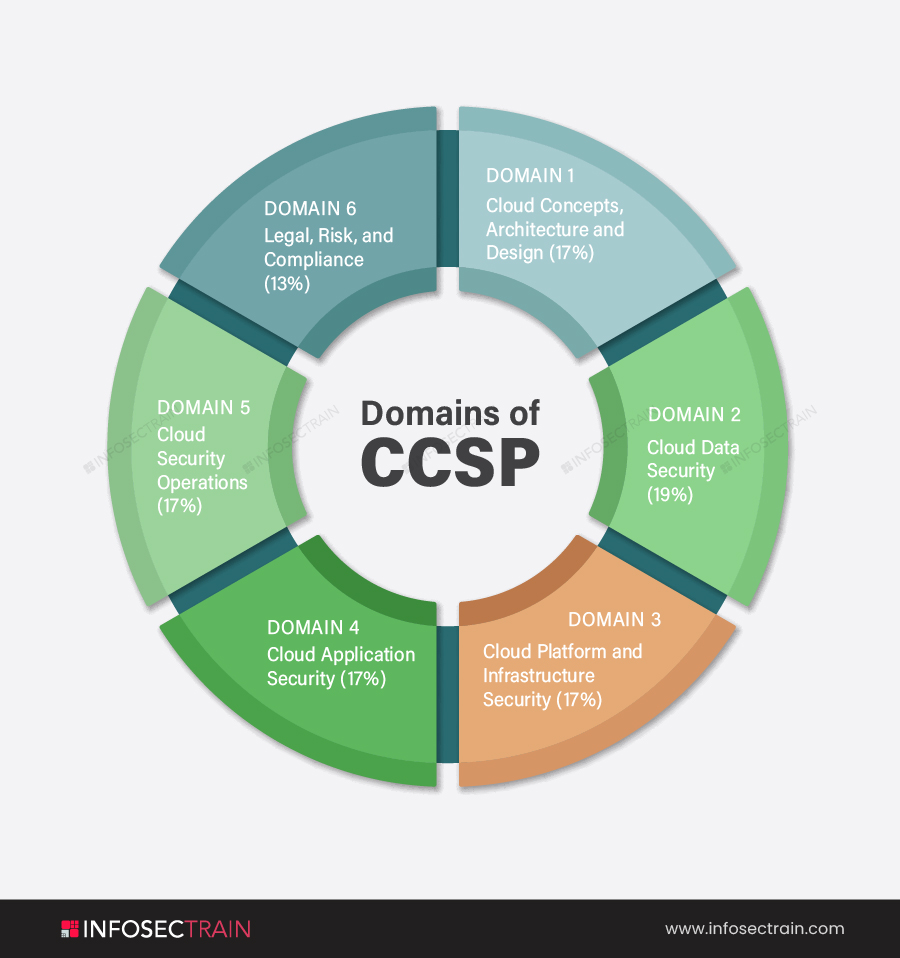
Domains of CCSP
CCSP with InfosecTrain
The CCSP certification training course at InfosecTrain is designed to provide you with all of the necessary knowledge regarding cloud computing function, security vulnerabilities that can be exploited, and how to fix them to maintain a safe and secure cloud environment. We are a leading security training provider globally. Our certified trainers have years of industry experience that they pass on to you during your training. So, take your first step towards building a bright career.
Interview Questions for Microsoft Azure Architect Design AZ-304
Microsoft Azure is the second-largest cloud computing platform in the world, and it is rapidly growing. A lot of organizations are migrating to the cloud and Azure is their first preference. Therefore the demand for candidates understanding the Azure architecture is increasing.

The design element of MS Azure is the subject of the AZ-304 exam. Those interested in pursuing this certification should have a solid understanding of Microsoft Azure and its architecture. It will be advantageous if you have an inquisitive mind and some hands-on experience with Microsoft Azure. We have brought you some interview questions that will help you in landing your dream job of Microsoft Azure Architect Design.
1. What are the three most important Azure platform components?
Compute, Fabric, and Storage, which are represented by Azure Compute, Azure AppFabric, and Azure Storage respectively, are the three major components of Microsoft Azure. In November 2017, Microsoft released a new version of the Azure AppFabric which was referred to as Service Fabric.
2. Mention the various layers in a cloud reference model.
Physical layer, Virtual layer, Control layer, Service orchestration layer, and Service layer are the five levels of a Cloud reference model.
3. Can you explain Design Data Integration?
Data Integration offers the connections and gateways that allow any external data to be brought into the Common Data Service (CDS) and stored as a Common Data Model (CDM). Customers may now combine their data in a single location for business applications and analytics. Data Integration is built on Power Query, the same technology that millions of users use in Power BI and Excel on a daily basis.
4. What does database scalability imply?
Database scalability refers to a database's capacity to adapt to changing needs by adding or deleting resources. To cope, databases have developed a variety of approaches.
5. What are storage tiers, and how do you use them?
Storage tiering is a method that allows you to make the greatest use of storage resources, backup data effectively, save money, and make the most of storage technology for each data type. We have 3 tiers in Azure Storage: Hot Tier, Cool Tier, and Archive Tier.
6. What is Azure Key Vault, and how does it work?
Microsoft Azure Key Vault is a cloud-based management solution that allows users to encrypt keys and tiny secrets using hardware-based encryption keys (HSMs). An HSM is a piece of hardware that holds cryptographic keys and is safe and tamper-resistant.
7. What are Azure Policies and how do I use them?
Azure Policy is an Azure service that lets you build policies that enforce and manage resource characteristics. When you apply these policies, they impose distinct rules and consequences on your resources, ensuring that they comply with your IT governance requirements.
8. What are the various traffic routing methods?
The various methods to route traffic are:
- Priority
- Weighted
- Geography
- Performance
- Multivalue
- Subnet
9. What is Azure Load Balancing, and how does it work?
An Azure load balancer is a Layer-4 (TCP, UDP) load balancer that distributes incoming traffic among healthy VMs to offer high availability. A load balancer health probe checks a specific port on each VM and only sends traffic to those that are up and running.
10. During data transfer, what form of encryption is used?
TLS and its precursor, Secure Sockets Layer (SSL), are cryptographic protocols that enable secure Internet communications for things like web surfing, e-mail, Internet faxing, instant messaging, and other data transfers.
AZ-304 with InfosecTrain
Training improves your knowledge and develops your foundation in any topic, therefore choosing the right training provider is crucial. You should check to see if the training center has been approved and recognized by reputable organizations or certification agencies. We have incredibly well-versed teachers at InfosecTrain who have earned experience in various domains. We are a premier training company with a global reputation. So, begin your preparations by enrolling in Infosec Train's AZ-304/AZ-301 Microsoft Azure Architect Design Online Training & Certification Course.
AWS Certified Solutions Architect- Associate Interview Questions
AWS Certified Solutions Architect- Associate, is a technical certification offered by AWS for professionals and freshers who run the solutions architect programs and business architecture programs. This certification is recommended to anyone whose interest lies in a job role that includes creating Alexa skills.
Before attending this certification exam or attending the AWS solutions architect interview, AWS recommends at least one year of working experience at generating voice applications by using the Alexa kit of skills and expertise in a minimum of one programming language.
This blog gives you the best and most common interview questions asked to hire an AWS Certified Solutions Architect- Associate.
1. Tell me how do you secure your data when transferring it into the cloud?
I will use these three steps to make sure the data is secured while transferring it to the cloud, and the steps are:
- Ensure that no one can prevent the data when it moves from point X to point Y in the cloud.
- Assuring that there are no data leakages with the encryption key.
- Separate my data from other organization’s data and then encrypt it by approved methods.
2. What is AMI?
Amazon Machine Image(AMI) is a template that offers the data needed to launch any instance; we can use as many as AMIs to launch the instance.
3. What network parameter can we expect when launching the instance within the cluster placement groups?
Well, it always depends upon the Instance type and the specification of network performance. But if the cluster group is standard, then these are the parameters that you can expect:
- 10 Gbps in case of single-flow.
- 20 Gbps in case of multi-flow or full-duplex.
- The traffic is limited to 5 Gbps outside the group.
4. What are the parameters you consider when selecting the Availability Zone?
The parameters that I consider while selecting the availability Zone are:
- Pricing
- Latency
- Response time
- Performance
5. Can we run various websites on the EC2 server with just one Elastic IP address?
No, we cannot run various websites on the EC2 server with just one IP address; we need multiple IP addresses to do so.
6. List the states that are available in the Processor State Control?
There are two states available in the Process State Control they are:
P-state: P-state contains 16 levels from P0 to P15, where P0 is the highest frequency, and P15 is the lowest frequency.
C-state: C-sate contains seven different levels from C0 to C6, where C6 is the robust state of the processor.
7. What is custom IAM?
Custom IAM is an approach that limits the access of the third-party software within the storage service of the S3 bucket called “Company Backup.”
8. What is the use of Virtual Private Network?
Virtual Private Network is used to establish the connection between amazon cloud and the corporate data center.
9. Can we modify the private IP address of the EC2 instance when it is running?
No, we cannot change the Private IP address of the EC2 instance when it is running because the private IP persists permanently throughout the life cycle of an instance.
10. Can we use direct connections when transferring the objectives over the data centers?
Yes, CloudFront is a sort of direct connection used to transfer the objects over the different data centers, but we have to pay for it depending on the data transfer rates.
AWS Certified Solutions Architect- Associate with Infosec Train:
InfoSecTrain is one of the best globally recognized training platforms focusing on Information security services and IT security training. Enroll in our AWS Certified Solutions Architect- Associate Training & Certification course to experience the practical sessions and excellent training from the best trainers.
Top AWS Certified SysOps Administrator – Associate Interview Questions
The AWS Certified SysOps Administrator- Associates are the system administrators in a system operations position. With experience in deployment, management, and operations upon AWS, this certification also validates the individual’s:
- Capability in deploying, managing, and operating fault-tolerant, highly available, and scalable systems in AWS
- Capacity in controlling and implementing the flow of the data in AWS
- Ability to select the relevant AWS services based on security, computation, and data needs
- Potentiality in identifying the use of best practices in AWS operations
- Competence in estimating AWS usage costs
- Proficiency in mitigating the on-premise workloads

This blog discusses the most relevant interview questions asked for AWS Certified SysOps Administrator- associate role.
1. What are the main objectives of the AWS Certified SysOps Administrator- Associate role?
The three main objectives of the AWS Certified SysOps Administrator- associate roles are:
- Technical expertise within AWS operations.
- Technical deployment expertise.
- Technical management expertise.
2. What do you know about cloud computing?
Cloud computing is nothing more than a delivery of computing services like storage, networking, servers, analytics, intelligence, and software over the internet to provide economies of scale, innovations, and flexible resources.
3. Tell me something about the operational excellence pillar?
The operational excellence pillar focuses on how your company is supporting your business objectives. It measures individuals’ abilities to run workloads adequately, and it constantly reinforces the procedure of delivering the business values.
4. List the design principles of the operational excellence pillar?
The five design principles of operational excellence are:
- Make small, regular, and reversible modifications
- Predict failure
- Perform operations as code
- Learn from all operational malfunctions
- Refine operations procedures regularly
5. What are the four areas that operational excellence in the cloud is composed of?
The four areas that operational excellence in the cloud is composed of are:
- Organization
- Prepare
- Operate
- Evolve
6. What do you know about the security pillar?
The security pillar concentrates on protecting complex IT systems and data. The key areas are integrity and confidentiality of data, privilege management like recognizing who can do what and setting controls to identify security events.
7. List the characteristics of Amazon EC2 services?
The different features of amazon EC2 services are:
- GPU compute instances
- High I/O instances
- Flexible storage options
- Improved networking
- HPC (High-Performance Computing) clusters
8. What is the use of Amazon EFS?
Amazon EFS offers a serverless and straightforward set-and-forget flexible file system. Using Amazon EFS, we can generate a filesystem, mount that file system upon the Amazon EC2, and write and read data in the file system.
9. What is RTO?
RTO (Recovery Time Objective) is the supreme acceptable delay among the interruption of a specific service and restoring that service.
10. What are the advantages of using an AWS control tower?
Advantages of using an AWS control tower are:
- The procedure of setting up and configuring a new AWS environment is accessible by using an AWS control tower
- Ongoing policy management is automatic
- The AWS environment is summarized by the view-policy level only
AWS Certified SysOps Administrator – Associate certification with Infosec Train:
InfosecTrain is one of the best globally recognized training platforms focusing on Information security services and IT security training. Enroll in our AWS SysOps Associate Certification Training course to experience the practical sessions and excellent training from the best trainers.
Five Steps to Investigate and Respond to Malware Incidents as a SOC Analyst
Malware is nothing but malicious software that damages your system without your knowledge. There are many types of malware like Trojan horse, spyware, ransomware, worms, virus, or any other spiteful code that damages our system. And, when the SOC team detects this malware or is notified about this infectious application, then that situation is called Malware Incident. The SOC team begins an investigation of the malware immediately after identifying it to know the gravity of the problem.
There are four essential skills required for SOC analyst and they are:
- Critical thinking
- Performing under pressure
- Strong fundamental skills
- Curious mind
In this blog, we will discuss about who notifies the SOC team about malware and the steps taken by the SOC team to investigate the malware. Let us discuss the life of a SOC analyst:
Who notifies the SOC team about malware?
There are various stakeholders involved in notifying the SOC team about malware they are:
1. Customers, Employees, or Clients: Whenever a malware attack happens, you will observe the abnormal behavior of the system like pop-up messages, many irrelevant advertisements, system crashes, or Blue Screen Of Death. When this behavior is followed by Customers, Employees, or clients, they will notify Security Operations teams to investigate the problem.
2. Defense and SOC security tools notify the malware: Due to the advanced technology nowadays, it is becoming challenging to absorb the defects in the system; hence SOC teams use different defense tools that will notify the malware in the system. These detections are differentiated into two categories as given below, and without these tools and the improved technologies behind them, the life of a SOC analyst would be tough:
- Behavior-based detection.
- Signature-based detection.
Now let us discuss the Investigation and incident response steps taken by the SOC team:
1. Preparation: Preparation is the first important step in the process of responding to malware attacks. In this step, the SOC team installs a security system in a place that identifies an incident.
2. Identification: As SOC teams have set up a Security system, this will alert the Intrusion Detection Systems, and web filtering gateways detect the unusual external connection. And then, the SIEM solutions will connect the dots of an attacker passing through the endpoint solution or the internal network.
3. Containment: Containment takes place to stop the further spread of the damage or the malware to the network. Containment is needed to concentrate on the next stage of the response.
4. Eradication: Eradication is one of the most complicated stages in the incident response process because it includes forensic analysis to discover the degree of presence of the threat actor. Security staff must make sure they eliminate the entire existence. By re-imaging the machine, backdoors searching, and determining the root cause analysis of the incident.
5. Recovery: Recovery is the final stage in the incident response. In this stage, we get the infected systems up and run them to reduce the potential monetary loss caused by the infected system.
So, these are the five steps taken by the SOC team to investigate and give the incident response.
Why Infosec Train:
InfosecTrain provides 80 hours of training with 4 hours per day with the industry-certified trainers who use this time to train you excellently and with real-life examples. You will get the recorded sessions by which you can learn at your own pace. To enroll in our course and get a deep understanding of the topic, please visit our website InfosecTrain
Top 3 Ethical Hacking Certificates For 2021
Today, we are witnessing many data breaches everywhere, like Insurance companies losing their records, Credit cards data is being stolen, the governments' private mails are being hacked, etc. Hence, many organizations are hiring Ethical hackers for their security purposes. Therefore, many opportunities are available in the field of ethical hacking.
In this blog, let us discuss the Top 3 Ethical hacking certifications which might land you in your dream job.
1.InfosecTrain's Certified Ethical Hacker: CEH is one of the standards and most apparent ethical hacking certifications available. CEH is created to examine the professionals according to their capability of dealing with security risks and threats. You can attend the exam without training, but you have to submit proof of at least two years of hands-on experience in cybersecurity. EC-Council manages this certification.
.jpg?timestamp=1627035119937)
About the exam:
Number of questions: 125
Exam time: Four hours
Exam format: Multiple choice
Exam fee: $500, extra $100 for self-study students.
2.Offensive Security Certified Professional with Infosec Train: The OSCP is a well-respected certificate needed for many penetration testing jobs. Well, this certification is challenging to get, but nothing is impossible. It would help if you had the correct guidance so you can get online classes too. To pursue this certificate, you need to have a strong base on software development and networking protocols.
The OSCP certificate is created for the technical specialists to "evidence their precise and practical knowledge of the penetration testing process including life cycle."
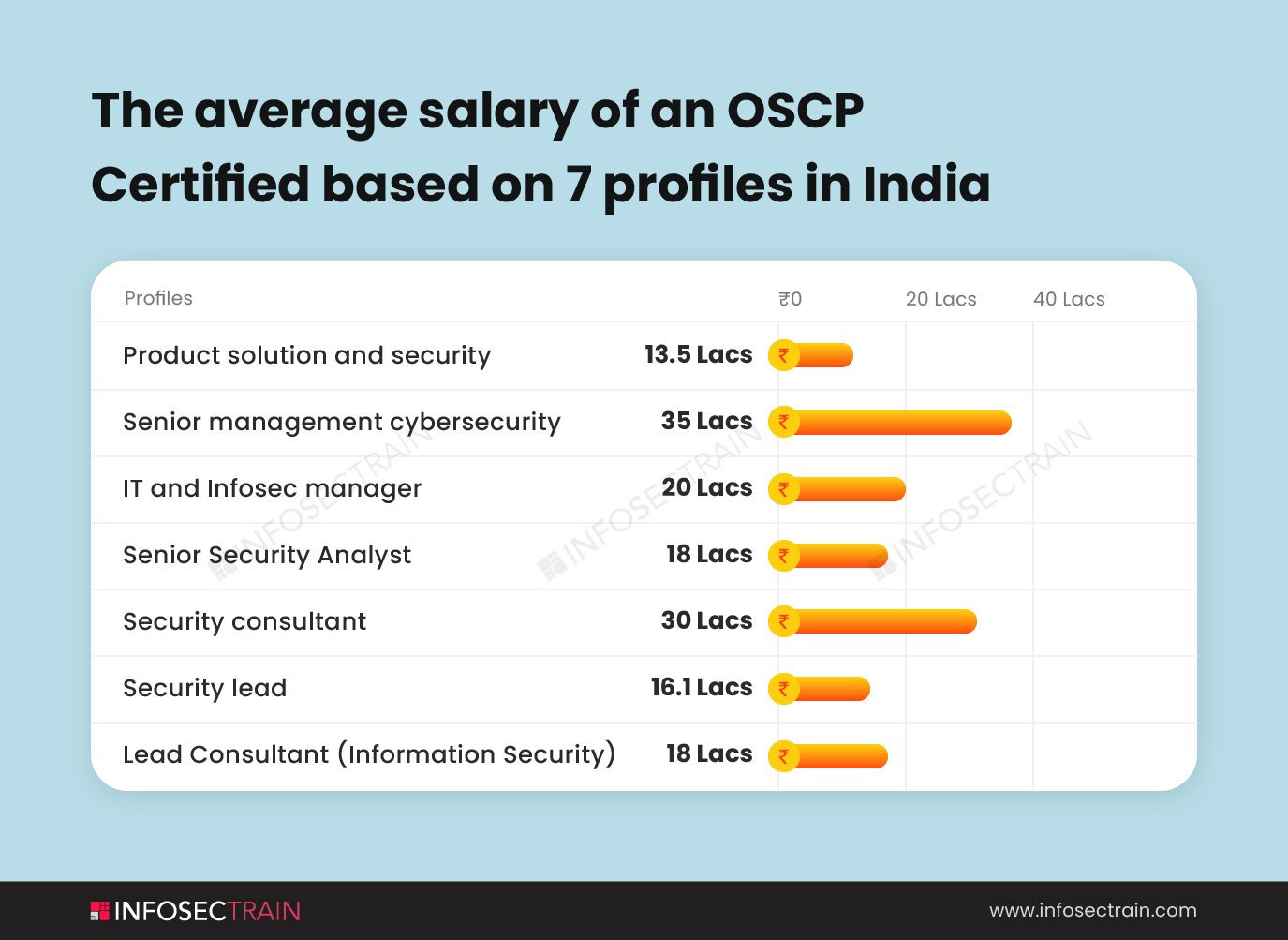
About the exam:
Exam time: You will have 23 hours 45 mins to complete the exam and another 24 hours to upload the documents.
Exam fee: $800
Number of machines you have to crack: We have to crack five machines in the OSCP exam
Exam format: Open book
3.Global Information Assurance Certification Penetration Tester(GIAC): GIAC program is managed by the SysAdmin, Audit, Network, and Security Institute, formally called the Escal Institute of Advanced Technologies. GIAC provides dozens of vendor-neutral certifications, including courses that need hands-on learning. GIAC courses are conducted online. The company also sponsors white research documents that are granted to the cybersecurity business without any charge. There are several possibilities to receive the GIAC Penetration Tester certification, but it is strongly suggested that students take the SEC560 course on Network Penetration Testing, including Ethical Hacking.
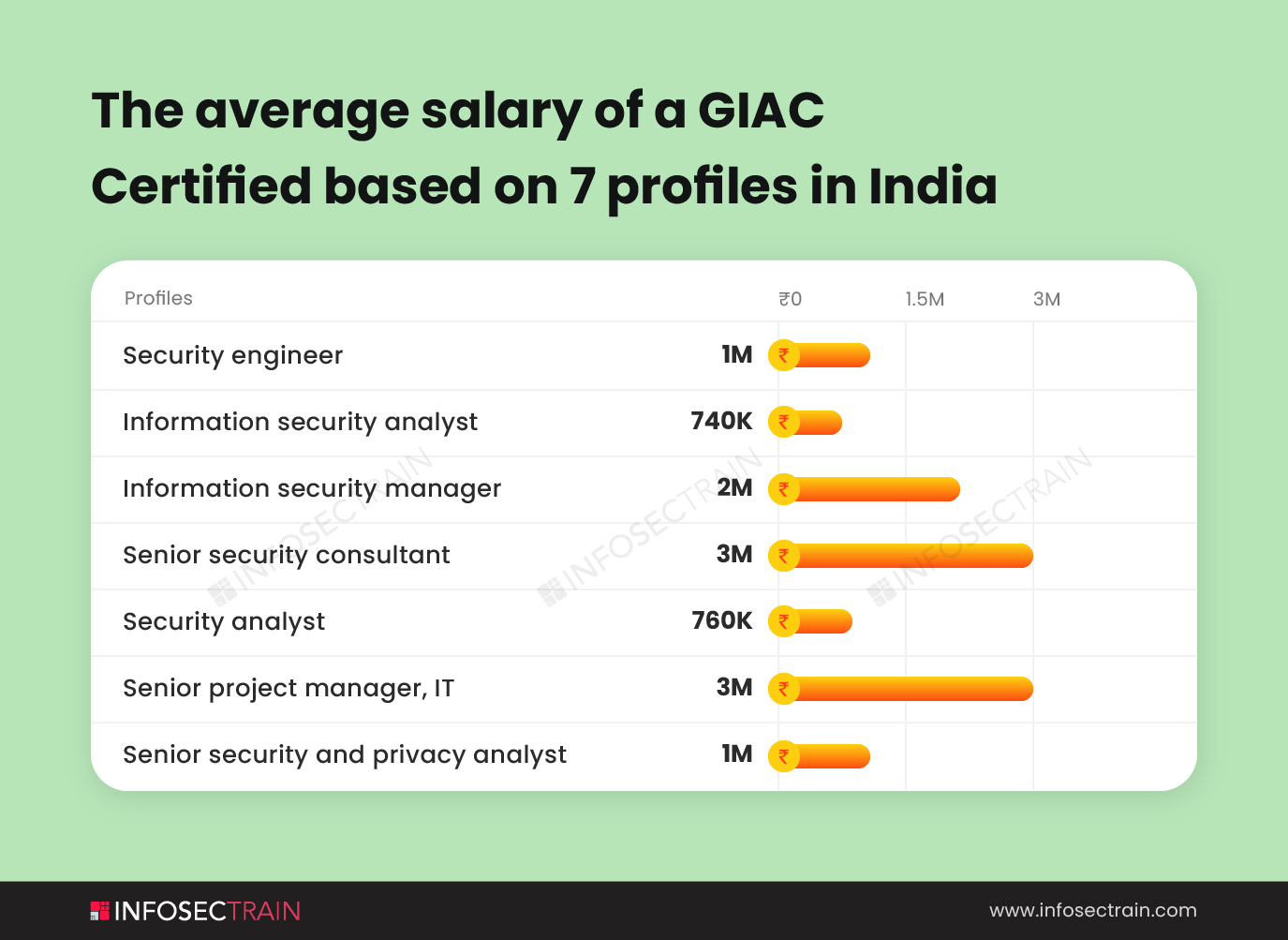
About the exam:
Exam fee: $999
Exam format: Multiple-choice
Exam time: 2-5 hours
Number questions: Exam details vary by choice of the exam;
please visit : https://www.giac.org/certifications/focus-areas
Why InfosecTrain:
As the toughest exams need the most excellent guidance, experts in InfosecTrain help you with every concept and make you crack the exams. So why late? Enroll in the CEH v11 Certification Training For professional expertise and an in-depth grasp of ethical hacking. With our well-versed and experienced teachers, we are one of the leading training providers. The training session will assist you in grasping the fundamental principles and providing a thorough understanding of the subject. This certification will be well worth every penny and minute you put into it.
How do I prepare for the Az-204 exam?
The Az-204 exam is intended to decide your capabilities in tasks like developing Azure computing solutions, Azure storage development, Azure security implementation, optimizing, monitoring, and troubleshooting the Azure solutions. And you must be able to connect and absorb the third-party and Azure services.

People eligible to attend this exam are cloud developers who can work in all the development phases like from the requirement definition and design phase to the maintenance phase.
Before deciding to attend the Az-204 exam, you have to know the details of the exam and modules within the exam, so let us discuss these details first:
Exam details:
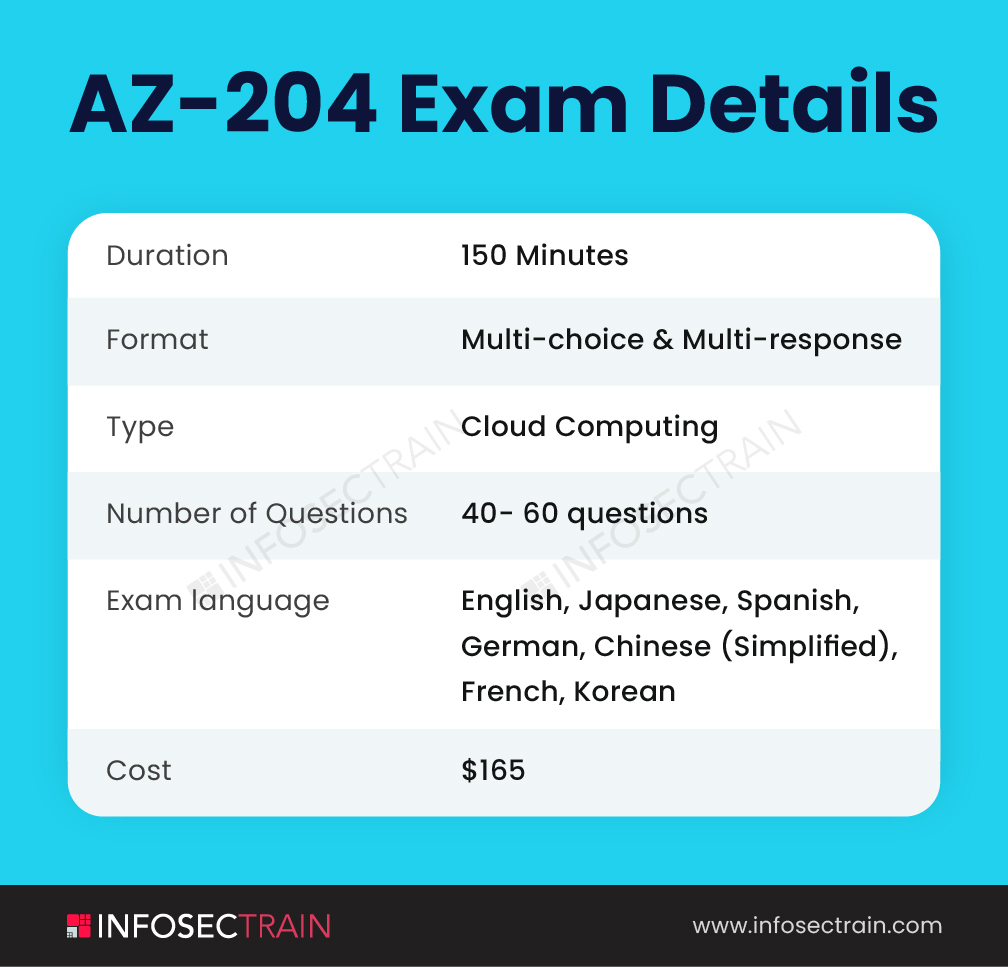
Exam Modules:
.jpg?timestamp=1630563401500)
Now let us discuss the steps that need to be taken to prepare for the Az-204 exam are:
1. Try the practice exams: Microsoft offers many practice exams similar to the actual exam. Practicing these exams may support you in getting the idea of original exam questions and patterns.
- The practice exam questions may be in the form of drag-and-drop or multiple-choice.
- In the actual exam, you get points for partially correct answers, but you will either get total marks or no marks at all in the practice exams.
- Code snippets are available for some questions.
2. Try to use CLI and C# SDKs to manage Azure resources: as the AZ-204 exam mainly focuses on how we set up and manage the Azure solutions, you have to spend more time practicing these tools and learn to manage the resources. Though you need not have complete knowledge of CLI, it would be helpful to have at least an idea about it.
3. Brainstorm about how and when to use various resources: In the AZ-204 exam Certification Training, you will find many practical questions where a situation is given and ask, “which Azure resource is a good option.” Hence it is recommended to practice and think about how and when to use the various resources in different situations.
4. Go through Microsoft resources: Microsoft offers us many resources on their learning website, including lab and theoretical content, which is worth practicing.
5. Do not panic: Yes, you should not panic because it leads to misunderstanding the questions; I know there are a lot of things to learn and remember, but you have many resources available, and of course, Infosec Train will give you the best lessons that help you to pass quickly.
Note:
Once you pass the Az-204 exam, you will be awarded an Azure Developer Associate badge; this certification will only be valid for up to 2 years.
Why Infosec Train:
- In Infosec Train, you will get 32 hours of valuable training from the best industry experts.
- Trainers in Infosec Train are Microsoft Certified; hence, they know how and when to teach you what makes your journey easy.
- You will have access to all the recorded sessions so that you can learn from anywhere and anytime.
Why Do You Need CISM Certification?
There may be few weak points in systems that may attract threats and cause data leakage in every organization. And if these weak points are not recognized and removed on time, they may cause massive damage to the entire organization. As data recovery is an expensive process, employers recruit CISM (A Certified Information Security Manager) to improve the firm’s security measures.
ISACA(Information Systems Audit and Control Association) sponsors the CISM certification; ISACA is a globally recognized organization that involves granting the most reliable ways for information systems management.
So in this blog, let us discuss why it is essential to have a CISM certification.
First, let us see the career benefits and then discuss the type of jobs profiles that match the CISM certified professional.
Career Benefits:
- Growing in career: If you have one of the best certificates that prove your knowledge in Information security, your job will accelerate at the highest speed.
- Salary: As the duties of CISM certified involves some huge tasks like tracking the security issues and develop efficient solutions, their salary will also be in huge numbers. For example, if most ethical hacker’s salaries lie somewhere between $90,000 to $100,000 per year, the CISM certified professional wage would be $115,000 per year.
- Global recognition: As ANSI approves CISM under ISO/IEC 17024:2021, which is an international standard, therefore, you will get international acceptance.
- Challenging tasks in your job: who wants to have a tedious job? Nobody right? So CMSI frequently asks their certified employees to upgrade their skill set for the new challenges, which helps them in personal and professional development.
Now let us discuss the job profiles that match the CISM certified professional are:
- Governance: in any organization, not all data access is given to every employee. Not all workers have the same right to access the data; hence IT governance tracks the available data for every employee. This helps organizations to stop inside data leakage.
- Risk Management: risk management team analysis the risk factors and tracks how the different files interact with various employees; CISM makes people better risk analysts by training them in tracking suspicious files.
- Information Security Manager: duties of Information Security Manager include strategic alignment execution, securing the value delivery, security metrics evaluation, and resource management.
Before attending the exam, you have to know two essential details they are:
Exam details:
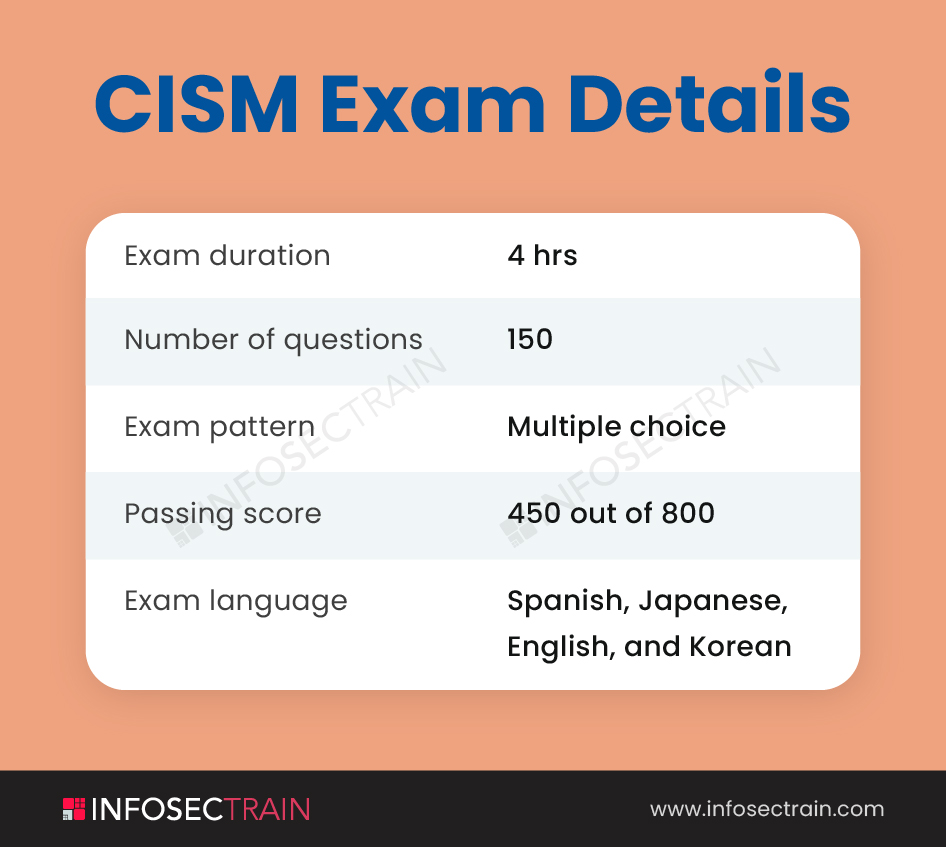
CISM Exam domains:
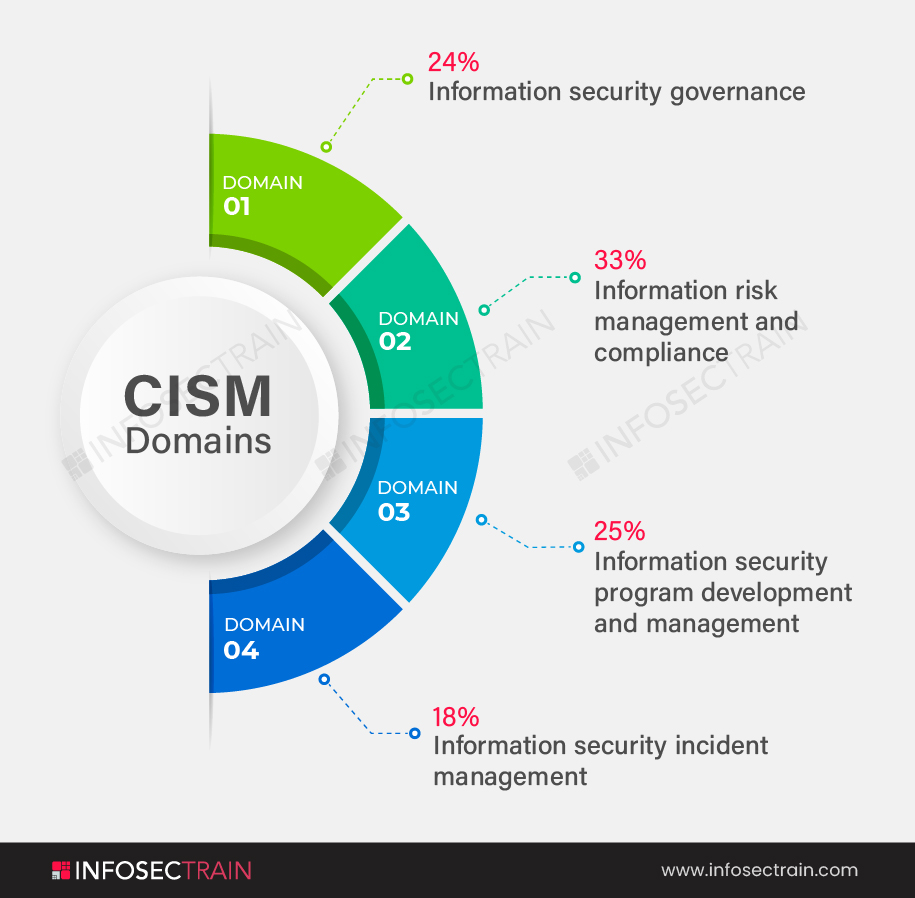
Why Infosec Train?
- Infosec Train allows you to customize your training schedules; Our trainers will provide the one-to-one training.
- You can hire a trainer from Infosec Train who will teach you at your own pace.
- As ISACA being our premium training partner, our trainers know how much and what to teach to make you a professional.
- One more best part is you will have access to all our recorded sessions.
Sounds exciting and straightforward at the same time, right? So what are you waiting for? Enroll in our course and get certified.
Process of Data Collection in QRadar SIEM
QRadar is a security information and event management solution that collects data from network devices and the business. It is a SIEM solution designed for companies to connect to operating systems, host assets, applications, vulnerabilities, user actions, and behaviors. QRadar is used to do real-time analysis of log data and network flows, allowing malicious activities to be identified and stopped in the shortest amount of time. As a result, QRadar ensures that it either avoids or mitigates harm to its host company.
Working of QRadar SIEM
The QRadar is a Security Intelligence Platform that uses advanced analytics and machine learning to parse logs and flow data in real-time to detect any suspicious occurrences. It then compares them to vulnerability and threat intelligence to provide prioritized alerts depending on impact and severity.
Once a threat is identified, QRadar can integrate the entire chain of events and investigate to discover the underlying cause and scope of the assault. You can obtain deeper visibility into user behavior, endpoint activity, network traffic, and more using pre-packaged rules, over 500 out-of-the-box connectors, and readily downloadable applications. All of this is visible from a single platform and manageable through a single pane of glass.
Data collection in QRadar SIEM
.jpg?timestamp=1626404831709)
QRadar's architecture is three-tiered, with collectors at the bottom. The processor is placed above the collectors, leaving the console at the top. QRadar collectors are connected to all network and cloud assets and apps. All collectors transmit logs to the processor for correlation and analysis, with the findings shown in the QRadar interface.
The first layer is data collection, which collects data from your network, such as events or flows. The all-in-one appliance may gather data directly from your network, or you can collect event or flow data via collectors such as QRadar Event Collectors or QRadarQFlow Collectors. Before sending to the processing layer, the data is parsed and normalized. When raw data is processed, it is normalized to be presented in an organized and helpful way.
Event data describes events in the user's environment at a particular moment in time, such as user logins and emails.
Flow data is information about network activity or sessions between two hosts on a network that QRadar converts into flow records.
QRadar converts or normalizes raw data into IP addresses, ports, byte and packet counts, and other information, which is then recorded in flow records. This is effectively a two-host session. In addition to capturing flow information using a Flow Collector, the QRadar Incident Forensics component supports complete packet capture.
QRadar with InfosecTrain
If you wish to learn QRadar, you should opt for InfosecTrain's QRadar SIEM Security Training since we are a top training provider. Our highly qualified and professional trainers are well-versed in the subject matter. We concentrate on establishing a solid foundation and equipping applicants with professional expertise.
5 Tips and Tricks to Achieve CCSP Certificate
(ISC)² designed the Certified Cloud Security Professional Certification to guarantee the cloud security professionals’ abilities and knowledge at cloud security design, architecture, implementations, controls, and operations.

This CCSP certification is designated for IT experts who possess at least five years of industry experience with at least three years of expertise in information security and one
year of expertise in any of the CCSP domains.
Now, in this blog, let us discuss tips and tricks on how to pass CCSP.
1. Get a complete understanding of the exam: In this phase, you must be aware of the complete details of the exam process like exam timing, number of questions, exam pattern, passing score, CCSP exam cost, and exam language.
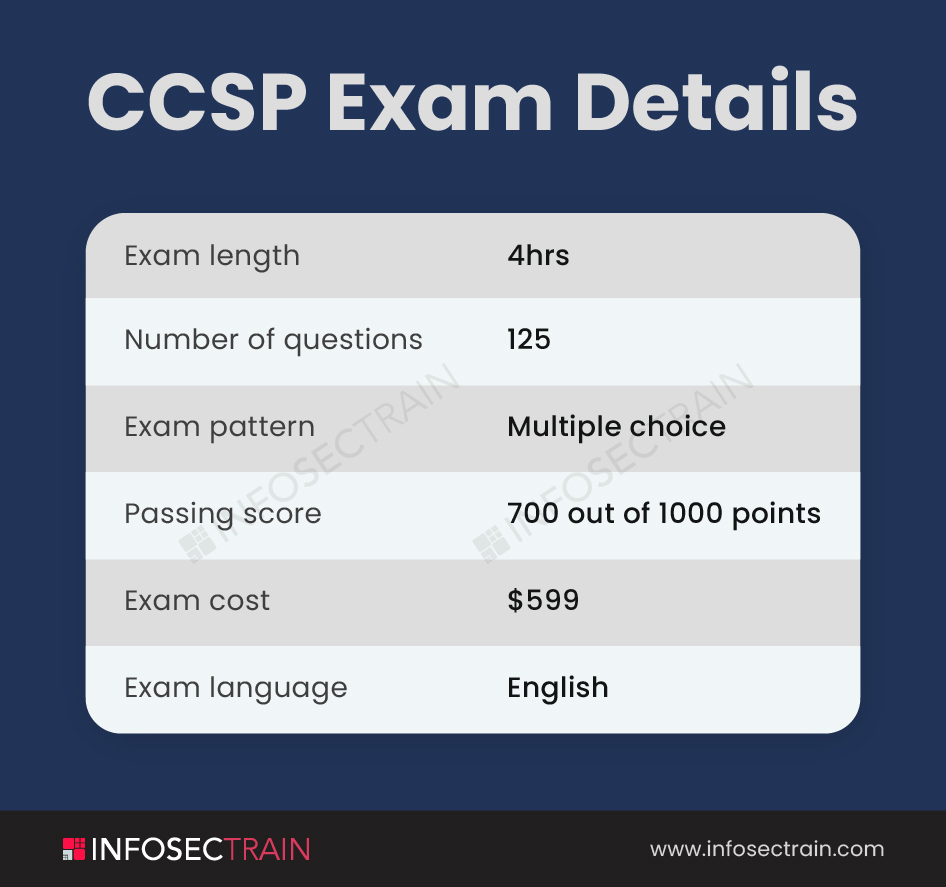
2. Know the domains and study accordingly: Six different domains in the CCSP exam are weighted separately, so go through the easy and highly weighted domains first and further go for the remaining.
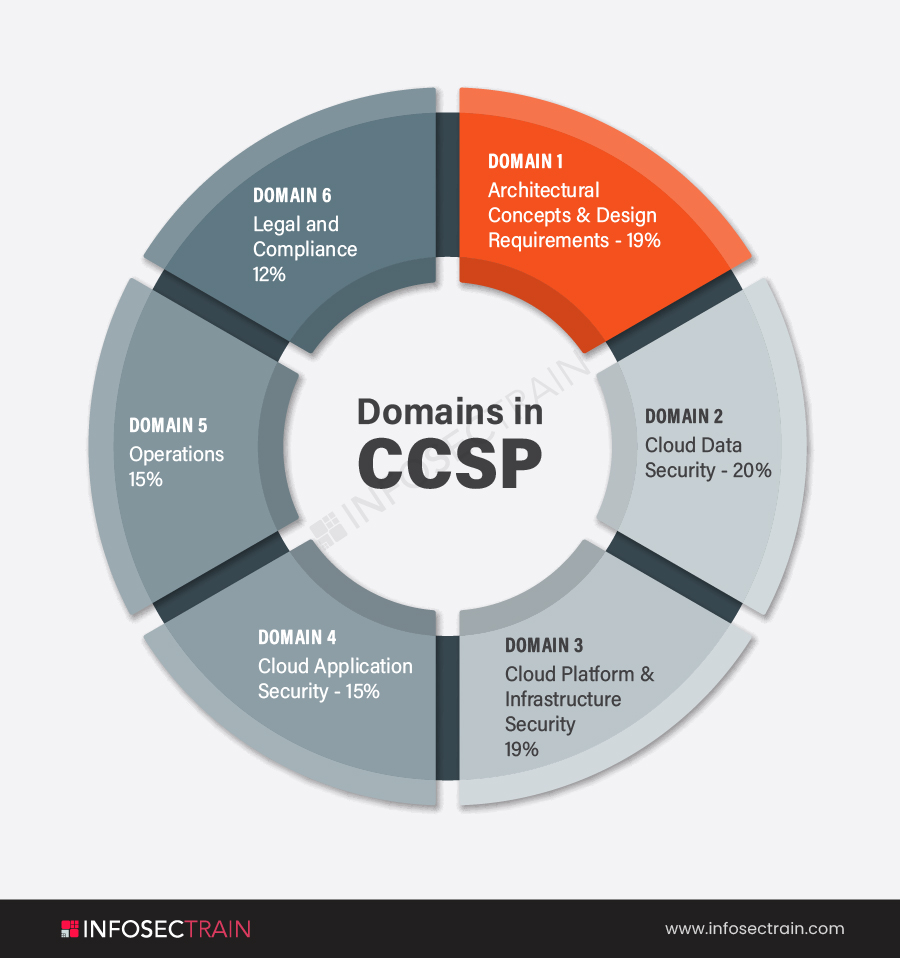
3. Take CCSP practice tests: taking practice tests is one of the reliable ways to prepare for the CCSP exam. The Internet provides many study material and practice tests of CCSP, but make sure you use the correct and authorized resources while taking the practice tests.
Below are two sites where you can take practice tests:
4. Assess your knowledge before registering for the exam: Before registering for the CCSP exam, make sure you are solid at all the crucial topics, assess your ability through the practice tests. Know your obligations in mind and pick the date that suits your schedule.
Go to the (ISC)² site to register for your exam only if you are sure that you want to take the CCSP exam.
5. Get a study buddy: it always works if we have good guidance with us this maybe you senior, or a person who is preparing for CCSP, or a person who already cleared CCSP (trust us, InfosecTrain can also play this role very well because there are experienced industry trainers to teach you every concept in your way).
Finally:
If you are willing to become a CCSP certified professional officially, you have to meet the (ISC)² requirements, and the requirements are:
- Pass the CCSP exam with a 750 or higher score.
- (ISC)² ethics must be agreed upon by you.
- It would be best if you met the minimum experience needs.
Why InfosecTrain:
InfosecTrain is a leading training platform. You can find the best trainers who have years of industry experience in a particular field. They will make sure you understand every concept by giving you real-time examples. What more do we want when we have someone who clears all our doubts anytime. So why late? Dive in and enroll in our course. Happy Learning!!
An Effective Guide to Understand Social Engineering Techniques
Social engineering is nothing but a cybersecurity threat that takes advantage of your most vulnerable link in the human workforce or the security chain to get passage to corporate networks. Attackers use complicated emotional and trickery manipulation to cause employees, even senior staff, to withdraw sensitive data.
Two prominent social engineering techniques are:
- Human-based social engineering techniques.
- Technology-based social engineering techniques.
Human-based social engineering techniques:
There are many Human-based social engineering techniques, but let’s discuss four main types:
- Shoulder Surfing: Shoulder Surfing is one of the most common techniques. This type is where the hacker can stand right next to you and watch the information like PIN and password and use that information for data breaching.
- Hoaxing: This is a technique where the social engineer provides false information to the target audience.
- Creating Confusion: Social Engineers create a confusing situation and then grabs confidential data by taking advantage of that situation.
- Tailgating: This is a social engineering technique where an unauthorized person follows the authorized person to a restricted area to purloin confidential information.
Now let us compare each other on the basis of the following properties:-
The below-mentioned parameters serve as the standard for a structured comparison between various human-based social engineering cyber threats that we face today. So, let us explore the multiple possibilities based on the same and make a detailed analysis of the threats explored above:
- Time consumption: This shows us how much time it will take to complete the technique. It generally covers the total time that may take for the successful completion of the cyber attacks in concern.
- Information Provider: It tells us the data provided to the target is false or true. To elaborate further, it is that tool that gives us the estimate of Data lost or found in an attack.
- Role-Playing: It tells us whether the attacker is pretending to be someone or not.
- The Intensity of Attack: It tells us the intensity of the risk involved due to the attack.
- Effectiveness: It tells us how efficient the attack is.
- Untargeted/Targeted: It defines whether the attack is for a particular person or not.
- Mediated/Directed: It tells us whether the attack is direct or indirect.
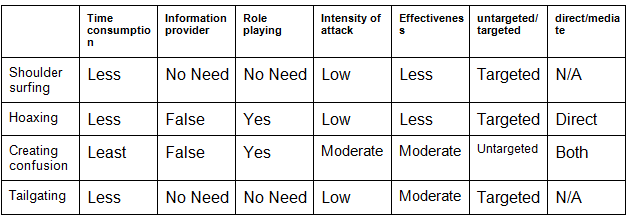
Technology-based social engineering techniques:
Let us discuss four different Technology-based social engineering techniques:
- E-mail attachment: A spy software is sent in the mail which spoofs our computer, and that software sends the confidential data to the attacker. There are various types of attacks usually executed using e-mail attachments, including traditional malware and spyware attacks.
- Phishing: This is a kind of technique in which the attacker creates a fake login web page that looks exactly like a real one, so the target enters credentials through which the attacker can access the info. This technique is often used to track and steal sensitive personal information of all kinds that can somehow cause harm to the owner of the data.
- Spoofing a brand: The process of spoofing a brand is relatively easy but morally corrupt. Here, the attacker usually mimics the website of any big brand and sends fake e-mails randomly using an extension of that brand name. People who are using that brand will eventually enter the confidential data, which, in turn, benefits the attacker.
- Baiting: Baiters may use passing opportunities like lured attractions or the proposal of free movies or music downloads to fool users into handing in their logins.
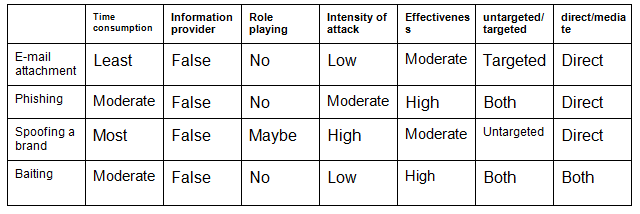
Why InfosecTrain?
We are proud to announce that Infosec train is one of the leading training providers with a pocket-friendly budget! So, if you want to get a good knowledge of social engineering techniques in the context of GDPR training Online, then join us to experience an incredible journey with our industry experts. Our courses are available both in live instructor-led and self-paced sessions, making it easy for you to take up and complete your learning/ training journey at ease! Join InfosecTrain to learn skills that can change your life!
What are the Job prospects after doing CISA?
The CISA(Certified Information System Auditor) certification is recognized globally and primarily focuses on security, audit, and control of the IS(Information Systems). This certification is precious in the field of audit, IT, governance, and risk management.

If you are willing to differentiate yourself from the people from your workplace, then CISA is your only and better option. There are many well-respected certifications within the technology field. CISA certification is one of the top-paying certifications of all time. While government companies are considering hiring auditors, they always prefer CISAs.
In this blog, let us discuss the scope of CISA. There are six main fields recommended after CISA certification they are:
- Internal Auditor: IAs are professionals whose primary duty is to provide objective and independent evaluations of the company’s financial and operational activities. IAs are hired to make sure that organizations follow all the functions and procedures correctly.
- IT audit manager: the primary purpose of an IT audit manager is to make sure that the IT system follows all the practices and policies. They must manage staff, maintain records, evaluate technology and identify controls. Not only do they manage IT systems, but they also act as mentors to the team.
- IT Project Manager: IT project managers primary responsibility is to develop and maintain IT projects at the company's time, cost, and scope. Their duties include setting milestones, communication plans, project plans, and allocating tasks to the team members.
- IT consultant: companies hire IT consultants to understand the business objectives and understand their customers. They are responsible for advising how to use technology, and they also suggest how to achieve the organization’s goals. IT consultants also manage the IT initiatives and collaborate with the in-house Information Technology staff.
- Cyber Security Professional: Cyber Security Professionals are responsible for the security and safety of the companies’ data. The availability of experienced specialists who can undertake the cybersecurity problem is significantly more limited in India, therefore opening many new opportunities for young Indians for a career in the cybersecurity field.
- Chief Information Officer: A CIO(Chief Information Officer) is the company's executive whose primary duty is to implement, use and manage the data and the computer technologies. As technology is developing and globally reshaping industries, the role of the CIO has grown in prevalence and significance.
Why Infosec Train:
Infosec Train designed the CISA certification training program to make it easy and efficient for the students. Teachers in the Infosec Train are experienced industry experts who explain each topic with real-time examples, so don’t waste your time thinking. Just dive in and enroll in the course. Happy Learning!!
Azure Monitor
Azure Monitor assists you in increasing the availability and performance of your apps and services. It is an Azure Cloud service that assists you in improving the performance of your apps and services by collecting, analyzing, and acting on telemetry from your cloud and on-premises settings.
.jpg?timestamp=1626091968469)
- Metrics that monitor the performance are automatically gathered along with logs that indicate the activities in your Azure subscription.
- With a little tweaking, you may gather more thorough logs that provide you with additional insights into the operation of your resources.
- You can find most of this information in the Azure portal's resource menus, or you can navigate to the Azure monitor menu to get a broader collection of capabilities and interact with monitoring data collected across all of your apps and services.
- The Azure Monitor, on the other hand, isn't only for monitoring Azure services, it can collect data from any tier in your application stack.
Uses of Azure Monitor
Azure Monitor can be used for a wide range of purposes, like:
- With Application Insights, you can detect and troubleshoot problems across apps and dependencies.
- You can connect infrastructure concerns to VM and Container information.
- Log Analytics allows you to drill down into your monitoring data for troubleshooting and deep diagnosis.
- Smart warnings and automatic actions help to support large-scale operations.
- Azure dashboards and workbooks may be used to create visualizations.
- Using Azure Monitor Metrics, you can collect data from monitored resources.
How does Azure Monitor operate?
The Azure platform is the source of the data collected by Azure Monitor. This incorporates information regarding the sign-on from Active Directory audit logs, the activity log for service health, and feature modifications for your Azure resources, as well as resource logs and platform metrics that give information on the operation and performance of each resource.
Compute resources, including the virtual machines that support the infrastructure of your application, necessitate the use of an agent to gather logs and performance data from the guest operating system workloads. These virtual machines can be hosted on Azure, another cloud, or even on-premises. An existing system center’s operations manager environment can also be connected.
Use Azure Monitor's application insights feature to gather comprehensive metrics and logs relating to the performance and operation of an application developed in any language in any environment.
If you need to gather data from any REST API client, Azure Monitor offers APIs for that.
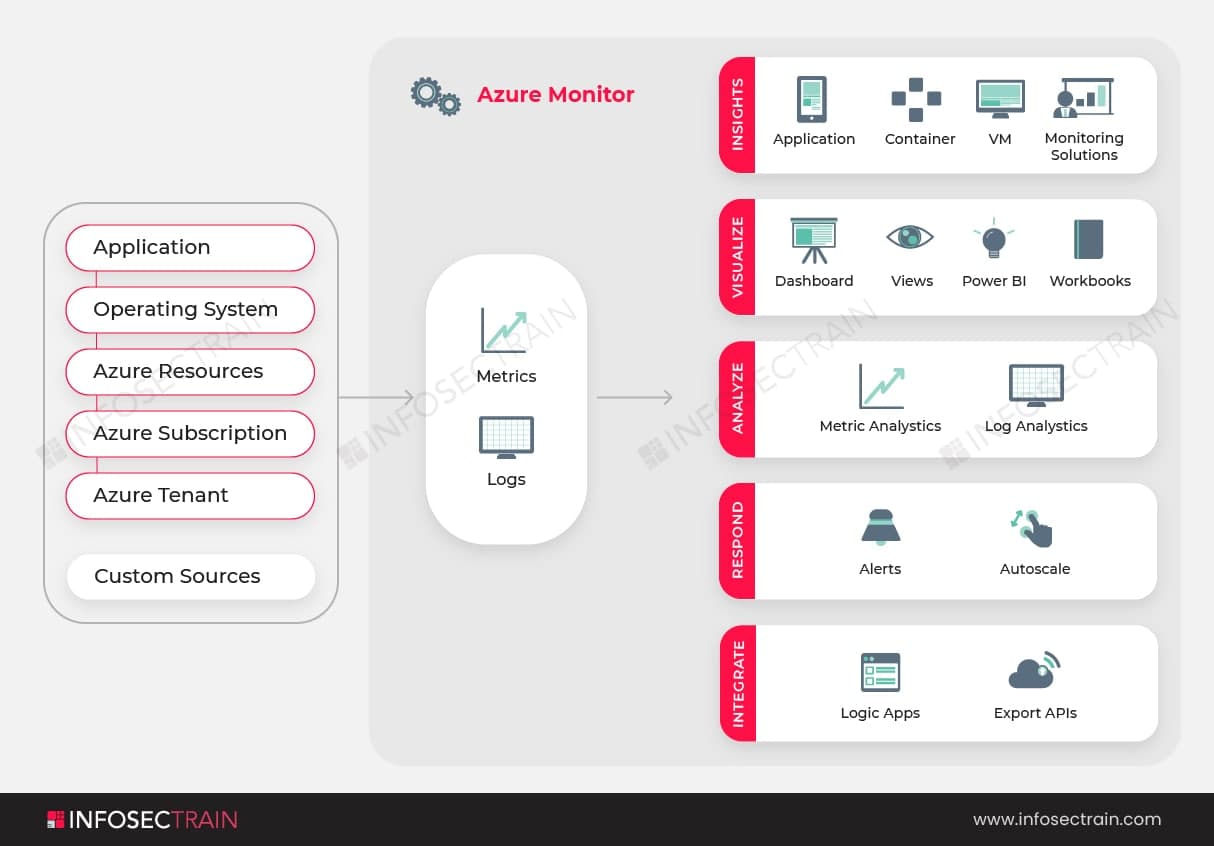
The data stores for metrics and logs, which are the two primary types of data used by Azure Monitor, are located in the center. The sources of monitoring data that feed these data repositories are shown on the left. The many functions that Azure Monitor conducts with this acquired data are shown on the right. This covers tasks like analysis, alerting, and feeding data to external systems.
Azure with InfosecTrain
Several Fortune 500 firms across the world have had excellent success using Azure. Azure specialists are in great demand and well-compensated in the market as a result of their extensive use. You may take the first step towards certification by enrolling in InfosecTrain, an internationally renowned top training source that will expose you to a variety of challenges. Azure training with Infosec Train will help you have a better comprehension of the subject and upskill your knowledge to a proficient level.
7 Reasons Why You Should Pursue CISSP Certification
IT is a dynamic field that has rapidly grown over the last several decades, and IT-related responsibilities such as ensuring business operability and data system security necessitate extensive knowledge, expertise, and maintenance efforts. Companies seeking a competitive advantage require experienced and well-educated IT professionals who have earned the most prestigious and industry-relevant certifications. The Certified Information Systems Security Professional (CISSP) certification is one such credential.

The Certified Information Systems Security Professional (CISSP) offered by (ISC)2 is a prominent certification in the field of information security and cybersecurity. The CISSP certification is for security professionals who create and maintain an organization's security infrastructure. The benefits of career development with CISSP credentials are explored and discussed in this article.
Reasons to Pursue CISSP Certification:
There are seven compelling reasons why the CISSP may be the appropriate certification for you.
1. Certification that is well-known worldwide
CISSP is recognized by businesses and government organizations all around the world, allowing certification holders to broaden the scope of their employment searches and the positions they seek. The CISSP accreditation will be valid no matter where you go.
2. A skillset that is both versatile and powerful
The CISSP certification educates you on how to comprehend cybersecurity from a technical standpoint, as well as what industry best practices are and how to apply them. Employers can rest assured that CISSP holders are well-versed in important facets of more than one field of information security. So, if you are working in one field and wish to move to another, your boss is aware that you won't be beginning from scratch.
3. A stepping stone to lifelong learning
The CISSP certification will not only assist you in exploring various aspects of information security but will also encourage you to continue learning, particularly if you stay up with current cybersecurity trends. CISSP can help you stay ahead of the curve in the area of cybersecurity.
4. Progression in your career
The CISSP credential can help you advance in your profession and open up new doors. Cybersecurity specialists who are adequately equipped and competent to execute the difficult work of defending the cyber environment are in high demand. Additionally, CISSP certification can help you stand out from the crowd.
5. Boosts your earning potential
The CISSP certification is valued and respected by employers, and as a result, it attracts a higher wage. Glassdoor estimates that the national average CISSP wages in the United States are $51,454.
6. Demonstrates years of hands-on expertise with cybersecurity
Candidates must have several years of professional information security experience, commit to a code of ethics, and be endorsed by someone who already holds the certification to acquire the actual certification. Employers recognize that someone with a CISSP certification has more experience in the field of information security than someone who has merely passed an exam as a result of the combination of these criteria.
7. Certification that is independent of the vendor
The CISSP is a vendor-neutral certification, so its value is unaffected by changes in technology or approach at a person's company.
Final Words
CISSP-certified cybersecurity professionals are among the most in-demand security experts on the globe. CISSP certification will open up a world of possibilities for you, providing you with various benefits that you may apply to your career in information security, knowledge, and life. The Certified Information Systems Security Professional (CISSP) training course at InfosecTrain is one of the most comprehensive options for preparing for the CISSP exam. Our training program is designed to give learners the technical and administrative skills they need to design, architect, and manage an organization's security posture using internationally accepted information security standards.
You can also watch the following video to get help in your CISSP certification exam preparation.
What is Identity Security?
IT is becoming more and more complex with each passing year. Organizations continue to expand, resulting in an influx of new employees, each with their own set of requirements. The employees or users are then given access to resources according to their preferences. As much as digital transformation has created new avenues for businesses, it has also left attackers with an open door. Any identity can be used to target an organization's most precious assets now that physical and network barriers have been removed. While cyber-attacks are unavoidable, losses aren't.

What is Digital Identity?
You must first understand identity in order to fully understand identity security. An identity is a user's basic digital information, as well as the credentials that individuals use to access IT resources. Throughout their time with an organization, these related IDs or attributes are recorded and updated, ensuring that permissions and security initiatives are up to date. Email address, login credentials (username/password), pin numbers, and others are examples of attributes.
What is Identity Security?
Identity security, also known as identity governance and identity management, guards against the cyber threats that come along when allowing diverse workforce access to technology. This is accomplished by allowing the management and governance access to all digital identities within an organization. Identity security is a comprehensive solution for safeguarding all of an organization's identities.
Identity security emphasizes both enablement and security- providing access while also ensuring that access is properly controlled. It entails creating user roles and policies to regulate access throughout the lifecycle of a digital identity.
Identity Security is used to securely authenticate, centrally control, and audit how apps, DevOps, and automation tools access databases, cloud environments, and other sensitive resources using secrets and privileged credentials.
What is the Purpose of Identity Security?
Allows Access: Identity Security is used to provide employees and customers with simple, secure access to apps and resources from any device, from any place, and at precisely the right time when they need it.
Keep DevOps Safe: Developer-friendly technologies make it possible for apps and automation tools to access sensitive resources safely using secret and privileged credentials.
Maintain Privilege: Privileged Access Management (PAM) solutions are included in Identity Security platforms to handle a wide range of use cases for securing privileged credentials and secrets on-premises, in the cloud, and everywhere in between.
Importance of Identity Security
Businesses are driven by the desire to quickly introduce new applications and services to link their consumers and workers to their services at any time and in any location. However, providing secure access to approved resources, preventing accidental data loss, guarding against the misuse of credentials and accounts, and protecting user privacy are all necessary to defend your organization. Identity security reduces these risks by enforcing detailed security controls that prevent unauthorized access to important resources and data while allowing trusted users to access data seamlessly.
Sailpoint Identity Security is the most straightforward way to accelerate your digital transformation while lowering risk. Organizations can move forward with confidence knowing their most valuable assets are safe by putting identity at the heart of their security strategy.
What Differentiates Identity Security from Zero Trust?
Zero Trust is a security approach based on the principle of "never trust, always verify," rather than a solution or technology. This method ensures that each user's identity is verified, their devices are validated, and their privileged access is intelligently limited to only what they require – and revoked when they don't. Identity security, as the embodiment of this approach, provides a basic set of technologies and best practices for achieving Zero Trust.
Final Words
The power of identity is delivered to clients all over the world by SailPoint, a pioneer in the management of identity enterprise. SailPoint's open identity platform helps businesses to expand into new markets, scale their workforces, seize new opportunities, move faster, and compete globally. The SailPoint training course at InfosecTrain will assist you to understand identity access management and its security in depth.
About ISO 27001- Internal Audit
Internal Audits must be conducted regularly if your company is to maintain ISO 27001 compliance.
An Internal Audit will ensure that your ISMS (Information Security Management System) continues to fulfill the standard's requirements. Regular audits are helpful because they help you to improve your organization’s structure over time.

What is ISO 27001?
Before starting, it's important to know that ISO/IEC 27001 is the latest version of ISO 27001. ISO/IEC 27001 is a globally recognized standard for information security management. The ISO (International Organization for Standardization) and the IEC (International Electrotechnical Commission) jointly issued the standard. Both are worldwide standards-setting bodies with a strong reputation.
ISO 27001 aimed to help organizations of any level or sector implement an ISMS (Information Security Management System) to secure their information logically and cost-effectively.
ISMS
An ISMS (Information Security Management System) is a set of guidelines that an organization must follow to:
- Identify their stakeholders and what they expect from the organization with respect to information security
- Identify which threats exist for the data
- Achieve the identified requirements and manage risks, develop controls (safeguards) and other mitigation strategies
- Implement all of the controls and other risk-reduction strategies
- Create continuous improvements to enhance the overall performance of the ISMS
Internal Audit
An ISO 27001 Internal Audit requires a detailed analysis of your company's ISMS to ensure that it complies with the Standard's criteria. It is handled by your employees, unlike a certification evaluation.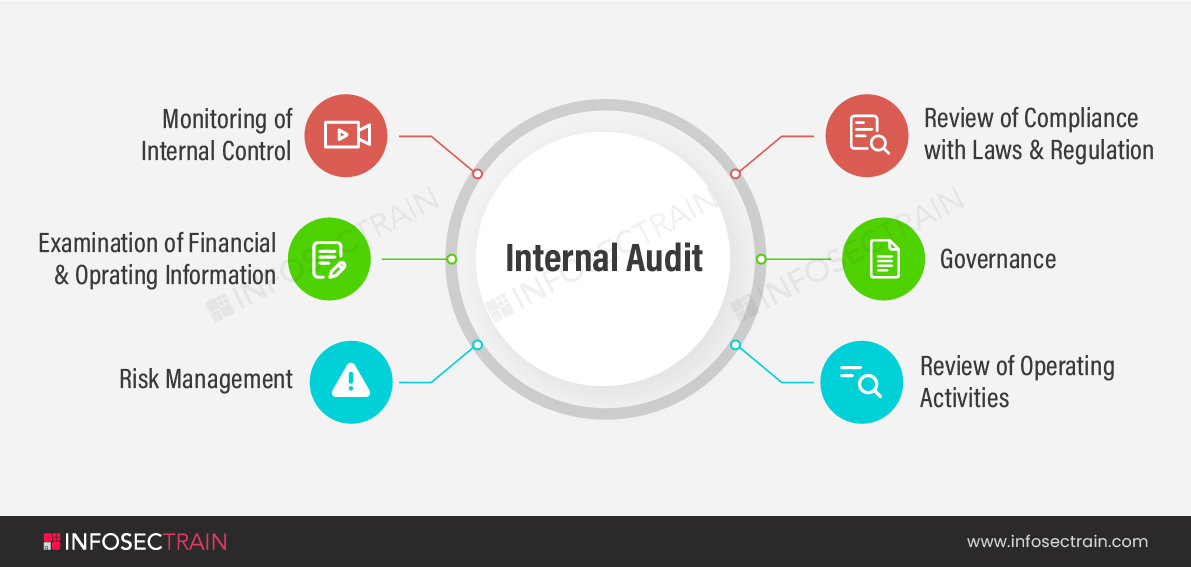
Internal Audits examine a company's internal controls, including financial reporting and accounting procedures. Internal Audits also give management the tools they need to improve operational efficiency by detecting problems and fixing errors before an external audit finds them.
It helps a company in achieving its goals by using a systematic, disciplined approach to evaluating and improving the efficacy of risk management, control, and governance systems.
In simple terms, an Internal Audit is in charge of checking the efficacy of management's internal control processes.
ISO 27001 Audit Plan
We have a five-step checklist for conducting an ISO 27001 Internal Audit that can be followed by companies of any size.
- Reviewing the documents- During the first stage of an Internal Audit, you should review the documentation that was prepared during the deployment of ISMS.
- Management review- You should consult with management before creating an audit plan to determine the audit's time frame and resources.
- Field review- The practical analysis of your organization takes place at this point.
- Speak with front-line staff members to see how the ISMS works in practice
- Validate information as it is acquired using audit tests
- Check ISMS files, printouts, and other important information
- Analysis- The evidence gathered during the audit should be processed and examined in the context of your company's risk treatment plan and control goals.
- Report- Observing and recommending improvements to processes and controls.
ISO 27001 Training with InfosecTrain
InfosecTrain offers ISO 27001 certification training. InfosecTrain is one of the best consulting organizations, focusing on a wide range of IT security training. The training sessions will be delivered by highly qualified and professional trainers with years of industry experience. You can check and enroll in our ISO/IEC 27001 Certification training to prepare for the certification exam.
Tips to Prepare for ECIH Exam
ECIH
ECIH stands for EC-Council Certified Incident Handler which is a certification offered by EC-Council. This course will teach you about the many stages of incident handling and response, such as planning, recording and assignments, triage, notification, containment, evidence gathering and forensic analysis, eradication, recovery, and post-incident activities.

This course is intended to provide individuals and organizations with the following skills:
- Handling and responding to all sorts of cybersecurity issues in a methodical manner
- To make sure that organizations are capable of detecting, containing, and recovering from an attack
- To develop security policies and guarantee that the agreed-upon levels of service quality are maintained
It basically helps you improve the security posture of your organization.
.jpg?timestamp=1624349376565)
Domains in ECIH
- Domain 1: Introduction to Incident Handling and Response (16%)
- Domain 2: Incident Handling and Response Process (14%)
- Domain 3: Forensic Readiness and First Response (13%)
- Domain 4: Handling and Responding to Malware Incidents (8%)
- Domain 5: Handling and Responding to Email Security Incidents (10%)
- Domain 6: Handling and Responding to Network Security Incidents (16%)
- Domain 7: Handling and Responding to Web Application Security Incidents (8%)
- Domain 8: Handling and Responding to Cloud Security Incidents (8%)
- Domain 9: Handling and Responding to Insider Threats (7%)
.jpg?timestamp=1624349194059)
Exam Information
Exam Format: Multiple Choice Questions
No. of Questions: 100
Exam Duration: 3 hours
Passing Score: 70%
Exam Language: English
Registration Fee: $300 USD
How to Pass ECIH?
In order to ace the ECIH exams, you should not only have a good knowledge of incident handling but you must also be adequate at practically handling incidents. You must have a grasp of all the stages of incident handling and response. Here are some of the tips that you can follow if you want the ECIH exam to be a cakewalk for you:
- Always choose a trusted source to understand the full exam structure and subjects.
- It is critical to devise a plan for preparedness. Make sure you're giving enough time to each domain depending on its relevance.
- You can utilize the internet to get study resources. The ECIHvideos are available on our YouTubeaccount.
- You must have a separate study area that is free of distractions.
- Examine the sample papers before taking the test to get a sense of how the questions will be framed.
- Taking pauses at regular intervals can help you to renew your thoughts and remember what you have learned.
- Time is a valuable resource that must be managed carefully. Plan ahead of time so that you have enough time to revise.
- Self-study is a non-negotiable component. If you read the subjects before the training session, you will have a better understanding.
- Maintain a healthy lifestyle to avoid health problems that might jeopardize your ambitions.
- Just like Dorothy completes Jerry in Jerry Maguire, the right training always completes your preparations. Choosing the appropriate training course may make or break your game. InfosecTrain provides Certified Incident Handler v2 (ECIH) trainingprogram.
ECIH with InfosecTrain
ECIH Training from InfosecTrain will expose you to the unique scenarios of Incident Handling. Because we are a major training provider worldwide, our highly qualified trainers with knowledge in the subject build the full action plan. At InfosecTrain, experienced specialists guide you through the process of creating a solid foundation of ECIH in order to upskill your incident handling and response to a skilled level.
How to Prepare for CISM Exam?
What is CISM?
Certified Information Security Manager (CISM) is an advanced-level certification offered by ISACA. ISACA’s Certified Information Security Manager (CISM) certification shows that a candidate has both skill and experience in:
- Information Security Governance
- Program Development and Administration
- Incident Administration
- Risk Management
- Information Technology
- Consultant
ISACA is one of the best organizations in the cybersecurity field.
ISACA’s Certified Information Security Manager (CISM) certification is for those with technical skills, an understanding of IT security, and management. It is also for those who want to become an Information Security Manager.

You can check Infosec Train’s CISM Introduction video to get an overview of CISM and topics covered in CISM.
CISM Preparation
For prospective applicants, CISM seems to be a tough certification to obtain. In addition, there are a few steps that must be followed in order to obtain CISM certification. I've outlined each step for you to get a better idea of how to prepare for the CISM exam.
1. Make a Study Schedule
Make a study schedule and be honest with your career. There are also other factors to remember when making the study plan, such as:
● Which is the most suitable time for you to study
● Which learning method is more effective for you? Some people prefer self-study, whereas others prefer an online classroom to complete the entire syllabus in a specified time.
● Self analyze the topics that require more time to comprehend and ensure that you create a strategy to cover all the topics
2. Read the Most Recent ISACA Exam Guides
● ISACA publishes a new edition of its candidate guide every year. This CISM exam guide contains a lot of practical information for the CISM exam.
● This guide aims to familiarise candidates with what to expect on exam day.
● It includes useful details such as exam domains, numbers of exam questions, exam duration, and languages. Make sure that no participant should attempt the CISM examination without first reading this exam guide.
3. Become a Member of the CISM Exam Study Group
● ISACA sponsors the CISM Exam Study Group, which is open to all candidates for free. It provides for the exchange of test questions, study methods, and exam tips.
● This group is managed by previous top candidates, who are in charge of moderating chat rooms, managing, and even driving conversations.
● It's an excellent resource for preparing for the examination. It helps you to communicate directly with other professionals who will solve our issue.
4. Have a Plan For Exam Day
● First, ensure that you have all the documents needed during the exam in place
● Maintain a cool and fresh state of mind. Mental fatigue is one of the major factors in many candidates' failures.
● Takes the needed planning to arrive at the exam location on schedule. Candidates who arrive late will not be allowed to take the test.
5. Take Practice Test
● One of the most effective ways to study for an exam is to take practice tests.
● This is not a real exam but the form, format, and level of complexity, accurately represent what candidates should expect during the actual exam.
● Candidates may use practice tests to test themselves from anywhere. Understand strong and weak domains with the help of Practice tests.
Instructor-led training with InfosecTrain
Self-study is a good start, but entering a CISM Exam training is a better idea. Organizations such as InfosecTrain address all of the exam preparation needs. InfosecTrain is a leading consulting company that focuses on IT security training and information security services. InfosecTrain provides 40 hrs of best instructor-led training for CISM examination. The ISACA CISM Training Course by InfosecTrain is made to help you succeed in the ISACA CISM exam on your very first attempt.
CompTIA Cybersecurity Analyst (CySA+) Questions
What is CySA+?
CompTIA Cybersecurity Analyst (CySA+) is a certification for IT professionals who use new solutions on devices and networks to prevent, identify, and defeat cybersecurity threats.
CompTIA CySA+ is the only intermediate Cybersecurity Analyst certification that includes both performance-based and multiple-choice questions.
The most common CySA+ questions and answers are listed below. These questions aim to give you details about the CompTIA Cybersecurity Analyst examination.
 Questions.jpg?timestamp=1623326890769) 1. Olivia is thinking about where she could get threat intelligence information that she can use in her protection software. Which of the following outlets is most likely to be free of charge?
1. Olivia is thinking about where she could get threat intelligence information that she can use in her protection software. Which of the following outlets is most likely to be free of charge?
- Vulnerability feeds
- Open source
- Closed source
- Proprietary
Answer B. Open source intelligence is content that is publicly accessible that does not require a membership fee. The terms "closed source" and "proprietary intelligence" are similar, and all require fees to the providers. While vulnerability inputs are classified as threat information, they usually require a membership.
2. Cynthia wants to collect information about the target organization's network assets during the reconnaissance stage of a penetration test without triggering an IPS to alert the target to her information gathering. Which of the following options is better for her?
- Perform a DNS brute-force attack
- Use a Nmap ping sweep
- Perform a DNS zone transfer
- Use a Nmap stealth scan
Answer A. A DNS brute-force attack that queries a list of IPs, standard subdomains, or other lists of targets can always circumvent intrusion detection and prevention mechanisms that don't pay attention to DNS queries, although it might seem strange. Cynthia may also be able to locate a DNS server that isn't secured by the IPS of the company! Cynthia should anticipate Nmap scans to be identified because they are more difficult to mask during reconnaissance. Cynthia shouldn't expect to do a zone switch, and if she does, a properly configured IPS should alert.
3. Charles creates and exchanges threat assessments with specific technologists and leaders as part of his threat intelligence program. What stage of the intelligence cycle are we in right now?
- A. Dissemination
- Feedback
- Collection
- Requirements
Answer A. During the dissemination process of the intelligence cycle, intelligence information is shared with consumers.
4. Fred thinks the malware he's looking at is using a swift flux DNS network, which associates several IP addresses with a single completely eligible domain name and uses multiple download hosts. Based on the NetFlow seen here, how many distinct hosts could he investigate?
Date flow, start, Duration, Proto, Src, IP Addr: Port- Dst IPAddr: Port Packets, Bytes, Flows
2020-07-11 14:39:30.606 0.448 TCP 192.168.2.1:1451- >10.2.3.1:443 10 1510 1
2020-07-11 14:39:30.826 0.448 TCP 10.2.3.1:443- >192.168.2.1:1451 7 360 1
2020-07-11 14:45:32.495 18.492 TCP 10.6.2.4:443->192.168.2.1:1496 5 1107 1
2020-07-11 14:45:32.255 18.888 TCP 192.168.2.1:1496- >10.6.2.4:443 11 1840 1
2020-07-11 14:46:54.983 0.000 TCP 192.168.2.1:1496- >10.6.2.4:443 1 49 1
2020-07-11 16:45:34.764 0.362 TCP 10.6.2.4:443- >192.168.2.1:4292 4 1392 1
2020-07-11 16:45:37.516 0.676 TCP 192.168.2.1:4292- >10.6.2.4:443 4 462 1
2020-07-11 16:46:38.028 0.000 TCP 192.168.2.1:4292- >10.6.2.4:443 2 89 1
2020-07-11 14:45:23.811 0.454 TCP 192.168.2.1:1515- >10.6.2.5:443 4 263 1
2020-07-11 14:45:28.879 1.638 TCP 192.168.2.1:1505- >10.6.2.5:443 18 2932 1
2020-07-11 14:45:29.087 2.288 TCP 10.6.2.5:443- >192.168.2.1:1505 37 48125 1
2020-07-11 14:45:54.027 0.224 TCP 10.6.2.5:443- >192.168.2.1:1515 2 1256 1
2020-07-11 14:45:58.551 4.328 TCP 192.168.2.1:1525- >10.6.2.5:443 10 648 1
2020-07-11 14:45:58.759 0.920 TCP 10.6.2.5:443- >192.168.2.1:1525 12 15792 1
2020-07-11 14:46:32.227 14.796 TCP 192.168.2.1:1525- >10.8.2.5:443 31 1700 1
2020-07-11 14:46:52.983 0.000 TCP 192.168.2.1:1505- >10.8.2.5:443 1 40 1
- 1
- 3
- 4
- 5
Answer C. From 192.168.2.1, four different hosts are accessed in this flow review. 10.2.3.1, 10.6.2.4, 10.6.2.5, and 10.8.2.5 are the addresses.
5. Mia wants to be sure that the architecture of a new ERP program in progress is reviewed by her company's cybersecurity department. Mia should consider the security architecture to be completed during which phase of the SDLC?
- Analysis and Requirements Definition
- Design
- Development
- Testing and Integration
Answer B. Security architecture and data flow diagram completed during the Design phase.
6. Mika needs to use service discovery and run a Nmap scan that covers all TCP ports. Which of the Nmap commands would she need to run?
- nmap -p0 -all -SC
- nmap -p 1-32768 -sVS
- nmap -p 1-65535 -sV -sS
- nmap -all -sVS
Answer C. Using an SYN scan (-sS) you will scan the entire TCP port range (1-65535) and declare the maximum list of potential ports. The -sV flag is used to allow service version recognition.
7. The following are the results of a port scan performed during a security review. What kind of device has been scanned most probably?
Example of a Nmap scan report (192.168.1.79)
Host is up (1.00s latency)
Not shown: 992 closed ports
PORT STATE
21/tcp open
23/tcp open
80/tcp open
280/tcp open
443/tcp open
515/tcp open
631/tcp open
9100/tcp open
Nmap done: 1 IP address (1 host up) scanned in 124.20 seconds
- A wireless access point
- A server
- A printer
- A switch
Answer C. In the fact that TCP ports 21, 23, 80, and 443 are both commonly used, 515 and 9100 are often associated with printers.
8. Brooke wants to find a technology platform that automates workflows through a range of security technologies, including automatic security incident response. Which tool category best fits this requirement?
- SIEM
- NIPS
- SOAR
- DLP
Answer C. While all of these tools can have some security automation, the aim of a SOAR (security orchestration, automation, and response) platform is to automate security through multiple solutions.
9. What team participates in offensive activities intended to breach security controls during a security exercise?
- Black team
- Red team
- Blue team
- White team
Answer B. The red team is in charge of offensive operations during a security exercise. The blue unit is in charge of defensive activities. The white team was assigned as a referee. There is no such thing as a black team.
10. Which of the following ISO standards advices about how to build and implement information security management systems?
- ISO 27001
- ISO 9000
- ISO 11120
- ISO 23270
Answer A. Information security management systems are covered by ISO 27001. Quality management is covered by ISO 9000. Gas cylinders are covered by ISO 11120. Programming languages are provided by ISO 23270.
Conclusion
InfosecTrain is a leading provider of IT security training. We provide a complete CompTIA CySA+ certification training program. If you need the help of professionals to pass the CompTIA CySA+ certification exam, check out our CySA+ Certification Training Course. Our course will help you learn how to cover complex persistent threats and how to configure and use threat-detection tools quickly and effectively.
CHFI v9 Benefits and Career Progression
Organizations either small or big, all are facing threats from hackers who steal confidential data with the intent to harm the organization. As the organization tries to maintain its confidentiality, they acknowledge the necessity of a talented person who has knowledge of hacking and internet security. These roles are performed by the Computer Hacking Forensics Investigators (CHFIs).

They analyze the system and gather digital evidence for prosecution. As they are certified individuals, they have the skills to analyze highly complicated digital evidence to uncover and document evidence against cyber offenders.
CHFI v9 Course Description
ComputerHacking Forensic Investigator (CHFI v9) is a vendor-neutral training certification course offered by EC-Council. It provides the necessary skills set for the identification of intruders, footprinting, and evidence gathering for prosecution. CHFI v9 detects the attacks and gathers the evidence to report the crime and conduct audits to prevent future attacks.
Due to the digitalization of business nowadays, preventing cyber attacks, investigating malicious attacks, and hacking incidents has become the most challenging task.
CHFI v9 certification allows cyber investigators to detect incidents such as compromised data, confidentiality lost data, trade secret thefts, and any digital frauds.
Exam Details
Exam Name: 312-49 (ECC EXAM)
Exam Format: Multiple-choice questions
Number of Questions: 150
Exam Duration: 4 Hours
What's New in CHFI v9?
- It consists of 14 comprehensive modules and has 39 labs
- It has over 40% new labs added
- Over 400 updated tools
- More practical knowledge
- New eye-catching graphics
- Coverage of latest operating systems
- Updated patch management and testing environment
- Well tested, result-oriented, descriptive, and analytical lab manual to evaluate the presented concepts
- Diagrammatic representation of concepts with example
After completion of the CHFI certification course one will have knowledge of:
- Cracking password
- Investigating reports
- Setting up method of the forensics lab
- Recovering methods of any deleted files
- Role of the first responder securing & evaluating an electronic crime scene
Benefits of Hiring Certified CHFI:
- Organizations today, either small or big, all are facing a common enemy: hackers or malicious intruders, who try to gain the confidential data of the organization for their benefit. So, in this case, hiring an individual who possesses knowledge of internet security and hacking can help the organization to maintain their confidentiality.
- Certified CHFI analyzes and gathers the digital evidence to present in the court of law.
- Certified CHFI has those skills and know-how to analyze highly complicated cyber evidence.
Career Opportunities After CHFI Certified
CHFI Professionals are in high demand across the industries. They are hired not only by IT Sectors and IT Security organization but also by different fields like:
- Law Enforcement
- Defence
- Military
- Legal Practice
- Bank
- Insurance Organization
CHFI Certification is the validation of your skills and knowledge. They gather the required evidence of theft to present in the court of law.
The CHFI v9 training and certification courses give various career options. Certified CHFI professional can pursue the following roles:
- Computer Forensics Analyst
- Information Security Analyst
- Malware Analyst
- Ethical Hacker
- Penetration Tester
- Network Forensic Examiner
- Forensic Analyst and Technician
- Digital Forensic Examiner
- Computer Network Defence (CND) Forensic Analyst
Salary of Certified CHFI Professionals
The starting salary in this field starts from $85,000 which rises up to $120,000. Experienced candidates in the same field over 5 years can expect higher salary packages.
Mean annual wage for CHFIs certification holders:
- LPT: Licensed Penetration Tester: $86,000
- CHFI: Computer Hacking Forensic Investigator: $88,000
- CEH: Certified Ethical Hacker: $90,000
- ENSA: Network Security Administrator: $92,000
- ECSA: Certified Security Analyst: $92,000
Why Should One Join CHFI v9 Certification Training?
One might wonder, "Why get a certification if I have the skillset to perform the task?" Well, certification is the validation of your skills and knowledge. You may gain hands-on knowledge, however, certification provides you a structured way of learning and fills in gaps from the hands-on experience. Any organization prefers certified candidates.
So getting training and certification from a leading organization like Infosec Train will definitely boost up your career.
Infosec Train provides world class quality training for CHFIv9. Our trainers are skilled professionals with years of industry experience. Check our CHFI v9 Training Course today and take the first step to progress in your career!
https://www.infosectrain.com/courses/chfi-v9-certification-training/
Essential Skills for Microsoft Azure Administrators
Microsoft Azure Administrators
Cloud computing is one of the most rapidly evolving technologies of our time. Nobody can deny that cloud computing has exploded in popularity in recent years. Microsoft Azure is a major player in the cloud industry, accounting for 29% of server workload in the overall cloud market. The Administrator job role is at the top of the list of the most common jobs associated with Azure.
An Azure Administrator is in charge of implementing, controlling, and managing Microsoft Azure solutions, such as major compute, storage, network, and security services. An Azure Administrator is usually part of a broader team that is responsible for implementing a company's cloud infrastructure. This role also requires knowledge of PowerShell, Azure CLI, Azure portal, and Azure Resource Manager templates.
Top Essential Skills for Microsoft Azure Administrator
An Azure Administrator must have a thorough understanding of the skills required to manage a Microsoft Azure-based cloud infrastructure, which includes:
.jpg?timestamp=1623153988637)
Manage Microsoft Azure Compute
The Azure Administrator is most often associated with Infrastructure-as-a-Service (IaaS), which essentially translates to cloud-based virtual machines (VMs). The job description for an Azure Administrator usually entails operating virtual machines in the cloud. As a result, if you want to be an Azure Administrator, you should be familiar with leading hypervisor platforms like Microsoft Hyper-V.
Containers are a modern approach to service virtualization, and container orchestration systems are important for container management. Azure Administrator must understand how to deploy, handle, and track both standalone containers and containers operated by an orchestrator such as Kubernetes to better serve the developers in their workplace.
Azure Administrators should also be able to use Azure Resource Manager to install virtual machines, Desired State Configuration to automate configuration changes and policies to backup virtual machines. Auto-scaling and high availability must also be configured.
Manage Microsoft Azure Storage
Storage solutions for virtual hard discs, database files, user data, and device data must all be managed by Azure administrators. Blobs (Containers), File Shares, Tables (structured storage), and Queues are all the Azure storage services. As a result, Azure Administrators must become proficient in the use of cloud storage, which provides a set of highly scalable, secure, performant, and cost-effective foundations on which all your company’s applications operate.
In addition to ensuring organizational compliance, Azure Administrator should be able to configure long-term archival storage.
Configure and Manage Microsoft Azure Network
In the cloud, you'll need to know how networking, databases, applications, and servers operate at a fundamental level. Azure Administrators should be able to link different virtual networks using network gateways and VNet peering, secure VNets using network security groups, and configure public and private DNS zones for the name resolution process.
In addition, Azure Administrators should be able to use Azure load balancer to spread a load of any application across several virtual machines, Network Watcher to control virtual networks, and ExpressRoute and the VPN gateway to link the Azure network to your company's on-premises network.
Manage Identities
Microsoft's Azure Active Directory (AD) is a managed directory service. The procedure for adding users and groups to the directory must be understood by Azure Administrator. Multi-factor authentication and synchronizing the AD accessible on-premises with Azure Active Directory are two other features of Azure AD that Azure Administrator should become familiar with.
Manage Microsoft Azure Security
Since the company's proprietary data is stored on someone else's infrastructure, the security stakes are high in the Azure public cloud. Azure Administrators must be capable of both protecting data and backing it up against unauthorized access. Azure Administrators should also check that data backups are suitable for reconstruction in the event of a disaster.
Furthermore, an Azure Administrator should be able to encrypt data in the rest, usage, and transit states. Security of Azure Active Directory accounts and reducing attack vulnerabilities in Azure resources are two other essential skills.
Why Microsoft Azure Administrator with InfosecTrain?
InfosecTrain is a leading provider of security and technology training and consulting services, specializing in a wide variety of IT security training and information security services. To prepare for a lucrative career as an Azure Administrator, you can check out and enroll in our Azure Administrator AZ-104 Certification Training course. Our training will assist you in gaining a better understanding of the subject. The course includes Instructor-led training, official courseware, a blended learning delivery model, preparation for interview questions, an online exam engine, and learning from industry experts.
CDPSE: Certified Data Privacy Solutions Engineer
CDPSE stands for Certified Data Privacy Solutions Engineer, and it is one of the newest certifications introduced by ISACA. CDPSE imposes a technology professional's ability to implement privacy by design, resulting in privacy technology platforms and advance data privacy. CDPSE also assesses a Data Analyst or Data Scientist's ability to maintain the data lifecycle and guide technologists on privacy compliance and the most reliable data practices. CDPSE allows Data Scientists and Privacy Technologists with common language and data science methodologies to enhance the user experience while maintaining the privacy and retaining trust. In addition, CDPSE holders have the validated expertise to ensure that privacy solutions mitigate risks of noncompliance.
What is the benefit of CDPSE certification?
In this Data Privacy Solutions Engineer certification course, the candidate will be learning how to create privacy solutions and be accountable for your business' privacy policies to support its unlimited growth. Participants will also learn the needed technical skill set of privacy-enhanced designs to build a common understanding of the best methods throughout your organization. CDPSE certification explains how to implement privacy impact assessment, strategies against threats, attacks, and vulnerabilities related to privacy such as encryption, hashing, data inventory, and classification like tagging, tracking, and SOR.
CDPSE certification Domains:
Domain 1: Privacy Governance 34%
The first domain carries 34% weightage in the exam and explains Governance, Management, and Risk Management.
Governance
- Personal Data and Information
- Privacy Laws and Standards across Jurisdictions
- Privacy Documentation (e.g., Policies, Guidelines)
- Legal Purpose, Consent, and Legitimate Interest
- Data Subject Rights
Management
- Roles and Responsibilities related to Data
- Privacy Training and Awareness
- Vendor and Third-Party Management
- Audit Process
- Privacy Incident Management
Risk Management
- Risk Management Process
- Privacy Impact Assessment (PIA)
- Threats, Attacks, and Vulnerabilities related to privacy
Domain 2: Privacy Architecture 36%
The second domain carries 36% weightage in the exam and explains Infrastructure, applications and Software, Technical Privacy Controls.
Infrastructure
- Technology Stacks
- Cloud-based Services
- Endpoints
- Remote Access
- System Hardening
Applications and Software
- Secure Development Lifecycle (e.g., Privacy by Design)
- Applications and Software Hardening
- APIs and Services
- Tracking Technologies
Technical Privacy Controls
- Communication and Transport Protocols
- Encryption, Hashing, and De-identification
- Key Management
- Monitoring and Logging
- Identity and Access Management
Domain 3: Data Cycle 30%
The second domain carries 30% weightage in the exam and describes Data Purpose and Data Persistence.
Data Purpose
- Data Inventory and Classification (e.g., Tagging, Tracking, SOR)
- Data Quality and Accuracy
- Dataflow and Usage Diagrams
- Data Use Limitation
- Data Analytics (e.g., Aggregation, AI, Machine Learning, Big Data)
Data Persistence
- Data Minimization (e.g., De-identification, Anonymization)
- Data Migration
- Data Storage
- Data Warehousing (e.g., Data Lake)
- Data Retention and Archiving
- Data Destruction
CDPSE Certification Exam Details:
Duration : 210 minutes
Number of questions: 120
Format: Multiple Choice
Language: English
CDPSE certification Prerequisites
- A candidate should have at least three years of experience in the CDPSE domains mentioned above
- CISA, CISM, CGEIT, CRISC, CSX-P certification is recommended
Who should attend CDPSE Certification Training?
The CDPSE certification is for those who are involved in creating and implementing technical privacy solutions. This is also for Data Scientists or Analysts who analyze the data. The following job roles can attend the CDPSE certification training.
- Consultant
- Data Analyst
- Data Scientist
- IS Engineer User Data Protection
- Domain Architect Legal Care/Compliance/Privacy
- IT Project Manager
How can Infosec Train help you?
Many organizations are looking forward to hiring a certified CDPSE candidate to protect their crucial information assets from unauthorized users. Infosec Train is an IT security training provider offering a comprehensive training program for CDPSE certification. If you want to learn CDPSE, you can check out Infosec Train’s CDPSE certification Training at the below link:
https://www.infosectrain.com/courses/cdpse-certification-training/
Why Should You Opt For ISO/IEC 27001 Lead Implementer Training?

What is ISO/IEC 27001?
- A set of normative requirements for the establishment, implementation, operation, monitoring, and review of an information security management system (ISMS)
- A set of requirements for selecting security controls tailored to the needs of each organization based on industry best practices
- An internationally recognized process, defined and structured to manage information security
- An international standard that fits all types of organizations, regardless of their size or sector in which they operate (e.g., commercial enterprises, government agencies, nonprofit organizations)
About ISO/IEC 27001 Lead Implementer Training:
The training course is produced to help the participants gain or enhance their competency to implement an information security management system (ISMS). From an educational perspective, competency consists of the following three elements:
This training course gives a comprehensive methodology for implementing the ISMS based on ISO/IEC 27001 requirements, not merely a list of ISO/IEC 27001 requirements. Therefore, general knowledge of information security management concepts is required to complete the training course successfully.
Learning Objective:
- Gain a complete understanding of the concepts, strategies, methods, and techniques used to execute effective management
- Recognize the correlation between ISO/IEC 27001, ISO/IEC 27002, and other standards and regulatory frameworks
- Explain the operation of an Information Security Management System and its processes based on ISO/IEC 27001
- Learn how to evaluate and implement the requirements of ISO/IEC 27001 in the particular context of an organization
- Obtain the required knowledge to support an organization in effectively planning, implementing, managing, monitoring, and maintaining an ISMS
Why Should You Opt?
- Qualify yourself to manage an ISMS project
- Achieve a independent recognition of your personal competencies
- According to salary surveys conducted over the last five years, certified implementers earn considerably higher average salaries than their non certified counterparts
How to Become a Certified ISO/IEC 27001 Lead Implementer?
InfosecTrain is one of the leading IT security training providers. We offer a comprehensive training program for ISO/IEC 270001 Lead Implementer. If you want to take the expert's help in getting through the ISO/IEC 27001 certification exam, check this ISO/IEC 27001 certification training course offered by Infosec Train.
How Earning The SSCP Certification Helps Your Career
SSCP Exam
The SSCP (System Security Certified Practitioner) credential is ideal for those having hands-on operational IT positions who have demonstrated technical expertise and realistic security knowledge. The SSCP certification validates that you have the advanced technical skills and expertise needed to implement, track, and administer IT infrastructure using (ISC)2's security best practices, policies, and procedures.

SSCP is a vendor-neutral, entry-level credential for those looking to establish their first foothold in the information security sector. SSCP credential helps IT security professionals advance in their careers or enable technically inclined people from other IT fields to break into security. Candidates need to pass the SSCP exam to obtain this credential and must have at least one year of work experience in one or more of the ISC2 SSCP Common Body of Knowledge's seven domains (CBK).
Why SSCP?
The biggest challenge for top businesses and government agencies is finding enough people with the right security skills to fulfill their demands due to the alarming rate of cybercrime. Earning an internationally recognized advanced security administration and operations credential, such as the SSCP, is a perfect way to advance your career while also enhancing the security of your company's sensitive assets. For several people in the organization, the SSCP offers a strong base of understanding of information security principles and problems.
The field of cybersecurity is rapidly expanding, with no signs of slowing. The number of job openings in the cybersecurity industry appears to be limitless. From technology and manufacturing to supermarkets, airlines, and shipping, to financial services and healthcare, as well as the government and federal industries, all are looking for qualified security personnel. When it comes to the recruitment process, a candidate's skill set is a plus. Hiring managers are looking for experts who have a solid understanding of the technical aspects of cybersecurity because they would be the ones to put the different security measures in place. The SSCP credential will help you advance in your career and open up new opportunities.
The depth and breadth of information security topics covered during the SSCP certification process will equip a professional to communicate confidently about emerging security trends and risks in the industry, as well as how such security issues affect business partners and clients. In terms of visibility, marketability, reputation, and credibility, having an SSCP certification makes a significant difference. The most noticeable benefit of the SSCP credential is the opportunity for higher earnings. Finally, obtaining the SSCP credential lays the groundwork for ongoing cybersecurity professional growth.
SSCP Career Opportunities
After receiving the SSCP qualification, you will have a plethora of career options. Some of the job roles are mentioned below:
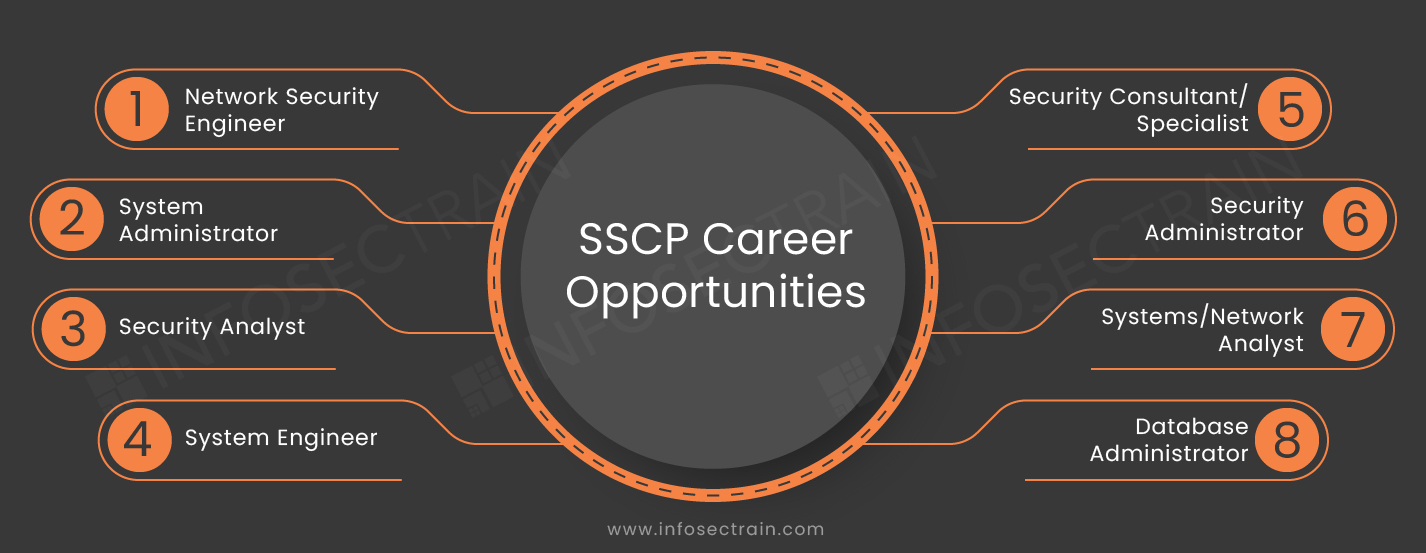
Network Security Engineer: A Network Security Engineer guards systems against cyber threats such as bugs, malware, and hacking attempts. They are in charge of provisioning, implementation, configuration, and administration of a variety of network and security hardware and software.
System Administrator: System Administrator is in charge of maintaining, configuring, and ensuring the safe and reliable operation of computer systems, especially multi-user computers.
Security Analyst: Security Analyst is crucial for ensuring the confidentiality of an organization's proprietary and sensitive data.
System Engineer: A Systems Engineer is responsible for designing, implementing, and maintaining the infrastructure required to run conventional client/server platforms, mainframes, and web applications.
Security Consultant/Specialist: Security Consultants evaluate all security measures for their own organization or for clients. Security Specialists are in charge of preventing unauthorized access to an organization's data and dealing with data breaches.
Security Administrator: Installing, managing, and troubleshooting security solutions are usually the responsibilities of Security Administrators.
System/Network Analyst: Analyzing network requirements, setting up computer networks in one or more locations, and configuring computer hardware and software for optimum network connectivity are a few of the responsibilities.
Database Administrator: Database Administrators are responsible for ensuring that databases operate smoothly. Capacity planning, installation, setup, database design, migration, performance monitoring, security, troubleshooting, and backup and data recovery are all possible roles of Data Administrator.
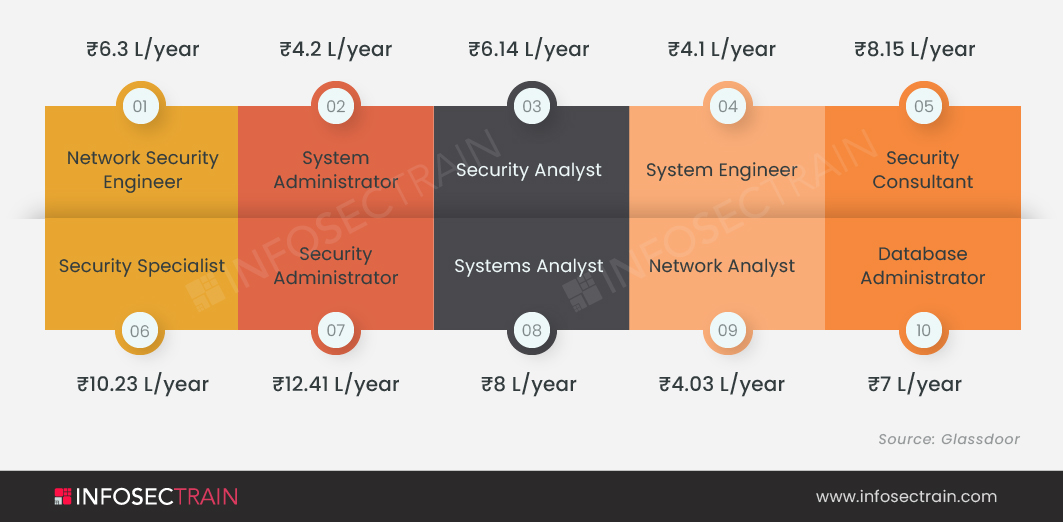
SSCP with InfosecTrain
Check out the SSCP training course offered by InfosecTrain. We are one of the leading IT security training providers. Earn the renowned ISC2 credentials with the help of our highly qualified and trained instructors. You will be able to implement, monitor, and administer IT infrastructure in compliance with information security policies and procedures to ensure data confidentiality, privacy, and availability once you have completed the course.
CompTIA Cloud+ Certification Benefits
CompTIA Cloud+ Certification
Cloud computing is bringing about a paradigm shift by allowing IT administrators to handle infrastructure as a single layer from which they can provide services to users more quickly and cost-effectively.
CompTIA Cloud+ validates that you have the knowledge and expertise to maintain and leverage cloud infrastructure resources. Cloud+ verifies what is needed to work efficiently in data center jobs by covering the increased diversity of knowledge, skills, and abilities expected of system administrators. It's the only vendor-neutral, performance-based credential that can help you maximize the value of cloud infrastructure services. Before taking the exam, you should preferably have at least two years of experience in system and network administration.
Who is the best candidate for the exam?
The CompTIA Cloud+ certification is for IT professionals who want to learn about the principles behind some of the key technologies that power today's cloud solutions and are needed for deploying, configuring, and managing private, public, hybrid, and multi-cloud solutions. Furthermore, the CompTIA Cloud + certification is relevant to the following professionals:
- System Administrator
- Systems Engineer
- Network Engineer
- Network Administrator
- Cloud Engineer
- Cloud Developer
- Project Manager, Cloud
Benefits of CompTIA Cloud+ Certification
The "cloud" has become an inextricable part of today's business world. Businesses all over the globe use cloud-based services such as Platform-as-a-Service (PaaS), Software-as-a-Service (SaaS), and Infrastructure-as-a-Service (IaaS). These cloud services allow businesses to grow their capabilities while reducing capital and labor costs associated with implementing new technologies. Building the right cloud infrastructure, as well as maintaining and supporting it effectively, requires specialized expertise. This is why IT professionals and recruiters are increasingly looking for cloud credentials like the CompTIA Cloud+. Daily, the position of the cloud professional expands. There seems to be no limit to the growth potential.
Progression in your career
Almost every job posting you come across will ask for or require certification. Obtaining Cloud+ certifications is one of the best ways to complement your current expertise and experience. The CompTIA Cloud+ certification will assist businesses in evaluating who is qualified to meet their cloud needs. The CompTIA Cloud+ certification will help you get where you want to be, whether you're just getting started with cloud computing or you're ready to advance in your IT career.
Strong Base
CompTIA Cloud+ also helps you understand networking principles and security factors in addition to cloud knowledge and information. As a result, a thorough understanding of CompTIA cloud+ would undoubtedly aid in the enhanced implementation of cloud infrastructure services.
Salary boost
It's also the most effective way to increase your career prospects and earnings. The Cloud+ certified professionals typically earn much more than the average. Employers are motivated to give top salaries to such applicants due to a scarcity of talent to fill such positions.
Enhance Self Confidence
The ability to gain a deeper, better, and wider understanding of cloud technology, problems, and solutions leads to increased confidence. The satisfaction of completing the CompTIA Cloud+ certification and being recognized as a cloud-certified professional would undoubtedly improve your self-confidence.
Since the certificate is vendor-neutral, it will enable you to work in a variety of cloud computing jobs. IT practitioners almost universally affirm their knowledge of a single vendor's product through certifications. CompTIA's goal was to bridge the gap in cloud skills by addressing advanced cloud skills within the context of larger IT systems.
CompTIA Cloud+ with InfosecTrain
The CompTIA Cloud+ certification training course is a technical training program by InfosecTrain designed to accredit IT professionals responsible for cloud computing technology deployment and maintenance. InfosecTrain is a world-renowned security and technology training and consulting firm. The course is led by highly qualified and experienced trainers.
All You Need to Know About SSCP
SSCP
The Systems Security Certified Practitioner (SSCP) certification verifies that you have the advanced technological skills and expertise needed to implement, monitor, and administer IT infrastructure while adhering to security practices, policies, and procedures. (ISC)2 offers the SSCP exam. The (ISC)2 is a non-profit community organization dedicated to encouraging a safe and secure cyber environment.
The SSCP is designed for IT Administrators, Managers, Executives, and Network Security Professionals who are responsible for the operational security of their organization's sensitive assets, such as Network Security Engineers, Security Analysts, Security Administrators, System Engineers, Security Consultants or Specialists, or Database Administrators.
To be eligible for the SSCP, you must pass the exam and have one year of expertise in one of the seven SSCP CBK domains in information systems security.
SSCP Domain Information
The credential covers seven domains in the Common Body of Knowledge (CBK), ensuring that you have the specialized knowledge and abilities needed to succeed in an IT Security position.
- Domain 1: Access Controls
- Domain 2: Security Operations and Administration
- Domain 3: Risk Identification, Monitoring, and Analysis
- Domain 4: Incident Response and Recovery
- Domain 5: Cryptography
- Domain 6: Network and Communications Security
- Domain 7: Systems and Application Security
The SSCP credential exam will be based on a new exam outline from November 1, 2021.
Exam Details
Exam Duration: 3 hours
Number of Questions: 125
Exam Format: Multiple-choice questions
Passing Score: 700 out of 1000 points
Languages: English, Japanese and Brazilian Portuguese
Testing Center: Pearson VUE Testing Center
The Benefits of SSCP
Earning a globally recognized specialized security administration and operations credential, such as the SSCP, is an excellent way to advance your career while also improving the security of your organization's sensitive assets. The most noticeable advantage of the SCCP credential is the opportunity for improved earnings.
How to Pass the SSCP Exam?
It's never been easier to get ready for the SSCP Certification Exam. Candidates preparing for the SSCP exam to gain professional certification often put in a lot of time and effort to obtain good results. The basic preparation tips are listed below:
- Create a study plan: This will help you stay on track and ensure that you have sufficient time to cover all of the important topics. It is not a good plan for success to learn anything at the last minute.
- Know your exam: Before you begin studying for the SSCP exam, the first thing to do is to learn all the details about it. To get a general understanding of the exam format, you can always consult an Exam manual or other reference materials, and the official video.
- Instructor-led training: Training not only fully prepares you for the exam, but also teaches you how to apply what you've learned in the future. Choosing an appropriate training course is critical to your preparations. Check out InfosecTrain’s SSCP Training.
- Videos and online study materials: You can use the internet to access a variety of study materials and videos.
- Practice: Practice broadens your knowledge and familiarity with the subject. It bolsters your strengths while also assisting you in recognizing your weaknesses.
Resources to Prepare you for the SSCP Certification
SSCP Exam Guide: The Official (ISC)2 SSCP Study Guide will assist you in preparing for the exam if you're hunting for an SSCP book. The Ultimate Guide to the SSCP covers everything you need to know about the certification for IT professionals.
SSCP Practice Test: Use the Official (ISC)2 SSCP Practice Tests to determine your exam readiness and prepare for your exam day. You can get it at https://www.isc2.org/Training/Self-Study-Resources
SSCP with InfosecTrain
To gain professional knowledge and a thorough understanding of the subject, enroll in an SSCP training course at InfosecTrain. InfosecTrain is one of the most reputable training providers, with highly qualified and experienced instructors. Any cybersecurity certification exam may be difficult to prepare for, so don't be afraid to seek assistance.
How to Prepare for the CRISC Exam?
ISACA’s Certified in Risk and Information Systems Control (CRISC) certification indicates expertise in identifying and managing enterprise IT risk and implementing and maintaining information systems controls. ISACA offers this credential to verify an individual's expertise and experience in identifying, evaluating, managing, and reducing different risks. It adequately prepares the employee for interactions with the organization's regulators, stakeholders, or peers.
The credential holder may efficiently engage in the company's risk management and plan the best approach for Information Security Control with his or her knowledge. The CIO Magazine believes that the CRISC exam is among the leading GRC certifications and the most comprehensive method for assessing the IT professionals in order to evaluate their risk management skills.
Why CRISC?
CRISC is an internationally recognized qualification that comes with several advantages that should be considered before taking the test. The following are the main advantages that this credential holder would receive:
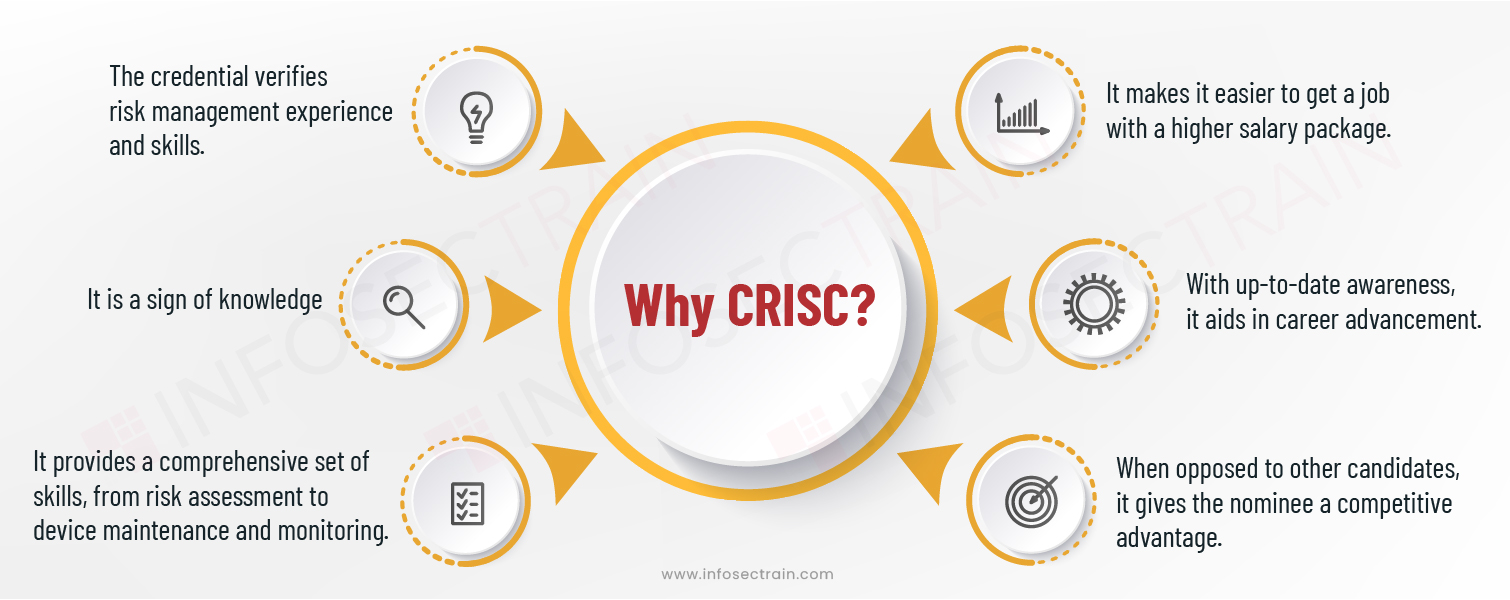
Exam Details
Exam Format: Multiple Choice Questions
Exam Duration: 4 hours
Number of Questions: 150
Passing Score: 450 out of 800
Exam Language: English, French, German, Hebrew, Italian, Japanese, Korean, Spanish, Turkish, and Chinese
Domains of CRISC Certification Exam
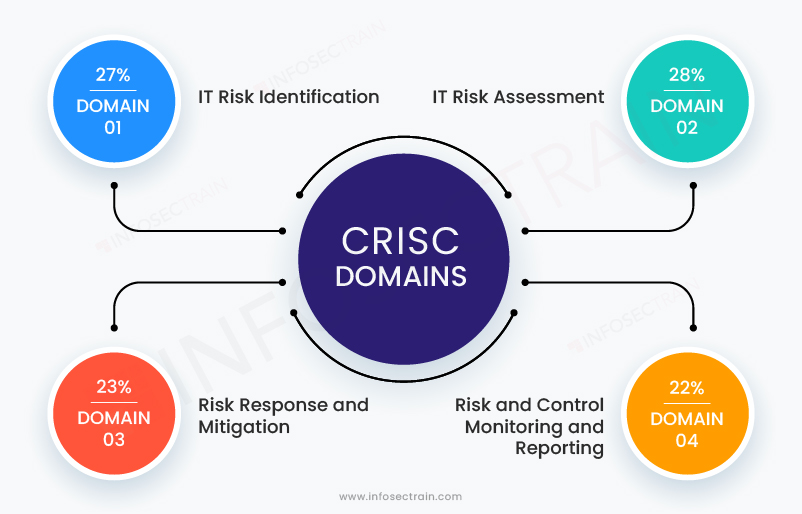
Preparing for CRISC Exam
CRISC certification is unquestionably the next big thing. Here are few pointers to help you ace this certification exam in the first go:
- To learn the entire exam format and the topics, always refer to a reliable source.
- It is essential to develop a preparation strategy. Make sure you're allocating the appropriate amount of time to each domain based on its importance.
- You can use the study materials that are available on the internet. You can check out the CRISC videos on our YouTube
- You must have a dedicated space for studying that doesn't have any distractions.
- Before taking the test, look over the sample papers and get a picture of how the questions will be structured.
- Taking breaks at regular intervals will refresh your mind and assist you in retaining what you have learned.
- Time is a precious resource that must be effectively handled. Make your plans ahead of time, so you get proper time to revise.
- Self-study is an essential component. You can better understand the subject if you read the topics before the training session.
- Maintain a safe lifestyle to prevent any health issues that might jeopardize your plans.
- Choosing the right training course can significantly change the game. InfosecTrain offers a Certified in Risk and Information Systems Control (CRISC) training program.
CRISC with InfosecTrain
To Gain instant recognition and credibility with CRISC and boost your career,you can opt for the Certified in Risk and Information Systems Control (CRISC). It will provide professional knowledge and an in-depth understanding of Risk and Information Systems. We are one of the leading training providers with our well-read and experienced trainers. This certification will indeed merit each penny and minute that you will invest.
Introduction of CTF Training (Capture The Flag)
About CTF Training
Capture the Flag (CTF) Training from InfosecTrain focuses on improving a professional's knowledge of Pentesting and providing practical experience to help them improve their skill set. This preparation ensures that problem-solving skills are polished and that important hands-on experience is provided at the appropriate level of pressure so that candidates get a sense of a real-life situation.
.jpg?timestamp=1621252827841)
CTF is a simulated training that uses a scenario to give people hands-on experience in a realistic cyber-fight. It is based on a military formula. The purpose is to capture the flag. The trainee is expected to search for it and find flags that the training's developers have hidden in the system. The simulations teach users how to spot vulnerabilities in virtual machines and how to use different tools, like the Metasploit system, to exploit them. The trainee attempts to conduct a forensic analysis of the given log file to prevent a live attack on one of the devices.
Target Audience
The training is open to all professional people who work in the following abilities:
- Programmer
- Security Expert
- System Administrator
- Application Administrator
- Network Administrator
Requirements
- Virtualization-capable computer
- RAM of at least 4 GB is needed (8 GB Preferred)
- Comfortable with Linux command-line interface (CLI)
- Detailed understanding of the TCP/IP protocols
- Comfortable with Python and PHP programming code
What you'll learn?
- Understanding of the penetration testing lifecycle and methodology
- Ability to improve network pentesting
- Knowing how hackers work is important
- Vulnerability detection and exploitation methods and strategies at a basic level
- You'll learn Python, PHP scripting, and other trade secrets that will amaze you
- Offering customized training on hacking techniques
- Improving their problem-solving abilities
- Providing a hands-on experience that is highly required
- Gamified training to better understand the CTF Contest
Course Content
- Introduction to Pentesting
- Assessment & Skill Management
- Basic & Linux Commands
- Netcat Tutorials
- Port Scanning with Nmap & Wireshark
- Enumeration
- Passive information gathering
- Directory Brute force Attack
- Windows Security Assessment
- Linux Security Assessment
- Reverse Shell
- Intro to Overflows
- Windows BO examples
- Linux BO examples
- File Transfers
- Linux Privilege Escalation
- Windows Privilege Escalation
- Web Application Attacks
- Password Cracking
- Database, Wireless & Cryptography
- PortFun
- Metasploit Framework
- Antivirus Avoidance
- Misconfigured Lab Setup
Why CTF Training?
CTF contests are an excellent way to improve a particular hacker's skills. Many corporations believe this is a good place to look for a professional Ethical Hacker with the most academic and practical experience.
As a result, CTF training is an opportunity not just to develop Ethical Hacking skills but also to be discovered by the company for the best career opportunities.
Training with InfosecTrain
InfosecTrain is a leading IT security training company that offers courses for a variety of well-known information security certifications. The Capture the Flag (CTF) Training offered by Infosec Train is an excellent way to learn Ethical Hacking techniques from industry experts.
In the link given below, you can find the most up-to-date schedule for the CTF training programme.
Benefits of ISO 27001:2013 Certification
What is ISO 27001?
Cyberattacks and data breaches are increasing continuously; information security has become a critical issue for every business. An effective approach should help defend against external attacks and common internal threats such as accidental breaches and human error. ISO 27001 is the international standard that gives the specification for an Information Security Management System (ISMS). This systematic approach consists of people, processes, and technology that helps you protect and manage all your organization's information through risk management.

Why ISO 27001: 2013 important for organizations?
It is a very cost-effective methodology of putting a set of processes and controls that will enable the organizations to demonstrate compliance with data protection, privacy, and governance. It gives the organization a market edge that differentiates them from the customers in an increasingly competitive market. ISO 27001:2013 standard helps an organization establish, implement, operate, monitor, maintain, and improve ISMS. This standard also helps the organization protect client and employee information, effectively manage risks to information security, and safeguard sensitive information.
Benefits of Achieving ISO 27001:2013 Certification
1) Improved data security : It helps to establish an ultra-safe data security management system. By implementation, you will understand the security landscape and digital defense mechanisms. You will learn about data management through an audit. The different threats which put your organization at risk will be monitored, and you will learn how to protect your assets through various tactics.
2) Improved processes and strategies : Qualified auditors attempt to address risks to mitigate security breaches. They map goals and objectives in an actionable procedure to explain data security responsibility across the team. The certification will also help you create documentation that can be used as a guide.
3) Awards you with a mark of quality : Another significant benefit of becoming ISO 27001 certified is that it increases your reputation. It will automatically increase customer confidence by its demonstration of commitment to cybersecurity and compliance with legality, such as GDPR. It will help you in business by putting you forward of other organizations who are not accredited, opening you up to new industries and contacts.
How can I get ISO 27001:2013 Certification?
InfosecTrain is one of the leading IT security training providers. We offer a comprehensive training program for ISO 27001:2013 certification. If you want to take the expert's help in getting through the ISO 27001:2013 certification exam, check this ISO 27001:2013 certification training course offered by Infosec Train:
Sample Questions for the AZ-104 Exam
1.You have gone ahead and issued the following command in Azure Cloud Shell New-AzVM -Name demovm -Credential (Get-Credential) Which of the following does not get created as part of this command?
- A virtual network
B. Azure AD credentials
C. A virtual machine
D. A public IP address
Answer- B. Azure AD Credentials
2.You have to deploy an application onto a set of virtual machines on Azure. You need to implement design aspects of scalability and availability for the application.
Which of the following could be used to implement the aspect of scalability?
- Azure Virtual Machine Scale Sets
B. Azure Availability Sets
C. Azure Availability Zones
Answer- A. Azure Virtual Machine Scale Sets
- You have a set of virtual machines set up in Azure. You are testing for inbound connectivity from several data sources. You need to use a tool to diagnose incoming traffic connectivity issues. Which of the following would you use for this purpose?
- Network Watcher - Next hop
B. Network Watcher - IP flow verify
C. Network Watcher - VPN diagnostics
D. Network Watcher - Diagnostics
Answer- B. Network Watcher - IP flow verify
- Your company currently has the following infrastructure setup
- On-premise network IP address range – 172.16.80.0/24
● On-premise VPN device public IP address – 40.12.0.5
● Azure virtual network
● Name – staging-network
● IP Address range - 10.4.0.0/16
● Subnets
● SubnetA – 10.4.0.0/24
The company wants to set up a site-to-site VPN connection.
- Which of the following would you create in the Azure virtual network?
- A Route Table
B. A Gateway Subnet
C. An Azure Load Balancer
Answer- B. A Gateway Subnet
- Your company currently has the following infrastructure setup
- On-premise network IP address range – 172.16.80.0/24
● On-premise VPN device public IP address – 40.12.0.5
● Azure virtual network
● Name – staging-network
● IP Address range - 10.4.0.0/16
● Subnets
● SubnetA – 10.4.0.0/24
The company wants to set up a site-to-site VPN connection.
- Which of the following would you specify as the IP address range in the Local Network Gateway resource you create in Azure?
- 40.12.0.5/32
B. 40.12.0.5/16
C. 172.16.80.0/24
D. 10.4.0.0/16
E. 10.4.0.0/24
Answer- C. 172.16.80.0/24
- Your company has a series of virtual machines created as part of their Azure subscription. They want to ensure the IT administrative team is notified if any of the virtual machines go into the “deallocated” state. Which of the following could you perform to fulfill this requirement?
- Create an Azure policy using an in-built definition from the Compute category
B. Assign a resource tag for the virtual machines and then create an alert based on the resource tags
C. Enable Diagnostics logs for the virtual machine. Create an alert based on the deallocated activity from the log trail
D. Create an alert based on the Activity log for the virtual machines
Answer- D. Create an alert based on the Activity log for the virtual machines
- A company has currently set up an Azure subscription. The company has several departments that would be creating and using resources on the Azure platform. These departments would be using resources scattered across several resource groups. The management wants to have the ability to bill each department separately based on the resource usage. Which of the following can be done to fulfill this requirement?
- Create a billing report and categorize the report resource group-wise
B. Tag the various resources department-wise
C. Add a property for each resource with the department name
D. Add a tag to each resource group with each department using the resources within the resource group
Answer- B. Tag the various resources department-wise.
- A company has currently set up an Azure subscription. The company wants to ensure that if any Azure SQL databases are created as part of the subscription, they need to have Transparent Data Encryption enabled. This is to keep in line with the security guidelines set by the company. Which of the following could be used to achieve this?
- Azure Advisor
B. Azure Locks
C. Azure Policies
D. Azure Monitor
Answer- C. Azure Policies
- Which of the following tools could be used to determine underutilized virtual machines running as part of your Azure subscription?
- Azure Advisor
B. Azure Subscription
C. Azure Policies
D. Azure Resource Group
Answer- A. Azure Advisor
- You have an Azure subscription with a tenant called contoso.com in Azure Active Directory (Azure AD) and an Azure Kubernetes Service (AKS) cluster named AKS1.
An administrator states that she is unable to grant users in contoso.com access to AKS1.
You must make certain that the contoso.com users have access to AKS1.
What should you start with? - From contoso.com, modify the Organization relationships settings
B. From contoso.com, create an OAuth 2.0 authorization endpoint
C. Recreate AKS1
D. From AKS1, create a namespace
Answer- B. From contoso.com, create an OAuth 2.0 authorization endpoint
- Contoso.com is the name of a Microsoft 365 tenant and an Azure Active Directory (Azure AD) tenant. You plan to grant access to a temporary Microsoft SharePoint document library called Library1 to three users named User1, User2, and User3. For the users, you must build classes. After 180 days, the solution must ensure that the groups are automatically removed.
Which of the two groups should you form?
NOTE: Each correct selection is worth one point. - An Office 365 group that uses the Assigned membership type
B. A Security group that uses the Assigned membership type
C. An Office 365 group that uses the Dynamic User membership type
D. A Security group that uses the Dynamic User membership type
E. A Security group that uses the Dynamic Device membership type
Answer- A. An Office 365 group that uses the Assigned membership type, and
C. An Office 365 group that uses the Dynamic User membership type
- You've recently developed a new Azure subscription with Admin1 as a recipient. Admin1 uses an Azure Resource Manager template to deploy an Azure Marketplace resource. When Admin1 uses Azure PowerShell to deploy the template, he receives the following error message: "User failed validation to purchase resources." Error Message: "This subscription's legal terms have not been approved for this item. Please go to the Azure portal (http://go.microsoft.com/fwlink/?LinkId=534873) and configure programmatic deployment for the Marketplace object, or build it for the first time there, to acknowledge the legal terms."
You must ensure that Admin1 can successfully deploy the Marketplace resource.
So, what are your options? - From Azure PowerShell, run the Set-AzApiManagementSubscription cmdlet
B. From the Azure portal, register the Microsoft.Marketplace resource provider
C. From Azure PowerShell, run the Set-AzMarketplaceTerms cmdlet
D. From the Azure portal, assign the Billing Administrator role to Admin1
Answer- C. From Azure PowerShell, run the Set-AzMarketplaceTerms cmdlet
- There are 5,000 user accounts in your Azure Active Directory (Azure AD) tenant. You build AdminUser1 as a new user account. You must give AdminUser1 the administrative position of User administrator. What do you do with the assets of the user account?
- From the Licenses blade, assign a new license
B. From the Directory role blade, modify the directory role
C. From the Groups blade, invite the user account to a new group
Answer- B. From the Directory role blade, modify the directory role
- You have a tenant called contoso.onmicrosoft.com that includes 100 user accounts in Azure Active Directory (Azure AD). For the tenant, you buy ten Azure AD Premium P2 licenses. You must ensure that ten users have access to all Azure AD Premium features. So, what are your options?
- From the Licenses blade of Azure AD, assign a license
B. From the Groups blade of each user, invite the users to a group
C. From the Azure AD domain, add an enterprise application
D. From the Directory role blade of each user, modify the directory role
Answer- A. From the Licenses blade of Azure AD, assign a license
- You have a Microsoft System Center Service Manager on-premises deployment and an Azure subscription called Subscription1. A virtual machine, VM1 is included in Subscription1. When the amount of usable memory on VM1 falls below 10%, you must ensure that an alarm is set in the Service Manager.
What should you start with? - Create an automation runbook
B. Deploy a function app
C. Deploy the IT Service Management Connector (ITSM)
D. Create a notification
Answer- C. Deploy the IT Service Management Connector (ITSM)
The AZ-104 Microsoft Azure Administrator certification validates the competencies of candidates in managing cloud services including computing, networking, storage, storage, security, and other Microsoft Azure cloud capabilities. The certification and training renders across the board understanding of cloud services across the entire IT lifecycle that would include applications, infrastructure services and environments.
Offensive Security Certification Guide
Offensive Security offers various security courses to develop candidate’s skills along three paths: penetration testing, web application security, and wireless security. While this course is well known among aspiring pen-testers, this course can also be applicable for those in IT career candidates willing to adopt skills in information security. Security certifications like Offensive Security, which mainly sheds light on Ethical Hacking concepts, arose in response to the growing Cyber Security threats. Offensive Security certification is quite different from other certifications, because it takes a hands-on approach and also deals with real-world situations.
Offensive Security Certification Exams
There are various Security Certification Exams that are included in Offensive Security Certification. They are:
- Offensive Security Certified Professional (OSCP)
The Offensive Security Certified Professional (OSCP) certification is specially designed for network security professionals who mainly deal with network security vulnerabilities. This course is mainly a Penetration Testing where candidate acts as a white-hat hacker to spot weaknesses in the network system.
- Offensive Security Certified Expert (OSCE)
Offensive Security Certified Expert (OSCE) is designed especially for network security professionals who can deal well with network vulnerabilities. OCSE especially sheds much light on specific exploits that attackers use to penetrate into the system.
- Offensive Security Web Expert (OSWE) or Web Application Security
Web App Security Training takes a deep dive in reviewing the source code, while Penetration Testing remains a common goal here, Web App Security Specialists not only reads, understands, and exploits the code, but also scans it.
- Offensive Security Wireless Professional (OSWP) or Wireless Security
Additional challenges are involved when it comes to wireless security devices and networks. Wireless devices need to be secured as it provides good opportunities for attackers to access confidential information, deliver malware, and execute man-in-the-middle-attacks, and more. Learning about these vulnerabilities enables you to defend against them. Understanding of 802.11 wireless networks standards and identifying vulnerabilities in them is the main motto of OSWP.
- Offensive Security Exploitation Expert
In this course the candidates should be able to hack Windows machines during the examination. They should have the ability to breach a vulnerable system so that they can tackle an attacker’s attack. This course is well structured for network security professionals.
Offensive Security Training
Offensive Security Training is best suited for:
- All levels of IT auditor/Penetration Tester
- Security consultants/Managers
- Security auditors/Architects
- Security System Engineers
- Chief Information Security Officer (CISOs)
- Chief Compliance/Privacy/Risk officers
Offensive security offers a good package for developers who hold a strong position as Offensive Security Engineer and the average package for these developers can be $91,000 a year.
Wrap up
Considering the increasing number of cyber threats, cyber security plays a major role from an organization point of view. Offensive security is important because it is a combination of Penetration Testing, Web Application Security and Wireless Security. So Offensive Security reviews are quite good as it plays a major role in maintaining the security posture of the organization. It is also a demanding job role in today’s technology world.
Why Infosec Train for Offensive Security Certification?
Infosec Train is a leading security training provider offering various security related certifications. They are partnered with EC-Council, Microsoft, CompTIA, PECB, and CertNexus. It provides training programs for globally reputed certifications in the information security domain, such as CISSP, CCSP, CEH, CCISO, and CompTIA Security+.
Infosec Train has many expertise professionals in cyber security and they are also well-versed with all the concepts related to security. They can also provide full-fledged preparation materials for various security exams. So Infosec train is better for Offensive Security Certification. If you want to enroll in our Offensive Security Certification training program, please visit the following link:
https://www.infosectrain.com/courses/offensive-cyber-security-engineer-training/
CASP+ Vs. CISSP
CSAP+: CASP+ (CompTIA Advanced Security Practitioner) is a vendor-neutral certification that confirms IT professionals with advanced-level security knowledge and skill. This certification program includes the technical knowledge and skills needed to design and secure engineer solutions across multiple enterprise circumstances. This certification is for IT security professionals who have a minimum of ten years of experience in the Information Technology field with at least five years of hands-on experience. It is also for IT professionals whose aim is to move into a Specialist Security Position like Risk Manager, Security Architect, or Penetration Tester.
CISSP : The CISSP certification helps organizations identifying the individuals who have the ability, knowledge, and experience needed to implement solid security practices, perform a risk analysis, identify specific countermeasures. The CISSP professionals help the organization protect its facility, network, systems, and information. The CISSP certification also shows the skill set of a candidate and the knowledge required by the information security industry.
CASP+ Vs. CISSP:
Both the certifications are similar in some ways but also differ from each other. One of the significant differences between CASP+ and CISSP is the experience requirements.
CISSP requires applicants to have a minimum of five years of full-time work experience in two or more of the eight CISSP domains.
On the other hand, CompTIA CASP+ needs the candidate to have a minimum of ten years of experience in IT administration, including at least five years of hands-on experience.
The CISSP exam is more complicated than CASP+ in terms of exam material. The CISSP exam consists of eight domains, while CASP+ includes only five. The different domains of both exams are described in the following table.
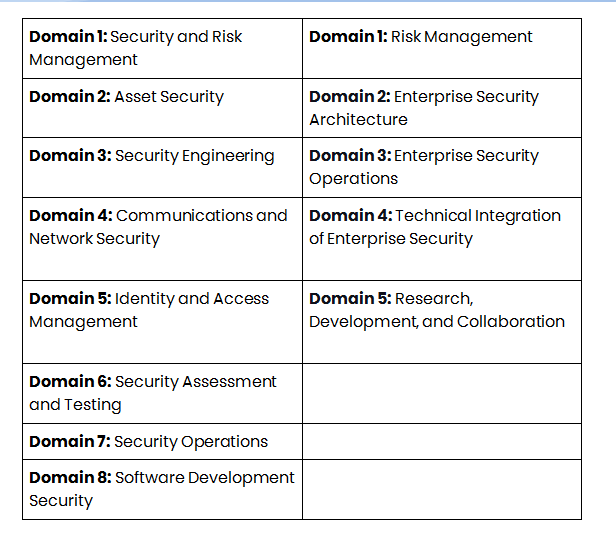
Which one to go for?
If you are a cybersecurity professional, the CISSP certification can provide you a deeper insight into information systems features that help you recognize vulnerabilities that can compromise valuable information. On the other hand, if you have 10 years of experience in IT administration, the CASP+ certification can provide you an advanced view of information systems and their role in protecting information.
How can I get CISSP or CASP+ certification?
InfosecTrain is one of the leading IT security training providers. We offer a comprehensive training program for Certified Information Systems Security Professional or CompTIA Advanced Security Practitioner certification. If you want to take the expert's help in getting through the CISSP or CASP+ certification exam, check these certification training course offered by Infosec Train:
https://www.infosectrain.com/courses/comptia-advanced/
https://www.infosectrain.com/courses/cissp-certification-training/
Cybersecurity Threats and Attacks: A Challenge to the IT Sector
Cybersecurity consists of two terms; "Cyber" means relating to the characteristic of computers, information technology, etc., and "Security" means protection or prevention. Thus, Cybersecurity is the term used to protect the systems connected to the internet, such as hardware, software, and data, from cyber threats. This practice of protecting these devices and especially data is done by individuals and enterprises to prevent unauthorized access for attackers trying to enter into the system. A good cybersecurity strategy adopted by the organization can prevent the systems from malicious attacks and stop further damage to the company and its reputation.
About Cybersecurity Threats
A cybersecurity threat is a malicious attack performed by attackers trying to gain unauthorized access to a system or network to deface the IT assets, company's sensitive data, and other intellectual property. There are different types of cybersecurity threats or attacks, they are:
Malware: Malware is that kind of malicious software in which any kind of file or program is used to harm a system. They may vary as per their severity and can be in the form of viruses, trojans, worms, spyware, etc.
Ransomware: Ransomware is malicious software used to lock users' system files through any kind of encryption program. Cybercriminals then demand payment to decrypt these system files.
Social Engineering Attack: Social Engineering Attack is the wide range of malicious activities accomplished through human interactions. It uses the psychological mindset of employees, tricks them, and takes away the company's sensitive information.
Phishing: In a Phishing Attack, an attacker sends fraudulent or fake emails from a reputed source to the users to steal sensitive information such as login credentials, credit card, and bank account details. There are various types of phishing attacks like email phishing, spear phishing, whaling, smishing, vishing, and angler phishing.
DNS Attack: DNS Attack is where the attacker takes advantage of the vulnerabilities of the Domain Name System (DNS) and redirects the users to other malicious sites. There are various types of DNS attacks like Domain Hijacking, DNS Flood Attack, Cache Poisoning, DNS Tunneling, and DNS Hijack Attack.
Denial of Service (DoS) and Distributed Denial of Service (DDoS): DoS attack is the attack where the attacker floods the systems, networks, or servers with massive traffic of legitimate requests. In a distributed denial-of-service (DDoS) attack,attackers attempt to disrupt traffic of a normal server, network, or service by overwhelming the target with flooding of internet traffic.
Man-in-the-middle-attack: Man-in-the-middle attack is a type of attack where an attacker intercepts the message from the intended source, modifies that message, and that modified message is then sent to an intended destination. The person from the intended destination thinks that the message is received from the intended source where the content was modified.
Wrap up
Cybersecurity is a challenging field where cybersecurity teams have to keep their eyes peeled 24/7 as they have to continuously monitor the threats in the systems, network, and especially the valuable assets of the organization. Attackers are continuously keeping track of the vulnerabilities of the system and then take advantage of this situation and perform data breaches that are creating huge financial and reputation losses for the IT sector. So, the IT sectors should improve their cybersecurity strategy so as to stop these threats.
Why Choose Infosec Train for Cybersecurity Training?
Infosec Train has many expert professionals in Cybersecurity, and they are well-versed with all the concepts related to security. They provide comprehensive training programs for various renowned information security certification exams. Interactive training sessions with dedicated cloud-based labs help participants gain the necessary skillset to become elite cybersecurity professionals.
Click the link provided below to check out our meticulously curated training programs and get yourself enrolled today:
https://www.infosectrain.com/career-oriented-training-courses/
AZ-104 Certification: All You Need to Know
AZ-104: Microsoft Azure Administrator
Microsoft’s cloud is evolving its learning tracks to help companies become more agile in the face of today’s rapid digital transformation. Azure Administrators have the skills necessary to help their organization enjoy the benefits of cloud computing by leveraging Azure’s resiliency, scalability, and unified data governance. The ‘Azure Administrator Associate Certification Exam AZ-104’ allows you to become a certified Microsoft Azure Administrator Associate. It ensures you have subject matter expertise in implementing, managing, and monitoring Azure-based solutions for an organization. The key skills of Azure Administrator are the ability to provision, scale, monitor, and regulate assets correctly when required.
Why Microsoft Azure Administrator Certification?
Organizations all over the world are shifting to the cloud, and they are looking for qualified professionals who can help them make this transition. It’s time to delve deeper into why you should make every effort to improve your current skills. Many organizations around the world prefer Microsoft Azure cloud over others. It is currently the fastest-growing cloud platform. In order to effectively deploy Azure cloud in their organization, they hire a team that is experienced and has Azure certification. This is where having an Azure Administrator certification will help you advance your career. It will verify that you have the skills needed to keep up with today’s technology. Having the right skills will also help you gain confidence and improve your job satisfaction. Being certified can give you a decent raise in your salary or a hike in your career. The most important thing for any job role is to have a good reputation in the marketplace. The Azure Administrator role will assist you in securing a well-recognized position inside a top organization. Furthermore, it will add value to the CV and give an edge during the recruitment process.
AZ-104 Exam Pattern
AZ-104 exam has an intermediate difficulty level when compared to other Microsoft role-based exams. You can prepare for this certification with self-paced online training, choose curated learning paths on Microsoft Learn, or instructor-led training. This exam tests candidates capabilities on five domains:
- Manage Azure identities and governance (15-20%)
- Implement and manage storage (10-15%)
- Deploy and manage Azure compute resources (25-30%)
- Configure and manage virtual networking (30-35%)
- Monitor and backup Azure resources (10-15%)
AZ-104 Certification with InfosecTrain
Microsoft Azure is a leading provider of necessary IT support and infrastructure to several corporations globally like eBay, Samsung, BMW, etc. To enhance the efficiency of their business, Azure Administrators are in high demand in the market. If you wish to take the initial step towards getting certified as Azure Administrator, Infosec Train is the place that provides you with all the necessary preparation required for the AZ-104 exam. We are one of the finest and globally recognized security and technology training and consulting organizations. Our certified instructors have vast industry experience, which they deliver during training. Azure AZ-104-certification-training with Infosec Train will help you have a better grasp of the subject. The course includes instructor-led training, official courseware, blended learning delivery model, interview question preparation, online exam engine, and learning from industry experts.
SOC Team Roles & Responsibilities | Security Operations Center
SOC team or Security Operations Centre team implements the organization's security policies and procedures, maintains the security standards created by the organization, and monitors the security aspects. The SOC team is essential from the organization's point of view as it safeguards the security assets, and it can be part of every organization, whether it is big or small. The team keeps track of each suspicious activity taking place on servers, endpoints, networks, applications, databases, websites, and other technology that are evolved in today's era. SOC can act as a lifeline because all the security-related aspects lie in the hands of this team and can also protect the company from huge losses.
Responsibilities of SOC
Typically, the SOC team has many responsibilities as security is the main factor for protecting the data loss and other losses for the company. But mainly, there are two main responsibilities involved with the SOC team; they are: maintaining the security monitoring tools that are used by the company and investigation of the suspicious activity involved.
Maintaining the security monitoring tools
For effectively securing and monitoring a system, many tools are involved in protecting data or other security assets that a SOC team maintains and provides updates for those tools regularly. This team can also provide security patches and updates to prevent any unauthorized access. Essential security tools that need to be routinely maintained are firewalls, intrusion detection and prevention systems, data loss prevention tools, etc. After this data collection, these logs and other information must be passed to SIEM and other tools used for log analytics.
Investigation of the suspicious activity involved
With the help of these tools, this team is responsible for investigating suspicious and other malicious activity that can pose a significant threat to an organization's security assets and can also cause considerable losses to a reputed firm. If the potential threats are found, SOC team can examine alerts and determine the scope of that specific threat. The amalgamation of proper tools and appropriate expert support are responsible for a successful SOC team.
Different roles or positions within a SOC team
The most common roles involved with SOC are SOC Analyst, Security Engineer, SOC Manager, and Chief Information Security Officer.
SOC Analyst: Security Analysts can also be called incident responders. They are like front-line warriors who tackle the problem of cyber-attacks and the threats caused by them. In short, we can say that their job is to detect threats, investigate those threats and respond to them as soon as possible. They can also make decisions on disaster recovery plans.
Security Engineer or Architect: Security Engineers play the role of maintaining tools used, recommending new tools, and applying security updates for those tools. They also oversee how the security architecture is built over different systems.
SOC Manager: The Security Manager is responsible for managing the operations as a whole. They also manage the team members and also coordinate with the Security Engineers. The scope of new security development projects is also set by the Security Manager. They act as direct heads to all members of the SOC team.
Chief Information Security Officer: The role that is on top of the hierarchy within a SOC team is Chief Information Security Officer. The final reports and all the strategies, security policies, and procedures are reviewed by CISO, and they are also responsible for managing the compliance. They should have good communication skills for communicating complicated issues to upper management and also good technical knowledge.
Conclusion
SOC team task is full of challenges as it comes to the company's security aspects, and they have to continuously monitor the foremost security parameters like firewalls, intrusion detection, and prevention system, or other loopholes in the system of the company. They have to keep their eyes peeled 24/7 as the attackers can penetrate the company's system with their attacks causing huge loss to a company. In short, the SOC team's job is full of pitfalls due to the involvement of security parameters and policies and procedures.
Why choose Infosec Train for SOC Analyst Training?
Infosec Train has many expert professionals in cybersecurity, and they are well-versed with all the concepts related to information security. Infosec Train also provides a comprehensive training program and full-fledged preparation materials for various certification exams related to Cybersecurity.
The following training programs will help you to forge a promising career as a SOC Analyst:
EC-Council's Certified SOC Analyst (CSA) Certification Training
Infosec Train's SOC Analyst training program
CISA Vs. ISO 27001 Lead Auditor
Certified Information System Auditor (CISA)
Certified Information Systems Auditor (CISA) is one of the most globally recognized certifications for IS auditing. Consulting organizations prefer to contract CISA-certified professionals to help service clients. Large and small organizations find themselves at a competitive drawback if they're unable to describe a stronger level of internal controls. CISA certification confirms that you understand the fundamentals of implementing audit concepts to the complex world of information systems.
The main duties of a CISA include:
- Execute the audits in compliance with the organization's set standards and objectives
- Share audit results and provide recommendations to management based on the outcomes
- Implement an audit policy for information systems that are based on risk management
ISO 27001 Lead Auditor
ISO 27001 Lead Auditoris a certification announced by the International Standardization Organization (ISO) that explains how to manage information security in a corporation. ISO 27001 can be implemented in any kind of organization such as private, government, small, or large. It was created by the world's best information security experts who provided methodologies for the implementation of information security management in an organization. Certified ISO 27001 Lead Auditor designation is a professional certification for audit team managers working to perform massive organizations' audits. ISO 27001 Lead Auditor certification requires two years of working experience as an auditor or lead auditor. With ISO 27001 certification, you will have the right to control the entire risk management system.
Similarities and differences
Both certifications require knowledge related to an audit process, enabling an individual to efficiently use a specified reference to assess processes and report an organization's compliance status. The difference between these two certifications is while ISO 27001 Lead Auditor focuses on the ISO 27001 standard. It is an international standard that explains how to manage information security. It specifies requirements for establishing, implementing, and maintaining an information security management system (ISMS) to help organizations make the information assets they hold more secure. CISA is more oriented to IT frameworks.
Which one to go for?
If you are the auditor, the CISA certification can provide you a deeper insight into information systems features that help you recognize vulnerabilities that can compromise valuable information. On the other hand, if you are an IT professional or manager, the ISO 27001 Lead Auditor certification can provide you a better view of how information systems fit into the business's design and their role in protecting information.
How can I get CISA or ISO 27001 Lead Auditor certification?
InfosecTrain is one of the prominent IT security training providers. We provide a comprehensive training program for CertifiedInformation Systems Auditor (CISA) or ISO 27001 Lead Auditor certification. If you want to take the expert's help in getting through the CISA or ISO 27001 Lead Auditor certification exam, check these certification training course offered by Infosec Train:
https://www.infosectrain.com/courses/cisa-certification-training/
https://www.infosectrain.com/courses/iso27001la/
How to Become a Cybersecurity Professional?
Cybersecurity professionals deliver security across the development process of software systems and networks. They are expected to find risks and vulnerabilities in the security posture of an organization. They manage and monitor various attacks and unlawful intrusions. The cybersecurity professional can recognize any breaches and security violations that need to be resolved, develop rules and regulations to assure the company's systems stay as safe as possible, in addition to developing security measures for all employees. Cybersecurity specialists are experts in finding loopholes in databases, networks, hardware, firewalls, and encryption. A cybersecurity professional's primary role is to avoid attacks by fixing critical issues before malicious hackers can exploit them. Also, cybersecurity professionals manage to clean up after security breaches and cyber-attacks.
Roles and responsibilities:
There are various roles and responsibilities of cybersecurity professionals. Some of them are as follows:
- Manage organizational resources to support security goals and policies
- Create and execute approaches to improve IT project's reliability and security
- Perform and maintain corporate security policies and procedures
- Maintain computer networks, hardware, software, and other related systems, protecting data by implementing network security measures, preserving data from attacks, and replacing damaged network hardware components when required
- Identify possible issues and fix existing problems
- Develop a set of security standards and practices, conducting scans of networks to find vulnerabilities and penetration testing
Tools and technical skills required to become a Cybersecurity professional
A cyber specialist must have an understanding of the following tools:
1) Nmap: Nmap stands for network mapper. Nmap is an information-gathering tool used for reconnaissance. It is an open-source network scanner. It sends packets and analyzes the responses; from these responses, you can find a vulnerable host on a particular network, open ports, operating system version, and other vulnerabilities.
2) Metasploit: Metasploit is an exploitation framework, which means it is a group of tools and utilities put together to make an exploit development. Basically, Metasploit is a penetration testing platform that allows us to use different modules and find, exploit, and validate vulnerabilities.
3) Social Engineering Toolkit: The Social-Engineer Toolkit is an open-source penetration testing framework for social engineering. It is a unique tool that identifies the attacks that are targeted at the human element. It is also an open-source framework.
4) SQLMap: SQLMap is a tool that is used to test SQL injection vulnerabilities. If SQL injection is present, it can also help speed up exploiting the vulnerabilities, assisting the tester in getting results faster, and assisting customers in understanding the code's weakness to address the code.
5) Nessus: Nessus is an open-source and remote security scanner tool that scans network tools and then creates a report listing all the discovered vulnerabilities. This tool allows you to watch your WiFi network's security by capturing data packets and transporting them to text files for further analysis.
A Path to become a cybersecurity professional
There are three steps to become a cybersecurity specialist:
1. Get qualified: Bachelor or master's degree in IT fields such as computer engineering, information security, computer science, programming, or any relevant field that offers cybersecurity specialization.
2. Skill Development:Some specific skills for cybersecurity professionals include:
- Penetration and vulnerability and IDS/IPS testing
- Windows, UNIX, and Linux operating systems
- Computer networking, routing, TCP/IP, and switching
- Ethical hacking and threat modeling
3. Get certified:Having a certification is always an advantage over other applicants so, get certified in at least one of the following cybersecurity certifications.
- CEHv11 (Certified Ethical Hacker v11)
- CompTIA Security+
- Certified Information Systems Security Professional (CISSP)
- Certified Information Systems Auditor (CISA)
- Certified Information Systems Manager (CISM)
- Cisco Certified Network Associate (CCNA)
How can InfosecTrain help you?
Infosec Train provides certification training and necessary preparation for all Information Security certification exams. It is one of the best consulting organizations, focusing on a range of IT security training. Well qualified instructors with years of industry experience delivering interactive training sessions thatwill help you hone your cybersecurity skills. You can visit the following link to prepare for the certification exam.
Top Cybersecurity Job Roles And Their Responsibilities
Cybersecurity includes the security of computer-based devices and information from unintended or unauthorized access. A cyber-attack takes numerous forms, including theft or unauthorized access of computers, laptops, tablets, or mobile devices. A remote attack on IT systems or websites attacks the information held in third-party systems such as cloud devices. If a cyber-attack strikes, it can result in financial losses, increased recovery costs, and substantial damage to reputation. So, to protect the organization and computer systems, every Organization requires a professional cybersecurity team. The public and private areas posted 313,735 openings for cybersecurity professionals between September 2017 and August 2018, and it's expected that there will be about 3.5 million unfilled industry positions by 2021.
Following are the renowned cybersecurity job roles and their responsibilities:
1) Information system security manager: The information system security manager is responsible for managing organizational resources to support security goals and policies. They create and execute approaches to improve IT projects' reliability and security, perform and maintain corporate security policies and procedures. They also manage ateam of security administrators, analysts, IT professionals and select new security products and technologies. CISM and CISA are two reputed credentials that help an individual to become an Information System Security Manager.
2) IT Auditors: IT Auditors examine internal IT controls, determine vulnerabilities, and develop remediation strategies. They respond to all system or network security breaches, implement, monitor, and improve security standards to secure the Organization's data, systems, and networks. For an IT Auditor, two years of work experience as an IT Auditor, an understanding of IT audit methodologies, and CISA certification are recommended.
3) Network Engineer: Network Engineer is responsible for maintaining and administering the company's computer networks. Network Engineer's primary duties involve maintaining computer networks, hardware, software, and other related systems, protecting data by implementing network security measures, preserving data from attacks, and replacing damaged network hardware components when required. They also identify possible issues and fix existing problems. For Network Engineer Bachelor degree in Information Technology and CCNA certification is recommended.
4) Security Engineer: A security engineer is responsible for software testing, monitoring networks and systems for security breaches. They can usually resolve possible problems of security threats. They are also accountable for developing a set of security standards and practices, conducting scans for networks to find vulnerabilities, and penetration testing. Penetration testing and CEHv11 certification are beneficial for a Security Engineer.
5) Cybersecurity Analyst: Cybersecurity analysts perform various tasks that vary according to the Organization they work for. They monitor the Organization's computer networks and systems to recognize any breaches and security violations that need to be resolved, develop rules and regulations to assure the company's systems stay as safe as possible, in addition to developing security measures for all employees. Security+, CYSA+, CISSP are popular certifications for a cybersecurity analyst.
How Can InfosecTrain help you to become a Cybersecurity professional?
InfosecTrain is an online training provider with a team of highly skilled experts to offer you the best guidance. Here, you will get every skill and knowledge that you need to clear your Cybersecurity certification exam. So, visit the following link to enroll now and step ahead in your career as a Cybersecurity professional.
What Will You Learn In The New CCNA 200-301 Certification?
Cisco Certified Network Associate is a certification offered by Cisco for networking professionals. Cisco is one of the renowned companies for building and selling networking devices. The CCNA 200-301 exam tests professionals' networking fundamentals, networking access, IP connectivity, and networking security skills in depth. It is an associate-level certification, so it does not require any prior experience. CCNA certification starts from the basics of networking and moves to the intermediate level. It provides the necessary skillset and knowledge needed for the various in-demand networking job roles.
How are the old CCNA and the latest CCNA exams different?
The CCNA 200-125 and the new CCNA 200-301 exams differ in modules as well as in some other areas:
Exam modules with their percentage weightage:
CCNA 200-125 CCNA 200-301
WAN Technologies (10%) Network Fundamentals (20%)
Infrastructure Service (10%) Network Access (20%)
Infrastructure Security (11%) IP Connectivity (25%)
Infrastructure Management (10%) IP Services (10%)
Network Fundamentals (15%) Security Fundamentals (15%)
LAN Switching Technologies (21%) Automation & Programmability (10%)
Routing Technologies (23%)
Domains of the new CCNA 200-301
Domain 1: Network Fundamentals
This domain explains the importance and uses of networking devices like routers, switches, and hubs. You will also learn different types of network topologies used and types of cabling, TCP and UDP protocols, IPV4 and IPV6, and Wireless principles in this domain.
Domain 2: Network Access
This domain provides an in-depth understanding of VLANs (Virtual Local Area Network), Interswitch connectivity Cisco Discovery Protocol and LLDP (Link Layer Discovery Protocol), Wireless architectures, RSTP (Rapid Spanning Tree Protocol), and WLAN (Wireless Local Area Network) Components.
Domain 3: IP Connectivity
In this domain,you will get familiar with the codes for connected routes, static routes, local routes, OSPF routes, and the routing table's components. You will also know how a router makes a forwarding decision by default and FHRP (First Hop Redundancy Protocol).
Domain 4: IP Services
This domain provides awareness of NAT's configuration & verification (Network Address Translation) static and pool and NTP (Network Time Protocol) operating in client and server mode. You will learn about network protocols such as DHCP (Dynamic Host Control Protocol), DNS (Domain Name System), and SMTP (Simple Mail Transfer Protocol).
Domain 5: Security Fundamentals
Security is a crucial aspect of networking; that's why this domain is added to the new CCNA Certification exam. In this module, you will understand threats, vulnerabilities, attacks, and mitigation techniques. It also explains how to apply them to protect the network infrastructure, port security, and Wireless security protocols like WPA, WPA2, WPA3.
Domain 6:Automation & Programmability
The module also covers characteristics of REST-based APIs (CRUD, HTTP verbs, and data encoding). Explain how to configure management mechanisms like Puppet, Chef, Ansible. It also gives knowledge of Cisco DNA Center enabled device management.
Features of CCNA 200-301 certification:
CCNA 200-301 is designed to improve and enhance the networking knowledge of an individual. The certification authorizes the holder's general ability to install, secure, operate, and troubleshoot issues within business networks. Cisco CCNA certification offers professionals an in-depth understanding of networking. It helps networking specialists keep up-to-date their skills and knowledge. This certification alone can open the door to opportunities in your career and raise a higher salary than other professionals applying for the same position.
CCNA certification with InfosecTrain:
Infosec Train provides all the necessary guidance for the CCNA certification exam. Qualified and highly skilled instructors deliver interactive training sessions with years of industry experience. You can check and enroll in our CCNA Certification Training to prepare for the certification exam.
An Introduction to CISSP Certification
CISSP (Certified Information Systems Security Professional) is one of the globally renowned certifications in the information security industry. Having this credential shows you have gone through the rigorous process of understanding IT infrastructure and honing skills to design and build a secure business environment. CISSP validates an information security professional's in-depth technical and managerial knowledge and experience to efficiently plan and maintain an organization's overall security posture. A survey conducted by the global information security and workforce study showed that 25% of CISSP certified professionals believed their certification helped increase their salaries.
CISSP Certification Requirements
CISSP is not an entry-level certification. To get a CISSP Certification, you should have five years of full-time work experience in two of the eight CISSP domains. A four-year college degree or another (ISC)2 certificate can substitute a year of experience.
All About the CISSP exam:
- CISSP is a CAT (Computerized Adaptive Test)
- How specifically CAT format works: When you begin the examination, you will be given four choices for each question. Choose one of the correct answers. When you choose a response and submit the answer, the next question will be based on theprior question's response. If someone has done the previous question correctly, the next question will be slightly difficult. If someone has done the previous question wrong, the difficulty level of the next question decreases.
- The duration of the CISSP exam is three hours.
- You can not go back to the previous question and flag the question.
CISSP Domains:
CISSP Certification consists of eight domains:
Domain 1: Security and risk management (15%):
It explains security risk and control. It will provide you a holistic view of security risk, governance risk management and also informs how you can take care of business continuity planning at an enterprise-level. This domain has the highest percentage in the examination.
Domain 2: Asset Security (10%):
The next domain is assets security, a smaller domain but surely an important one. This domain will teach you about asset classification, privacy protection,asset retention, data security controls, and secure data handling.
Domain 3: Security Architecture and engineering (13%):
It involves five distinct modules and three other parts. It explains cryptography, security architecture, and engineering, system architecture, and it also informs about physical security. So it is necessary for the examination point of view.
Domain 4: Communication and network security (14%):
It is one of the extensive domains in CISSP from an exam point of view. Most people do not have a networking background, so they can have difficulty understanding this domain's concepts.
Domain 5: Identity and access management (13%):
This domain covers Physical and Logical Access Control, Identification, Authentication, Authorization, Authorization Mechanism, and Access Control Attack Mitigation.
Domain 6: Security assessment and testing (12%):
In this domain, we look at different features that we need to know from an application security perspective. It covers System Security Control Testing, Software Security Control Testing, Security Process Data Collection, and Audits.
Domain 7: Security operations (13%):
This domain covers various security operations concepts such as Physical Security, Personnel Security, Logging and Monitoring, Preventative Measures, Resource Provisioning and Protection, Patch and Vulnerability Management, and Incident Response.
Domain 8: Software development security (10%):
In this, we will see various ways of developing software(like software development life cycle, life cycle model, and activity of malicious code and their impact on applications, including your software applications).
How Can InfosecTrain Help you?
InfosecTrain provides all the necessary CISSP certification exam guidance. Certified instructors deliver all training with years of industry experience. You can check and enroll in our CISSP Certification Training to prepare for the certification exam.
CCSP stands for Certified Cloud Security Professional. Security is an essential aspect for any organization working on the Cloud. This is one of the reasons why CCSP professionals are in such high demand in the market. Cracking its interview can be a tricky part, so here is a list of 10 questions that are commonly asked in the CCSP interview.
Question1: What are the various security controls available for Data Security in Cloud platforms?
Answer:The security controls for Data Security are:
- Know what you are responsible for
- Control who has access
- Protect the data
- Secure the credentials
- Security hygiene still matters
- Improve visibility
- Adopt a shift-left approach to security
Question2: What are the best practices in Identity and Access Management in Cloud?
Answer: The finest approaches for Identity and Access Management in Cloud are:
- You must consider Identity as a primary security perimeter
- Make use of strong passwords
- Practice Multi-Factor Authentication (MFA)
- Don't make use of privileged accounts for daily operations
- Groups must be used for assigning permissions
- Don't embed keys into code or instance
- Access to resources must be audited
Question 3: What are the common security concerns in hosting a PaaS application?
Answer: The common security concerns in hosting a PaaS application are:
- Interoperability
- Portability
- Host Vulnerability
- Object Vulnerability
- Access Control
- Privacy-aware Authentication
Question4: Explain the strategies of BC DR in the Cloud.
Answer: Some BCDR strategies to be considered in Cloud are:
- Preventing downtime and data loss from complex, multi-generational IT infrastructures with a simplified cloud-based BCDR solution.
- Taking measures to restore with SLAs, support your recovery time, and point objectives (RTOs/RPOs) in seconds or hours.
- Automatically testing and validating your ability to recover and provide granular reports to key data protection stakeholders.
- Engaging the most effective plan to ensure resiliency and minimize service disruption.
Question5: What is the importance of SLA in the Cloud?
Answer: SLA serves as a future establishment for the provisioning and monitoring of services in cloud computing. Users need SLAs to stipulate their needs regarding quality of service, security, and a backup plan for performance failure.
Question6: What are the various cloud-specific risks induced by moving to a Public Cloud provider?
Answer: The major cloud-specific risks induced by moving to a public cloud provider are:
- Public Cloud is a shared model, so it allows users with limited control.
- Considering you are secured and not following any security measures.
- It is less secure as one flaw in the infrastructure can make the entire system vulnerable.
- Sharing your data on the public cloud allows them to become the owner of your data.
Question 7: How to ensure the data residency requirements in the Cloud?
Answer: Data Residency requirements usually assert that confidential information should not be stored on remote servers outside the country or state of residency. This can be risky for clients of cloud services or, significantly, web applications. Remote hosting is quite often part of the agreement in all external Cloud or web applications.
Question8: What are some of the key factors to consider while moving to a Cloud platform?
Answer: Some key factors to consider while moving to a Cloud platform are:
- Complexity
- Security
- Internet Bandwidth and Reliability
- Performance matters
- Business Impact Analysis
- Future Migration Needs
- Production versus development and test
- Cost and Return on Investment (ROI)
- Licensing
- Portability and Interoperability
- Service Level Agreements
Question9: What are the major factors of concern while opting for a SaaS service?
Answer: The major factors of concern while opting for a SaaS service are:
- Lack of control: Since the control resides with a third party, everyone is required to use the most recent version of the software applications and cannot put off upgrades or customizations in the features.
- Security and data concerns:Access management and the privacy of confidential information is a significant concern inCloud and hosted services.
- Limited range of applications:On one hand, SaaS is gaining popularity; there are yet several applications that don't provide a hosted platform.
- Connectivity requirement: SaaS is dependent on the internet. So, if your internet service crashes, you will lose access to your software or data.
- Performance:SaaS may run at a slower speed compared to on-premise client or server apps, so it's worth considering performance when the software isn't hosted on a local machine.
Question10: What are the various storage types available in the Cloud?
Answer: There are three types of storage available in the Cloud:
- Object storage,
- File storage, and
- Block storage
These are some of the frequently asked CCSP interview questions. If you want to excel in your career in the Cloud Security domain, you can join InfosecTrain for Certified Cloud Security Professional (CCSP). We offer a wide range of courses with our experienced trainer and are among the leading training providers in the Cloud Industry.
Network Security Interview Questions and Answers
Networks are more prone to Cyberattacks as they are directly connected to the internet. The demand for skilled network security professionals is continuously rising as Cybercriminals keep targeting networks to compromise valuable information assets. If you are applying for a network security job role,it is essential to familiarize yourself with the frequently asked network security questions to present yourself in a better way in front of the interviewing panel.
Here are some of the important interview questions for network security job roles:
1) What do you see as the objective of information security within a business or organization?
Ans: The objective of information security within a business or organization is:
- Protecting the company's secrets and Intellectual property
- Protecting clients' and employees' privacy
- Ensuring the integrity of information and processes.
- Ensuring that audit logs of activities are available for any investigations as required.
2) Define risk, vulnerability, and threat in network security?
Ans: Vulnerability: A weakness of the system and the absence of a safeguard.
Threat: Something that could pose harm to the crucial information assets.
Risk: Risk is the concept that indicates exposure to the chances of damage.
Risk= Threat * Vulnerability
3) What is the impact of an attack on a computer network?
Ans:If it's an external attack only to disrupt your systems, depending upon your defenses when the attack stops, very little will have happened.
If it's an attack on your internal systems, this type of attack is intended to get something that the attacker thinks is valuable. This kind of attack is more difficult because it can go undetected or completely shut down your network.
4) What are the best ways to prevent a brute force login attack?
Ans:There is various methodology against a brute force login attack:
- The web application should use an account lockout policy after three failed login attempts. The account gets locked out for a while, and users receivenotification regarding this on email.
- Web applications should use CAPTCHA.
- The web application should require the use of strong passwords.
5) What is the difference between symmetric and asymmetric encryption?
Ans:Symmetric encryption applies a single key that requires to be shared among the users who need to receive the message. While asymmetric encryption used a pair of the public-private key for encryption and decryption.
6) What is the salting process, and why is it used?
Ans:Salting is a randomly generated fixed-length value designed to be unique with each user password. To make data more secure,Salt is added with the current password string and fed into the hashing system to create a new hash result whenever a user creates a password.
7) How will you prevent the 'Man-in-the-middle' attack?
Ans:Man-in-the-middle attack can be prevented by following security practices such as using encryption mechanism at wireless access points, changing default router credentials, and using public key pair-based authentication like RSA. VPN providers (Nord VPN, ExpressVPN, Surfshark) are also the best way to prevent a Man-in-the-middle attack because these services encrypt connections and protect us if we are visiting an insecure HTTP website.
8) Which is better from a security perspective, HTTPS or SSL?
Ans: HTTPS is the Hypertext transfer protocol secure, and SSL is the Secure socket layer. We can't say that which is more secure because SSL encrypts the sensitive data in transit over the network, and HTTPS is a secure way of sending data between browser and server. HTTPS is the combination of HTTP with SSL.
Getting familiar with the network security interview questions is essential for preparation, but it is more important to equip yourself with the adequate skills and technical knowledge to stay ahead in this highly competitive market. Join the comprehensive training programs offered by Infosec Train to forge a promising career in the information security domain.
Check out the latest schedule of our CCNA training course by visiting the following link:
Infosec Train's CCNA 200-301 training course
What You Need To Know About CISA Certification
CISA (Certified Information Systems Auditor) is a reputed certification hosted by the ISACA (Information System Audit and Control Association). CISA is designed for those who audit, control, monitor and assess an organization's information technology and business systems. The credential enables professionals to improve the career prospects and possibly enhance the potential income. It also helps employers identify the candidates' expertise and skills to successfully manage and assess their IT and business systems.
Benefits of CISA certification:
The CISA certification will open new doors of opportunities for you in the field of IT auditing. Some employers require it as a prerequisite for a job. Information systems are one of the most valuable features of our developing business, and becoming a CISA will demonstrate to organizations you are qualified to face that challenge. If you want to jump into the industry, the CISA certification will help you obtain a lucrative job and help you become a CIO.
Description of the Exam
- The exam consists of 150 multiple-choice questions that the CISA job practice areas.
- Four hours are allotted for completing the exam.
- 450 marks out of 800 required to pass the exam.
CISA Domains:
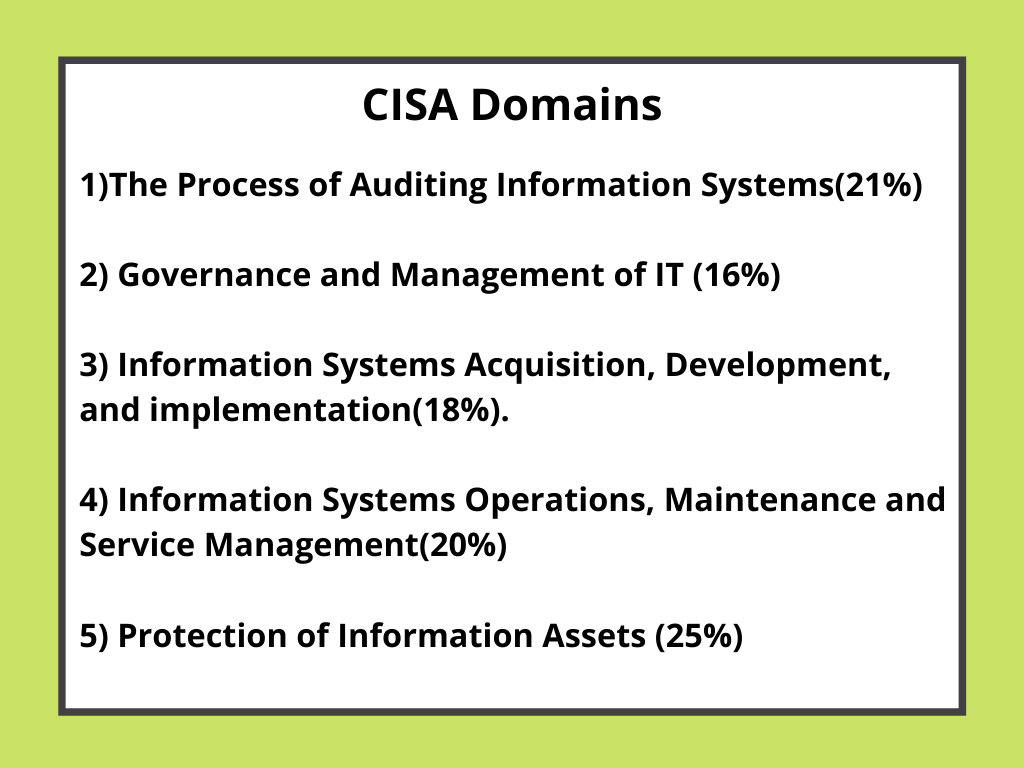
Domain 1: The Process of Auditing Information Systems (21%)
The Process of Auditing Information Systems encompasses the standards, principles, methods, guidelines, practices, and techniques that an information system auditor uses to plan, execute, assess and review business or information systems and related processes.
Domain 2: Governance and Management of IT (17%)
Governance and management of IT is an integral part of enterprise governance. This domain explains necessary leadership and organizational structures and processes to achieve objectives and support its strategy.
Domain 3: Information Systems Acquisition, Development, and Implementation (18%)
This chapter on information systems acquisition, development, and implementation provide an overview of organizations' key processes and methodologies when creating and changing application systems and infrastructure components.
Domain 4: Information Systems Operations, Maintenance and Service Management(20%)
This domain aims to assure that the processes for information systems operations, maintenance, and service management meet the organization's strategies and objectives.
Domain 5: Protection of Information Assets (25%):
This domain focuses on the key components that ensure confidentiality, integrity, and availability of information assets. The design, implementation, and monitoring of logical and physical access controls are explained.
CISA exam tips:
The following tips may help you get through the CISA Certification exam:
Create a Study Plan: First of all, you should create a study plan and start your preparation accordingly. Emphasize more on the most important topics or topics that carry a high percentage weightage in the examination.
Time Management: In the CISA exam, you have 4 hours to complete 150 exam questions, meaning you have around one minute and ten seconds to complete any given question, so manage your time accordingly.
Practice sample papers: If you want to get good marks in the CISA exam, practicing sample papers is mandatory. It will help you to test your knowledge and also in managing the time during the actual exam.
How can you get CISA certification?
Infosec Train is one of the prominent IT security training providers. We offer a comprehensive training program for CertifiedInformation Systems Auditor(CISA) certification. If you want to take the expert's guidance in getting through the CISA certification exam, check this CISA certification training course offered by Infosec Train:
https://www.infosectrain.com/courses/cisa-certification-training/
CISM Certification and training: What you need to know
The CISM (Certified information security manager) certification introduced by ISACA is a globally accepted standard of achievement in cybersecurity management. ISACA is a global association that focuses on IT professionals or IT governance with knowledge, training, the community in audit, risk, and privacy. CISM certification is ideal for those who are experienced information security managers. The CISM certification is also for individuals who have information security and related management responsibilities. The certification addresses the interdependencies between business objectives and IT security and focuses on managing information security within an organization. The purpose behind the development of this certification is to equip Information Security professionals with core Information Security knowledge and experience. The Certification holders are capable of aligning an enterprise's IT security program with its business goals.
Why CISM?
Once you clear the CISM exam, you can demonstrate your understanding, knowledge, and skills to build an information security program in your organization and align the organizations' goal and objective with it. After CISM certification, you have information security expertise, knowledge, and experience in developing an information security program. With this certification, professionals can work anywhere across the globe as multinational organizations recognize this certification.
CISM Domains:
Domain 1: Information Security Governance (24%):
Information security governance typically focuses on several key processes. Those processes include personal management, sourcing, risk management, configuration management, access management, vulnerability management, incident management, and business continuity planning.
Domain 2: Information Risk Management (30%):
This domain covers information asset classification to ensure that measures taken to protect assets are proportional to their business value. Also, it focuses on risk assessments, vulnerability assessments, and threat analyses are conducted consistently, at appropriate times, and to identify and assess the risk to the organization's information.
Domain 3: Information Security Program Development and Management(27%):
This domain will explain how to develop and maintain an information security program that identifies, manages, and protects the organization's assets while aligning to information security strategy and business goals, thereby supporting an effective security posture.
Domain 4: Information Security Incident Management(19%):
In this domain, you will learn about security incidence response, develop a security incidence response plan and playbooks, test business continuity plans, and test disaster recovery plans.
Exam information:
- Duration: 4 Hours
- Number of questions: 150
- Question format: Multiple Choice
- Passing marks: 450 out of 800
CISM Certification Valid for?
The validity for CISM certification is three years. If you want to maintain the credential, you need to pay $45 an annual maintenance fee if you are an ISACA member, and for a non-ISACA Member, the credential holder is $85.
Who should get CISM certification?
- Security consultants and managers
- IT directors and managers
- Security auditors and architects
- Security systems engineers
- Chief Information Security Officers (CISOs)
- Information security managers
How you can get CISM certification:
Infosec Train is one of the leading IT security training providers. We offer a comprehensive training program for Certified Information security manager (CISM) certification. If you want to take the expert's help in getting through the CISM certification exam, check this CISM certification training course offered by Infosec Train:
https://www.infosectrain.com/courses/cism-certification-training/
Reasons Why You Should Pursue CISSP Certification
CISSP stands for Certified Information Systems Security Professional. The importance of CISSP certification in industries has a role to play in determining its worth. Global Information Security Workforce Study conducted a survey and showed that 25% of employees believed that CISSP certification helped them increase their salaries. The CISSP certification is ideal for those who want to make their career in information security from the management level. It will provide you the ability to implement information security programs efficiently. You will be getting an in-depth understanding of security and risk management, communication and network security, security assessment, and testing. Here are some reasons why you should gain CISSP certification:
1) Increase the reliability of business:
CISSP certification will increase the reliability and goodwill of the organization in front of the vendors and entrepreneurs. It validates the association's efficiency and long periods of experience gained in the business. CISSP certification also proves employees' ability to create effective business solutions.
2) Gaining a broader perspective of the security industry
CISSP certification provides you better visibility into the more significant security market. You can use this information to eliminate security flaws that do not pose a threat today but might become a problem tomorrow. It would help you make the right business decisions regarding information security.
3) Higher salary options with better job opportunities
CISSP certified IT professionals have the third-highest global salary. CISSP has ranked in the top 10 in the U.S. every year since 2015. The credential is necessary for information and Cybersecurity job applicants in many businesses around the world.
4) Skills to Succeed in Cybersecurity Field
CISSP certificate improves your Cybersecurity skills. it provides all the necessary information for a Cybersecurity professional to design and manage information security programs. The CISSP is a vendor-neutral certification that is recognized as the standard credential in information security globally. This certification validates candidate skills in different fields such as Risk Management, Network Security, Identity and Access Management, Security Assessment and Testing.
5) Recognized Worldwide
CISSP credential is known worldwide and highly respected by most significant companies such as Google, IBM, P&G, etc. CISSP certified professionals are with a high breadth of knowledge. They are generalists in various IT security domains and are considered among the most valued employees to keep infrastructure safe and secure.
Why Infosec Train for CISSP certification?
Infosec Train provides all the necessary preparation guidance and instructor-led training for the CISSP certification exam. It is one of the best consulting organization, focusing on a range of IT security training and information security services. You can check and enroll in our CISSP-certification-training to prepare for the certification exam.
Why Organizations Need A Threat Intelligence Team
What is Threat Intelligence?
In cybersecurity, we have traditionally been inward-looking, focusing on identifying what we want to protect and constructing defenses around them. Sometimes adversaries successfully breached those defenses, we adept at preventing those intrusions from being successful in the future. Organizations use cyber threat intelligence to understand better, predict, and adapt to the behavior of the malicious actor, whether they are criminal groups or hacktivists. Cyber threat intelligence can adopt many forms, including information about the malware and adversary uses known command or special techniques. Cyber threat intelligence involves collecting reliable, context-relevant analysis, production of useful intelligence, and disseminating the relevant information to stakeholders at all levels within the organization. A threat intelligence analyst must possess specific skills and knowledge to effectively understand modern attackers’ methodology to deploy the threat intelligence accordingly.
Types of threat intelligence:
There are three types of threat intelligence:
1) Tactical: Technical intelligence(including indicators of compromise such as IP address, file name, or hashes)which can be used to access to assist in the identification of threat actors.
2) Operational: Details of the motivation and capabilities of threat actors, including their tools, techniques, and procedure.
3) Strategic: Intelligence about the overarching risks associated with cyber threats, which can be used to drive high-level organization strategy.
Why Become a Certified Threat Intelligence Analyst?
In the IT world, organizations hire cyber threat intelligence analysts or contract with threat intelligence service providers to identify possible risks and threats in an organization. Cyber threat analysts manage all-source analysis, digital forensics, and adversary targeting to identify, monitor, assess, and counter the threat posed by critical infrastructure and cyber-related interests. A Certified threat intelligence analyst can apply for different roles such as:
- Ethical Hackers.
- Security Practitioners, Engineers, Analysts, Architects, and Managers.
- Threat Intelligence Analysts, Associates, Researchers,
- Threat Hunters.
- SOC Professionals.
- Digital Forensic and Malware Analysts.
- Incident Response Team Members.
Why Do Organizations Require a Threat Intelligence Team?
Attackers are continuously evolving new methods to get into the security posture. new malwares are formed regularly. However, many organizations today still have the basic, conventional methods to address these evolving techniques. Responding to threats is much essential. Having a threat intelligence analyst will help organizations to fight unprecedent threats that are arising in the Cybersecurity world. An experienced threat intelligence analyst will cpllect large amounts of relevant threat information from various data sources and detect the possible security threat that an organization may face.
Become a Certified Threat Intelligence Analyst with Infosec Train
Infosec Train is one of the leading IT security training providers. We offer a comprehensive training program for Certified Threat Intelligence Analyst (CTIA) certification. If you want to take the expert’s help in getting through the CTIA certification exam, check this CTIA certification training course offered by Infosec Train: